
'Shut heavy industry, curbed car growth': Chinese envoy shares how Beijing tackled air pollution
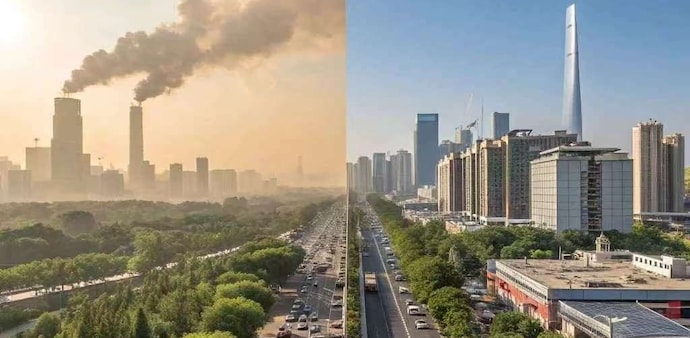
China adopted ultra-strict regulations like China 6NI (on par with Euro 6), phased out retired old, high-emission vehicles, and curbed car growth through license-plate lotteries and odd-even/weekday driving rules
- Dec 17, 2025,
- Updated Dec 17, 2025 6:28 PM IST
As Delhi continues to battle severe pollution, China on Wednesday shared how Beijing tackled its own air pollution challenge. Yu Jing, spokesperson of the Chinese Embassy in India, listed two key measures - vehicle emissions control and industrial restructuring - that helped improve the air quality.
For vehicle emissions control, she said China adopted ultra-strict regulations like China 6NI (on par with Euro 6), phased out retired old, high-emission vehicles, and curbed car growth through license-plate lotteries and odd-even/weekday driving rules.
Jing also pointed to investments in public transport and cleaner mobility, noting efforts to "build one of the world's largest metro and bus networks," "accelerate the shift to electric mobility," and "work with the Beijing–Tianjin–Hebei region on coordinated emissions cuts."
Summing up the approach, she said, "Cleaner air doesn't happen overnight-but it is achievable."
In another post, Jing detailed the second pillar of Beijing's strategy, which was industrial restructuring. She said Beijing shut down or removed 3000+ heavy industries. The authorities also relocated Shougang, one of China's largest steelmakers - a move that Jing said alone cut inhalable particles by -20%."
The Chinese envoy further said former industrial sites were repurposed, explaining that vacated factories were transformed into parks, commercial zones, cultural and tech hubs. For example, the former Shougang site became the 2022 Winter Olympics venue.
She also outlined how Beijing reduced pressure on the capital by shifting functions elsewhere. "Relieve non-capital functions by relocating wholesale markets, logistics hubs and some educational and medical institutions," she wrote, while adding that authorities sought to "coordinate regional integration by shifting general manufacturing to Hebei, while retaining high-value R&D and services in Beijing."
On Monday, Jing said that both China and India knew the struggle with air pollution amid rapid urbanisation. "While the challenge remains complex, China’s sustained efforts over the past decade have delivered noticeable improvements," she said. She also shared air quality index readings for the two capitals, showing an AQI of 68 for Beijing and 447 for Delhi.
Addressing concerns over daily fluctuations, Jing wrote in another post, "While real-time data can fluctuate and spike during unfavorable weather conditions, Beijing has achieved significant long-term progress, with PM2.5 levels down by over 60% since 2013."
She added, "Tackling air pollution requires persistent, long-term efforts. China stands ready to be a partner with India on this shared journey toward clearer skies."
On Wednesday, Delhi's air quality showed some improvement, with the AQI easing to 328 in the morning from 377 a day earlier, even as smog continued to blanket the city. An AQI between 0 and 50 is classified as 'good', while 301 to 400 is 'very poor', and 401 to 500 'severe'.
As Delhi continues to battle severe pollution, China on Wednesday shared how Beijing tackled its own air pollution challenge. Yu Jing, spokesperson of the Chinese Embassy in India, listed two key measures - vehicle emissions control and industrial restructuring - that helped improve the air quality.
For vehicle emissions control, she said China adopted ultra-strict regulations like China 6NI (on par with Euro 6), phased out retired old, high-emission vehicles, and curbed car growth through license-plate lotteries and odd-even/weekday driving rules.
Jing also pointed to investments in public transport and cleaner mobility, noting efforts to "build one of the world's largest metro and bus networks," "accelerate the shift to electric mobility," and "work with the Beijing–Tianjin–Hebei region on coordinated emissions cuts."
Summing up the approach, she said, "Cleaner air doesn't happen overnight-but it is achievable."
In another post, Jing detailed the second pillar of Beijing's strategy, which was industrial restructuring. She said Beijing shut down or removed 3000+ heavy industries. The authorities also relocated Shougang, one of China's largest steelmakers - a move that Jing said alone cut inhalable particles by -20%."
The Chinese envoy further said former industrial sites were repurposed, explaining that vacated factories were transformed into parks, commercial zones, cultural and tech hubs. For example, the former Shougang site became the 2022 Winter Olympics venue.
She also outlined how Beijing reduced pressure on the capital by shifting functions elsewhere. "Relieve non-capital functions by relocating wholesale markets, logistics hubs and some educational and medical institutions," she wrote, while adding that authorities sought to "coordinate regional integration by shifting general manufacturing to Hebei, while retaining high-value R&D and services in Beijing."
On Monday, Jing said that both China and India knew the struggle with air pollution amid rapid urbanisation. "While the challenge remains complex, China’s sustained efforts over the past decade have delivered noticeable improvements," she said. She also shared air quality index readings for the two capitals, showing an AQI of 68 for Beijing and 447 for Delhi.
Addressing concerns over daily fluctuations, Jing wrote in another post, "While real-time data can fluctuate and spike during unfavorable weather conditions, Beijing has achieved significant long-term progress, with PM2.5 levels down by over 60% since 2013."
She added, "Tackling air pollution requires persistent, long-term efforts. China stands ready to be a partner with India on this shared journey toward clearer skies."
On Wednesday, Delhi's air quality showed some improvement, with the AQI easing to 328 in the morning from 377 a day earlier, even as smog continued to blanket the city. An AQI between 0 and 50 is classified as 'good', while 301 to 400 is 'very poor', and 401 to 500 'severe'.