
Six months after Operation Sindoor: Why Jacobabad’s damaged hangar is still making headlines
Jacobabad Airbase has long been one of Pakistan’s most strategically significant military facilities. Once a crucial operational hub for NATO during Operation Enduring Freedom, the base today hosts some of the PAF’s most advanced platforms.
- Nov 15, 2025,
- Updated Nov 15, 2025 4:18 PM IST
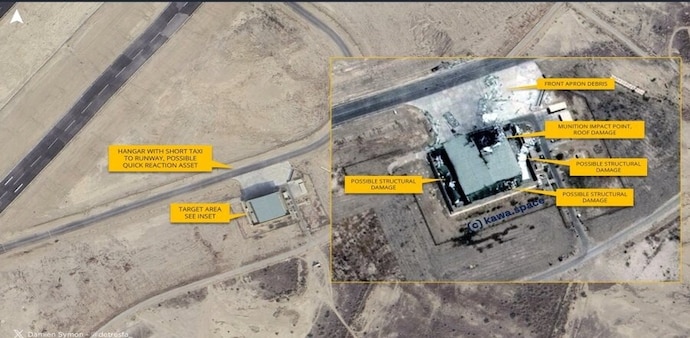
New satellite imagery of Pakistan’s Jacobabad Airbase — one of the key sites targeted by India during Operation Sindoor in May 2025 — shows that the Pakistan Air Force (PAF) is still carrying out structural inspections and post-strike assessments nearly six months after the conflict.
Defence analyst Damien Symon, who shared the latest visuals, said the updates point to “progressive dismantling” of a major hangar hit by Indian precision strikes. “Imagery over the past few months reveals the hangar targeted by India at Jacobabad Airbase, Pakistan during the May 2025 conflict has had its roof taken apart in stages, likely as internal damage checks continue before the structure is repaired,” Symon wrote in a post on X (formally twitter).
According to recent satellite frames:
- Fresh imagery shows a steady dismantling of the hangar’s outer structure.
- Multiple roof sections have been removed, pointing to internal integrity examinations.
- The pattern of inspection matches standard post-strike damage assessment protocols.
- Full-scale repairs are expected only after the technical evaluation concludes.
- The continued monitoring suggests that the hangar remains a high-priority asset for Pakistan’s military planners.
High-resolution Maxar satellite images from May 10-11, which analysed the site soon after the strikes, had already indicated extensive destruction across several Pakistani airbases. These images, accessed exclusively by India Today, revealed large runway craters, destroyed hangars, and damage to administrative and storage buildings at Sukkur, Nur Khan (Rawalpindi), Rahim Yar Khan, Mushaf (Sargodha), Jacobabad, and Bholari.
Officials familiar with the assessment process said that the scale and precision of the strikes were among the key reasons the Shehbaz Sharif government moved swiftly to seek a ceasefire after three days of escalating hostilities.
Jacobabad airbase: A strategic nerve centre
Jacobabad Airbase has long been one of Pakistan’s most strategically significant military facilities. Once a crucial operational hub for NATO during Operation Enduring Freedom, the base today hosts some of the PAF’s most advanced platforms:
- JF-17 Block II fighter jets
- Multiple F-16 Fighting Falcon variants
- Leonardo AW139 helicopters flown by the 88 Search and Rescue Squadron
Pakistani media reports also point to the presence of private foreign contractors at the base who support the maintenance of the US-supplied F-16 fleet — further underscoring the installation’s importance.
The continued dismantling of the damaged hangar shows that Jacobabad remains under active evaluation months after the conflict. As Pakistan works to restore one of its most sensitive military hubs, the imagery offers a rare, evolving window into the long-term impact of India’s Operation Sindoor — and the enduring vulnerabilities it exposed in Pakistan’s air defence infrastructure.
New satellite imagery of Pakistan’s Jacobabad Airbase — one of the key sites targeted by India during Operation Sindoor in May 2025 — shows that the Pakistan Air Force (PAF) is still carrying out structural inspections and post-strike assessments nearly six months after the conflict.
Defence analyst Damien Symon, who shared the latest visuals, said the updates point to “progressive dismantling” of a major hangar hit by Indian precision strikes. “Imagery over the past few months reveals the hangar targeted by India at Jacobabad Airbase, Pakistan during the May 2025 conflict has had its roof taken apart in stages, likely as internal damage checks continue before the structure is repaired,” Symon wrote in a post on X (formally twitter).
According to recent satellite frames:
- Fresh imagery shows a steady dismantling of the hangar’s outer structure.
- Multiple roof sections have been removed, pointing to internal integrity examinations.
- The pattern of inspection matches standard post-strike damage assessment protocols.
- Full-scale repairs are expected only after the technical evaluation concludes.
- The continued monitoring suggests that the hangar remains a high-priority asset for Pakistan’s military planners.
High-resolution Maxar satellite images from May 10-11, which analysed the site soon after the strikes, had already indicated extensive destruction across several Pakistani airbases. These images, accessed exclusively by India Today, revealed large runway craters, destroyed hangars, and damage to administrative and storage buildings at Sukkur, Nur Khan (Rawalpindi), Rahim Yar Khan, Mushaf (Sargodha), Jacobabad, and Bholari.
Officials familiar with the assessment process said that the scale and precision of the strikes were among the key reasons the Shehbaz Sharif government moved swiftly to seek a ceasefire after three days of escalating hostilities.
Jacobabad airbase: A strategic nerve centre
Jacobabad Airbase has long been one of Pakistan’s most strategically significant military facilities. Once a crucial operational hub for NATO during Operation Enduring Freedom, the base today hosts some of the PAF’s most advanced platforms:
- JF-17 Block II fighter jets
- Multiple F-16 Fighting Falcon variants
- Leonardo AW139 helicopters flown by the 88 Search and Rescue Squadron
Pakistani media reports also point to the presence of private foreign contractors at the base who support the maintenance of the US-supplied F-16 fleet — further underscoring the installation’s importance.
The continued dismantling of the damaged hangar shows that Jacobabad remains under active evaluation months after the conflict. As Pakistan works to restore one of its most sensitive military hubs, the imagery offers a rare, evolving window into the long-term impact of India’s Operation Sindoor — and the enduring vulnerabilities it exposed in Pakistan’s air defence infrastructure.