
Smog keeps Delhi in grip: Another day of hazardous air as AQI stays ‘very poor’ at 351
GRAP Stage III restrictions are already in force across the NCR, including curbs on construction activities and certain categories of vehicles.
- Nov 15, 2026,
- Updated Nov 15, 2026 9:52 AM IST
Delhi’s air quality remained in the “very poor” category on Sunday, with the city’s overall Air Quality Index (AQI) recorded at 351 at 8 am, according to the Central Pollution Control Board's (CPCB) data. The reading was 17 points lower than at the same hour on Saturday, but pollution levels continued to pose health risks for residents, particularly children, the elderly and people with respiratory conditions.
The Delhi Environment Department said all 59 monitoring stations were reporting, with PM2.5 identified as the lead pollutant at 51 stations. An AQI between 301 and 400 is classified as “very poor", while readings above 400 fall in the “severe” category.
The improvement comes after Delhi’s average AQI had slipped to 403 on Friday morning, placing the capital in the “severe” category. On Saturday, the city’s average AQI stood at 348 at 7:05 am.
Pollution hotspots
Several parts of the capital continued to record hazardous concentrations of particulate matter. On Sunday morning, IIT Delhi recorded an AQI of 426, while Chandni Chowk registered 384, North Campus recorded 400, Pusa stood at 403 and NSUT Jaffarpur recorded 407, according to CPCB data.
MUST READ: Delhi's Diwali AQI worsens for third straight year: Why pollution controls are failing to deliver
Although the citywide reading improved on Sunday, officials and residents were advised to remain cautious, as localised pollution can remain severe even when the average AQI declines. The Delhi government’s portal described conditions as “very poor” and advised residents to stay indoors and run air purifiers where possible.
Weather offers limited relief
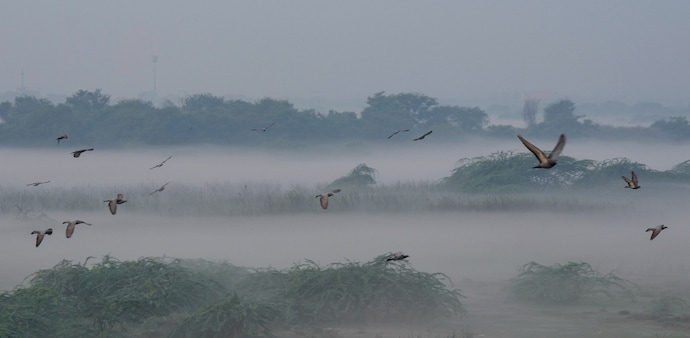
Foggy conditions were reported in New Delhi, with the temperature at 21 degrees Celsius, humidity at 91 per cent and wind speed at 3.7 km/h, according to the Delhi government’s AQI portal. Low wind speeds and fog can trap pollutants close to the ground, worsening visibility and prolonging exposure to harmful particulates.
Forecasts indicated that rainfall could bring marginal relief in the coming days. However, weather experts caution that any improvement is likely to be temporary unless emissions from vehicles, construction dust, industry and stubble burning are curbed.
Restrictions in force
GRAP Stage III restrictions are already in force across the National Capital Region, including curbs on construction activity and certain categories of vehicles. The measures are intended to reduce additional pollution during periods of deteriorating air quality.
DON'T MISS: Buying an air purifier? 4 things you must check beyond Hepa filters as Delhi-NCR AQI worsens
Health experts generally advise residents to avoid outdoor exercise, keep windows closed during peak pollution hours, use certified air purifiers indoors and seek medical attention if experiencing breathlessness, chest discomfort or persistent coughing.
The Delhi government’s portal also lists pollution-control helpline 1800 202 5051 for reporting open burning, dust and industrial smoke.