
'Terrorism remains a live threat': Brahma Chellaney's warning after Delhi blast and Faridabad module bust
'The blast came soon after police uncovered a terror module with a massive cache of explosives - nearly 2,900 kilograms - pointing to a coordinated plot targeting the NCR,' says Chellaney
- Nov 11, 2025,
- Updated Nov 11, 2025 2:51 PM IST
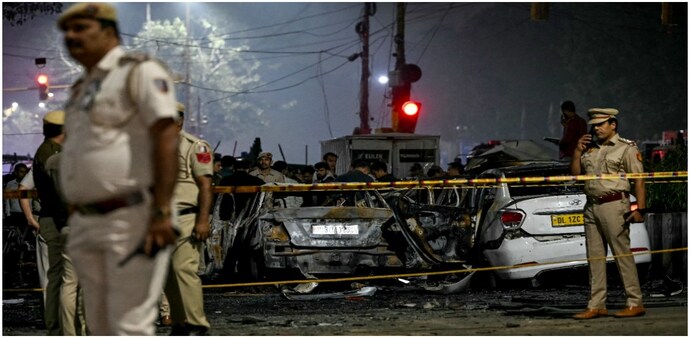
"Terrorism remains a live threat to internal security," geostrategist Brahma Chellaney said on Tuesday, a day after the deadly car explosion near Delhi's Red Fort. The explosion, which occurred at a traffic signal near the Red Fort Metro Station on Monday evening, has raised serious concerns about the ongoing threat of terrorism within India's borders.
"At a moment when India is grappling with fresh diplomatic and strategic challenges, the deadly car explosion near the Red Fort in Old Delhi has delivered a grim reminder that terrorism remains a live threat to internal security," Chellaney wrote on X.
The blast killed nine people and left several vehicles gutted. A high-intensity explosion ripped through a Hyundai i20 car near the Red Fort Metro Station at a traffic signal. Home Minister Amit Shah confirmed that top investigating agencies were probing the incident with full intensity and that the investigation would go in-depth.
What makes the explosion more disturbing is its timing. "The blast came soon after police uncovered a terror module with a massive cache of explosives - nearly 2,900 kilograms - pointing to a coordinated plot targeting the National Capital Region (NCR)," the foreign policy expert noted. This find, coupled with the tragic blast, underscores the ongoing threat from terrorism, both internal and cross-border.
Police sources revealed that Umar Mohammad, a Pulwama resident and a doctor, was allegedly driving the car used in the explosion. Investigations have suggested possible links to a terror module in Faridabad, where a significant amount of explosives was seized earlier that day.
The arrested suspects, including doctors and professionals, indicate the emergence of a "white-collar" terror network capable of planning and executing sophisticated operations under the radar of traditional security surveillance.
Chellaney pointed out the disturbing profile of those arrested. "More disturbing is the profile of some of those arrested. The alleged involvement of doctors and other professionals suggests the emergence of a ‘white-collar’ terror network capable of planning and executing sophisticated operations under the radar of traditional security surveillance."
Investigators have found that the blast near the Red Fort involved ammonium nitrate, fuel oil, and detonators. Early reports suggest links between the Faridabad terror module and the Delhi blast, with initial findings pointing to the involvement of some of the same materials.
Hours before the blast, authorities had seized 2,900 kg of explosive materials, including ammonium nitrate, potassium nitrate, and sulphur. A total of eight individuals, including three doctors, were arrested in Faridabad. Among those arrested was Umar Mohammad, who was allegedly connected to the Pakistan-based Jaish-e-Mohammed terror module.
"This episode is a sobering reminder that the frontlines of national security lie as much within India’s cities as along its borders with Pakistan and Bangladesh," Chellaney concluded, warning that the infrastructure of cross-border terrorism remains intact, posing an ongoing threat to India's security.
"Terrorism remains a live threat to internal security," geostrategist Brahma Chellaney said on Tuesday, a day after the deadly car explosion near Delhi's Red Fort. The explosion, which occurred at a traffic signal near the Red Fort Metro Station on Monday evening, has raised serious concerns about the ongoing threat of terrorism within India's borders.
"At a moment when India is grappling with fresh diplomatic and strategic challenges, the deadly car explosion near the Red Fort in Old Delhi has delivered a grim reminder that terrorism remains a live threat to internal security," Chellaney wrote on X.
The blast killed nine people and left several vehicles gutted. A high-intensity explosion ripped through a Hyundai i20 car near the Red Fort Metro Station at a traffic signal. Home Minister Amit Shah confirmed that top investigating agencies were probing the incident with full intensity and that the investigation would go in-depth.
What makes the explosion more disturbing is its timing. "The blast came soon after police uncovered a terror module with a massive cache of explosives - nearly 2,900 kilograms - pointing to a coordinated plot targeting the National Capital Region (NCR)," the foreign policy expert noted. This find, coupled with the tragic blast, underscores the ongoing threat from terrorism, both internal and cross-border.
Police sources revealed that Umar Mohammad, a Pulwama resident and a doctor, was allegedly driving the car used in the explosion. Investigations have suggested possible links to a terror module in Faridabad, where a significant amount of explosives was seized earlier that day.
The arrested suspects, including doctors and professionals, indicate the emergence of a "white-collar" terror network capable of planning and executing sophisticated operations under the radar of traditional security surveillance.
Chellaney pointed out the disturbing profile of those arrested. "More disturbing is the profile of some of those arrested. The alleged involvement of doctors and other professionals suggests the emergence of a ‘white-collar’ terror network capable of planning and executing sophisticated operations under the radar of traditional security surveillance."
Investigators have found that the blast near the Red Fort involved ammonium nitrate, fuel oil, and detonators. Early reports suggest links between the Faridabad terror module and the Delhi blast, with initial findings pointing to the involvement of some of the same materials.
Hours before the blast, authorities had seized 2,900 kg of explosive materials, including ammonium nitrate, potassium nitrate, and sulphur. A total of eight individuals, including three doctors, were arrested in Faridabad. Among those arrested was Umar Mohammad, who was allegedly connected to the Pakistan-based Jaish-e-Mohammed terror module.
"This episode is a sobering reminder that the frontlines of national security lie as much within India’s cities as along its borders with Pakistan and Bangladesh," Chellaney concluded, warning that the infrastructure of cross-border terrorism remains intact, posing an ongoing threat to India's security.