
'The record hasn't been happy for India, but...': Ex-High Commissioner on BNP and ties with Delhi
'I would like to believe now in the changed circumstances, and what BNP has gone through in these years, especially since August 2024, Rahman probably will have an impact in bringing temperatures a bit,' says Riva Ganguly Das
- Dec 25, 2025,
- Updated Dec 25, 2025 8:01 PM IST
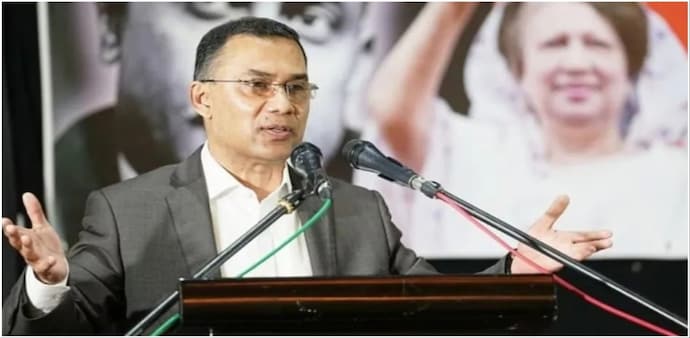
As BNP leader Tarique Rahman returns to Dhaka after 17 years, there is hope in some quarters that Bangladesh’s political situation may stabilise and ties with India could improve.
"I think his return is politically very significant," Riva Ganguly Das, former Indian High Commissioner to Bangladesh, told news agency ANI. "He has been away for a very long time, and because Begum Zia herself was not well, he has managed the party quite well."
Das said Rahman's return comes at a time of deep political unrest in Bangladesh. "His coming back at this stage, when there is so much violence in Bangladesh and the country is literally being torn apart between various ideological views, it is expected that he will bring back some semblance of political stability and maybe he will be able to consolidate the centrist forces which are there in Bangladesh because the main concern now is the rise of right wing and what the right wing has been up to," she said.
Das served as India’s High Commissioner to Bangladesh from March 2019 to August 2020.
While underscoring the political significance of Rahman’s return, Das flagged the strained history between India and the BNP. "The record of BNP - last time they were in power in 2001 - has not been very happy for India," she said. "Relations were tense, there were insurgency activities near the border, and the Chittagong arms haul case is very well known."
However, she noted that the political context has changed since then. "The big difference from then and now is that at that time, there was a coalition government with the Jamaat. Jamaat had 20-plus seats and a couple of ministries. That was slightly different BNP," she said.
"I would like to believe now in the changed circumstances, and what BNP has gone through in these years, especially since August 2024, Rahman probably will have an impact in bringing temperatures a bit."
Das also pointed out that the BNP has never clearly articulated its India policy. "At no point has BNP very clearly put forward what their India policy is. From time to time, we see very shrill anti-India statements coming out of the BNP leaders," she said. "I would like to believe that if they come to power, there will be some sort of working relations between India and Bangladesh."
The BNP-led government between 2001 and 2006, in which the Jamaat-e-Islami held several key ministries, had strained India-Bangladesh relations.
As BNP leader Tarique Rahman returns to Dhaka after 17 years, there is hope in some quarters that Bangladesh’s political situation may stabilise and ties with India could improve.
"I think his return is politically very significant," Riva Ganguly Das, former Indian High Commissioner to Bangladesh, told news agency ANI. "He has been away for a very long time, and because Begum Zia herself was not well, he has managed the party quite well."
Das said Rahman's return comes at a time of deep political unrest in Bangladesh. "His coming back at this stage, when there is so much violence in Bangladesh and the country is literally being torn apart between various ideological views, it is expected that he will bring back some semblance of political stability and maybe he will be able to consolidate the centrist forces which are there in Bangladesh because the main concern now is the rise of right wing and what the right wing has been up to," she said.
Das served as India’s High Commissioner to Bangladesh from March 2019 to August 2020.
While underscoring the political significance of Rahman’s return, Das flagged the strained history between India and the BNP. "The record of BNP - last time they were in power in 2001 - has not been very happy for India," she said. "Relations were tense, there were insurgency activities near the border, and the Chittagong arms haul case is very well known."
However, she noted that the political context has changed since then. "The big difference from then and now is that at that time, there was a coalition government with the Jamaat. Jamaat had 20-plus seats and a couple of ministries. That was slightly different BNP," she said.
"I would like to believe now in the changed circumstances, and what BNP has gone through in these years, especially since August 2024, Rahman probably will have an impact in bringing temperatures a bit."
Das also pointed out that the BNP has never clearly articulated its India policy. "At no point has BNP very clearly put forward what their India policy is. From time to time, we see very shrill anti-India statements coming out of the BNP leaders," she said. "I would like to believe that if they come to power, there will be some sort of working relations between India and Bangladesh."
The BNP-led government between 2001 and 2006, in which the Jamaat-e-Islami held several key ministries, had strained India-Bangladesh relations.