
'They saw Indians as problems, we see 140 cr solutions': PM Modi criticises Congress approach to citizens
PM Modi stated that while Congress leaders historically viewed citizens as challenges, his government sees them as sources of solutions. This comparison formed the core of his response during the Motion of Thanks on the President's address, underlining a significant ideological divide between the two parties
- Feb 5, 2026,
- Updated Feb 5, 2026 8:36 PM IST
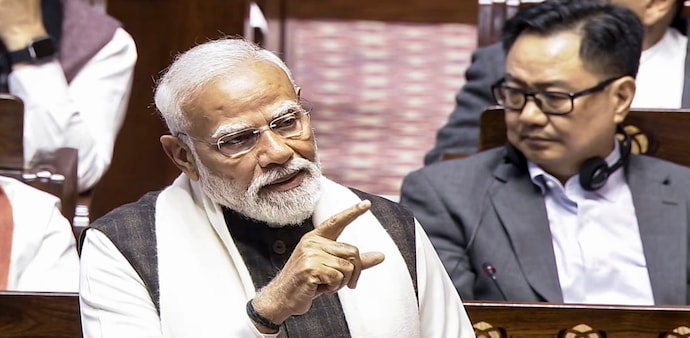
Launching a sharp critique in the Rajya Sabha on Thursday, Prime Minister Narendra Modi drew on remarks made by former Prime Ministers Jawaharlal Nehru and Indira Gandhi to argue that the Congress party has long been out of step with the aspirations of ordinary Indians. Speaking during his reply to the Motion of Thanks on the President’s Address, PM Modi said his government sees citizens as partners in development, unlike past regimes which, he claimed, treated people as obstacles rather than stakeholders in progress.
He stated that while Congress leaders historically viewed citizens as challenges, his government sees them as sources of solutions. This comparison formed the core of his response during the Motion of Thanks on the President's address, underlining a significant ideological divide between the two parties and suggesting far-reaching implications for policy formulation and governance priorities.
PM Modi referenced a statement made by former Prime Minister Indira Gandhi, recalling her description of how former Prime Minister Jawaharlal Nehru characterised India’s populace. Quoting Gandhi, he said, "Former Prime Minister late Jawaharlal Nehru viewed the country as having 35 crore problems, while she herself faced 71 crore problems during her tenure."
Modi countered this viewpoint, asserting: "Nehru saw 35 crore Indians as problems; we see 140 crore solutions," and positioning his administration as empowering rather than burdened by India’s population.
In her speeches, former PM Indira Gandhi had said, “Nothing in India is simple or small. When asked how many problems he had, my father once replied, ‘350 million', which was our population at that time.”
She went on to describe the scale of governance challenges in a rapidly expanding democracy, linking them to development pressures rather than dismissing citizens themselves.
PM Modi argued that the difference in perspective is not just rhetorical but influences concrete policy decisions. He maintained that his government’s focus is on empowering individuals and creating opportunities, diverging from what he described as Congress’s legacy of viewing demographic growth as a challenge rather than an asset. Modi claimed this shift enables more innovative and inclusive governance.
Jeep versus mule
PM Modi also invoked Indira Gandhi’s own critique of India’s planning apparatus to question the effectiveness of the Congress-era Planning Commission. Referring to her oft-cited “jeep versus mule” anecdote from Himachal Pradesh, Modi argued that the system recognised its limitations but lacked the will to correct them.
Indira Gandhi had recounted how officials denied funds for mules needed by workers in hilly terrain because policy permitted only jeeps—even in areas without roads. The Planning Commission’s stance of “jeep or nothing,” she wrote, epitomised bureaucratic rigidity and the disconnect between policy design and on-ground realities.
Highlighting government effectiveness, Modi cited the completion of the Sardar Sarovar Dam on the Narmada river as a benchmark for his administration’s project execution capacity. He noted that while the project was started before his time in politics, it was only finished during his tenure as Prime Minister, underlining what he described as his government’s commitment to delivering results across key infrastructure sectors.
Addressing rural and agricultural issues, the Prime Minister alleged that Congress governments had neglected small and marginal farmers, focusing instead on influential interest groups. He presented his government’s Pradhan Mantri Kisan Samman Nidhi Yojana as an example of targeted support, reporting that over four lakh crore rupees had been directly transferred to farmers’ bank accounts, aiming to reduce intermediaries and strengthen rural economies.
Launching a sharp critique in the Rajya Sabha on Thursday, Prime Minister Narendra Modi drew on remarks made by former Prime Ministers Jawaharlal Nehru and Indira Gandhi to argue that the Congress party has long been out of step with the aspirations of ordinary Indians. Speaking during his reply to the Motion of Thanks on the President’s Address, PM Modi said his government sees citizens as partners in development, unlike past regimes which, he claimed, treated people as obstacles rather than stakeholders in progress.
He stated that while Congress leaders historically viewed citizens as challenges, his government sees them as sources of solutions. This comparison formed the core of his response during the Motion of Thanks on the President's address, underlining a significant ideological divide between the two parties and suggesting far-reaching implications for policy formulation and governance priorities.
PM Modi referenced a statement made by former Prime Minister Indira Gandhi, recalling her description of how former Prime Minister Jawaharlal Nehru characterised India’s populace. Quoting Gandhi, he said, "Former Prime Minister late Jawaharlal Nehru viewed the country as having 35 crore problems, while she herself faced 71 crore problems during her tenure."
Modi countered this viewpoint, asserting: "Nehru saw 35 crore Indians as problems; we see 140 crore solutions," and positioning his administration as empowering rather than burdened by India’s population.
In her speeches, former PM Indira Gandhi had said, “Nothing in India is simple or small. When asked how many problems he had, my father once replied, ‘350 million', which was our population at that time.”
She went on to describe the scale of governance challenges in a rapidly expanding democracy, linking them to development pressures rather than dismissing citizens themselves.
PM Modi argued that the difference in perspective is not just rhetorical but influences concrete policy decisions. He maintained that his government’s focus is on empowering individuals and creating opportunities, diverging from what he described as Congress’s legacy of viewing demographic growth as a challenge rather than an asset. Modi claimed this shift enables more innovative and inclusive governance.
Jeep versus mule
PM Modi also invoked Indira Gandhi’s own critique of India’s planning apparatus to question the effectiveness of the Congress-era Planning Commission. Referring to her oft-cited “jeep versus mule” anecdote from Himachal Pradesh, Modi argued that the system recognised its limitations but lacked the will to correct them.
Indira Gandhi had recounted how officials denied funds for mules needed by workers in hilly terrain because policy permitted only jeeps—even in areas without roads. The Planning Commission’s stance of “jeep or nothing,” she wrote, epitomised bureaucratic rigidity and the disconnect between policy design and on-ground realities.
Highlighting government effectiveness, Modi cited the completion of the Sardar Sarovar Dam on the Narmada river as a benchmark for his administration’s project execution capacity. He noted that while the project was started before his time in politics, it was only finished during his tenure as Prime Minister, underlining what he described as his government’s commitment to delivering results across key infrastructure sectors.
Addressing rural and agricultural issues, the Prime Minister alleged that Congress governments had neglected small and marginal farmers, focusing instead on influential interest groups. He presented his government’s Pradhan Mantri Kisan Samman Nidhi Yojana as an example of targeted support, reporting that over four lakh crore rupees had been directly transferred to farmers’ bank accounts, aiming to reduce intermediaries and strengthen rural economies.