
‘Tibet doesn’t have Hanumana to lift it up’: Elected leader Penpa Tsering speaks on autonomy
Penpa Tsering said that the Chinese have struck the very root of the Tibetan identity.
- Nov 12, 2025,
- Updated Nov 12, 2025 12:07 PM IST
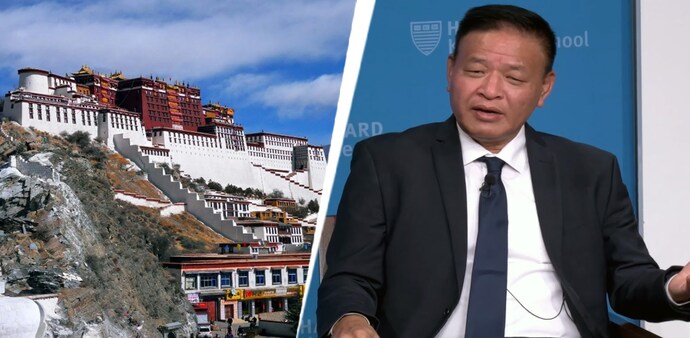
Tibet does not have Lord Hanumana to lift it up and put it near the US, and so it is only advisable that we live peacefully together with the neighbours, said Sikyong Penpa Tsering, the elected leader of the Central Tibetan Administration.
Speaking at a conversation titled ‘Tibetan Democracy in Exile: Governance Without a State’ hosted by Institute of Politics Harvard Kennedy School, Penpa Tsering was responding to a question on autonomy. He said Tibet as a country is not very accessible to outsiders for its geographical layout. Tsering said, try as on may, the country cannot be moved out of where it is placed, indicating that there is no other way but to maintain good relations with the neighbours.
“We lived with the Chinese people, we lived with Nepalese, Bhutanese, Indians, Uyghurs, Mongols for centuries in peace. There have been very few wars. It's not possible to have too much war on Tibet also because Tibet is the roof of the world. The average altitude is about 16,010 ft above sea level. It's called the third pole by Chinese environmental scientists today. It's also called as the water tower of Asia because most of these major rivers in Asia originate from Tibet. So it's not easy for outsiders to come into Tibet. You need a robust physique to come into Tibet to climb all those mountains, down valleys. It is also not easy for Tibetans to go out of Tibet. So, Tibet remained isolated for very long,” he explained.
“In India you have this mythological monkey god called Hanuman who is supposed to have powers to lift mountains. So we don't have a Hanuman to lift Tibet out of that place and put it somewhere in the Atlantic or Pacific near United States. So we have to go back to live with Chinese, with Nepalese, Indians as neighbours. So if we have to live as neighbours then why don't we live in peace?,” said Tsering.
The elected leader said that Tibet is not only landlocked, it is also a vast country. “It’s a little bigger than Mexico as a country. So, it has geopolitical importance, environmental importance, and Buddhist values based on non-violence and compassion. As a human, my job is to promote human values.”
He said that 157 Tibetans have self-immolated inside Tibet, and most of them are between the age of 17 and 35. Tsering said that the Chinese have struck the very root of the Tibetan identity. China has colonial-style boarding schools wherein there are about 1 million Tibetan children, away from their family, culture and language, he said. “They are taught only Mandarin, and loyalty to the Communist Party. So, this is going to be very, very consequential if this continues for another two or three decades down the line for the Tibetans because one whole generation of Tibetans would be turned into Chinese,” he said.
Tibet does not have Lord Hanumana to lift it up and put it near the US, and so it is only advisable that we live peacefully together with the neighbours, said Sikyong Penpa Tsering, the elected leader of the Central Tibetan Administration.
Speaking at a conversation titled ‘Tibetan Democracy in Exile: Governance Without a State’ hosted by Institute of Politics Harvard Kennedy School, Penpa Tsering was responding to a question on autonomy. He said Tibet as a country is not very accessible to outsiders for its geographical layout. Tsering said, try as on may, the country cannot be moved out of where it is placed, indicating that there is no other way but to maintain good relations with the neighbours.
“We lived with the Chinese people, we lived with Nepalese, Bhutanese, Indians, Uyghurs, Mongols for centuries in peace. There have been very few wars. It's not possible to have too much war on Tibet also because Tibet is the roof of the world. The average altitude is about 16,010 ft above sea level. It's called the third pole by Chinese environmental scientists today. It's also called as the water tower of Asia because most of these major rivers in Asia originate from Tibet. So it's not easy for outsiders to come into Tibet. You need a robust physique to come into Tibet to climb all those mountains, down valleys. It is also not easy for Tibetans to go out of Tibet. So, Tibet remained isolated for very long,” he explained.
“In India you have this mythological monkey god called Hanuman who is supposed to have powers to lift mountains. So we don't have a Hanuman to lift Tibet out of that place and put it somewhere in the Atlantic or Pacific near United States. So we have to go back to live with Chinese, with Nepalese, Indians as neighbours. So if we have to live as neighbours then why don't we live in peace?,” said Tsering.
The elected leader said that Tibet is not only landlocked, it is also a vast country. “It’s a little bigger than Mexico as a country. So, it has geopolitical importance, environmental importance, and Buddhist values based on non-violence and compassion. As a human, my job is to promote human values.”
He said that 157 Tibetans have self-immolated inside Tibet, and most of them are between the age of 17 and 35. Tsering said that the Chinese have struck the very root of the Tibetan identity. China has colonial-style boarding schools wherein there are about 1 million Tibetan children, away from their family, culture and language, he said. “They are taught only Mandarin, and loyalty to the Communist Party. So, this is going to be very, very consequential if this continues for another two or three decades down the line for the Tibetans because one whole generation of Tibetans would be turned into Chinese,” he said.