
US green card curbs: India slams Vance's 'indentured servants' remark for colonial undertones
The suspension under the PERM framework halts the permanent-residency certification process for foreign workers employed by the affected Indian IT service firms. The US administration framed the restriction as a step to protect domestic employment and address potential wage suppression.
- Oct 9, 2026,
- Updated Oct 9, 2026 1:30 PM IST
India on October 9 rejected comments made by US Vice President JD Vance regarding foreign tech workers, calling descriptions of H-1B visa holders as "indentured servants" unwarranted and deeply offensive.
The hard stance New Delhi follows the United States' decision to suspend six major IT outsourcing firms — Cognizant, Infosys, TCS, Wipro, HCL and Capgemini — from the Program for Electronic Review Management (PERM) green card processing framework.
"We believe that such descriptions are unwarranted and ignore the fact that Indian professionals in the United States are highly educated and skilled contributors to its economy and innovation ecosystem," Ministry of External Affairs (MEA) said in a statement.
MUST READ | 'Indentured servants': JD Vance on H-1B workers as US stops tech firms from green card programme
Addressing the terminology used by US officials, the MEA highlighted the historical contributions of immigrants while objecting to the choice of words.
"Indeed, the history of the United States itself has been shaped by generations of immigrants whose labour, enterprise and innovation have contributed to its growth and prosperity. Resorting to terminology that carries painful historical and colonial legacy connotations is deeply offensive," the statement added.
The suspension under the PERM framework halts the permanent-residency certification process for foreign workers employed by the affected Indian IT service firms. The US administration framed the restriction as a step to protect domestic employment and address potential wage suppression.
Responding to the economic rationale offered by Washington, the MEA stated that cross-border movement of skilled personnel benefits both nations.
DON'T MISS | H-1B vs PERM explained: What the US suspension means for Indian IT workers
"Talent mobility adds value to both economies. While it creates opportunities for Indians, it equally helps US companies with cutting-edge talent, innovation, research, productivity, competitiveness and job creation, besides creating shareholder wealth in the US," the MEA said.
The MEA added that India remains in communication with US authorities to resolve concerns regarding the movement of Indian professionals and the operations of Indian information technology firms in the United States.
What Vance said on PERM & H-1B workers
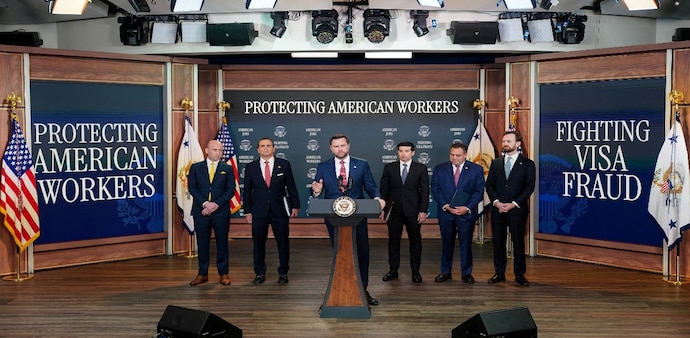
A day earlier, US Vice President JD Vance has accused Microsoft and major technology corporations of exploiting the H-1B visa system to replace American workers with lower-paid foreign staff, calling foreign employees brought in by outsourcing firms "indentured servants."
DO CHECKOUT | J-1 visa fraud: Trump administration probes Harvard, Yale, Stanford, MIT, Caltech, others
The rhetoric accompanied a sweeping crackdown by the Trump administration, which suspended Microsoft and several global tech giants from the primary programme used to sponsor foreign workers for employment-based green cards amid allegations of fraud and wage suppression.
Vance outlined stark wage discrepancies between American employees and foreign workers brought in on temporary visas. He alleged that major corporations systematically utilise these wage disparities to maximise corporate profits at the expense of domestic labour.
"If you are working as an H-1B visa in the United States of America, you're earning $20,000 less than an American citizen hired in the same position. If you were brought in by one of these foreign outsourcing firms, you're making $48,000 less than an American citizen in a similar position," Vance said.
India on October 9 rejected comments made by US Vice President JD Vance regarding foreign tech workers, calling descriptions of H-1B visa holders as "indentured servants" unwarranted and deeply offensive.
The hard stance New Delhi follows the United States' decision to suspend six major IT outsourcing firms — Cognizant, Infosys, TCS, Wipro, HCL and Capgemini — from the Program for Electronic Review Management (PERM) green card processing framework.
"We believe that such descriptions are unwarranted and ignore the fact that Indian professionals in the United States are highly educated and skilled contributors to its economy and innovation ecosystem," Ministry of External Affairs (MEA) said in a statement.
MUST READ | 'Indentured servants': JD Vance on H-1B workers as US stops tech firms from green card programme
Addressing the terminology used by US officials, the MEA highlighted the historical contributions of immigrants while objecting to the choice of words.
"Indeed, the history of the United States itself has been shaped by generations of immigrants whose labour, enterprise and innovation have contributed to its growth and prosperity. Resorting to terminology that carries painful historical and colonial legacy connotations is deeply offensive," the statement added.
The suspension under the PERM framework halts the permanent-residency certification process for foreign workers employed by the affected Indian IT service firms. The US administration framed the restriction as a step to protect domestic employment and address potential wage suppression.
Responding to the economic rationale offered by Washington, the MEA stated that cross-border movement of skilled personnel benefits both nations.
DON'T MISS | H-1B vs PERM explained: What the US suspension means for Indian IT workers
"Talent mobility adds value to both economies. While it creates opportunities for Indians, it equally helps US companies with cutting-edge talent, innovation, research, productivity, competitiveness and job creation, besides creating shareholder wealth in the US," the MEA said.
The MEA added that India remains in communication with US authorities to resolve concerns regarding the movement of Indian professionals and the operations of Indian information technology firms in the United States.
What Vance said on PERM & H-1B workers
A day earlier, US Vice President JD Vance has accused Microsoft and major technology corporations of exploiting the H-1B visa system to replace American workers with lower-paid foreign staff, calling foreign employees brought in by outsourcing firms "indentured servants."
DO CHECKOUT | J-1 visa fraud: Trump administration probes Harvard, Yale, Stanford, MIT, Caltech, others
The rhetoric accompanied a sweeping crackdown by the Trump administration, which suspended Microsoft and several global tech giants from the primary programme used to sponsor foreign workers for employment-based green cards amid allegations of fraud and wage suppression.
Vance outlined stark wage discrepancies between American employees and foreign workers brought in on temporary visas. He alleged that major corporations systematically utilise these wage disparities to maximise corporate profits at the expense of domestic labour.
"If you are working as an H-1B visa in the United States of America, you're earning $20,000 less than an American citizen hired in the same position. If you were brought in by one of these foreign outsourcing firms, you're making $48,000 less than an American citizen in a similar position," Vance said.