
'Velvet glove around iron fist': Brahma Chellaney on Trump's India playbook, continued praise of Modi
Geostrategist Brahma Chellaney on Friday took to social media to decode Trump's strategy vis-à-vis Prime Minister Narendra Modi and India.
- Sep 19, 2025,
- Updated Sep 19, 2025 12:41 PM IST
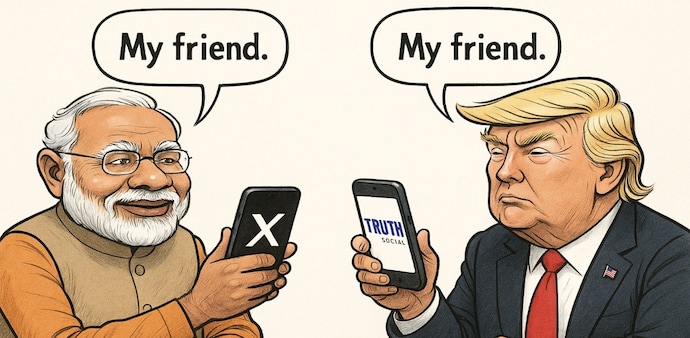
US President Donald Trump's continuing praise of Prime Minister Narendra Modi, while sanctioning India, has left many of us confounded. Geostrategist Brahma Chellaney on Friday took to social media to decode Trump's strategy vis-à-vis Prime Minister Narendra Modi and India.
Chellaney said in his post on X (formerly Twitter) that Donald Trump's India playbook is becoming clearer by the day. He said that the continued praise of Modi is meant to sugarcoat "bitter pills".
"Trump's India playbook is becoming clearer: smother Modi with continuing praise while tightening the vise on India. Calling Modi 'great', a 'very close friend' and 'doing a tremendous job' is Trump's sugarcoating for bitter pills — from making India the first and only target of his secondary sanctions on Russian energy to axing the sanctions waiver for Chabahar, India's strategic counterweight to Pakistan's Chinese-run Gwadar port," Chellaney said.
He added that in Trump's Art of the Deal, flattery does not mean friendship. "In Trump's Art of the Deal, flattery isn't friendship — it's the velvet glove around the iron fist."
Recently, US President Donald Trump spoke about his strong personal ties with India and Prime Minister Narendra Modi, despite ongoing disputes over India's oil imports from Russia.
Speaking to reporters during his UK visit, Trump stated, "I am very close to India, I am very close to the PM of India. I spoke to him the other day. I wished him a happy birthday. We have a very good relationship," Trump said.
His comments followed his criticism of European countries for purchasing Russian oil, arguing that such actions undermine efforts to isolate Moscow. "Found out that the European nations were buying oil from Russia," Trump said.
"But I said, you know, I sanctioned them. China is paying a very large tariff right now to the United States, but I'm willing to do other things, but not when the people that I'm fighting for are buying oil from Russia. If the oil price comes down, very simply, Russia will settle. And the oil price is way down."
Despite repeated concerns over India's Russian oil trade, Trump suggested that reducing global oil prices would be the decisive factor in resolving tensions involving Russia. His stance appears to have softened towards India, with less emphasis on tariff threats in recent weeks.
India, for its part, has stated that its oil trade with Russia does not violate international laws. Indian officials have also accused Western countries of hypocrisy, pointing to continued European and American imports of Russian goods.
Trump's earlier criticism included several threats to impose tariffs on India's imports, especially after reports surfaced regarding the ongoing Russian oil trade. These criticisms led to diplomatic friction, with Modi declining a dinner invitation after the G7 Summit in Canada and cancelling a planned trip to New York for the UN General Assembly.
US President Donald Trump's continuing praise of Prime Minister Narendra Modi, while sanctioning India, has left many of us confounded. Geostrategist Brahma Chellaney on Friday took to social media to decode Trump's strategy vis-à-vis Prime Minister Narendra Modi and India.
Chellaney said in his post on X (formerly Twitter) that Donald Trump's India playbook is becoming clearer by the day. He said that the continued praise of Modi is meant to sugarcoat "bitter pills".
"Trump's India playbook is becoming clearer: smother Modi with continuing praise while tightening the vise on India. Calling Modi 'great', a 'very close friend' and 'doing a tremendous job' is Trump's sugarcoating for bitter pills — from making India the first and only target of his secondary sanctions on Russian energy to axing the sanctions waiver for Chabahar, India's strategic counterweight to Pakistan's Chinese-run Gwadar port," Chellaney said.
He added that in Trump's Art of the Deal, flattery does not mean friendship. "In Trump's Art of the Deal, flattery isn't friendship — it's the velvet glove around the iron fist."
Recently, US President Donald Trump spoke about his strong personal ties with India and Prime Minister Narendra Modi, despite ongoing disputes over India's oil imports from Russia.
Speaking to reporters during his UK visit, Trump stated, "I am very close to India, I am very close to the PM of India. I spoke to him the other day. I wished him a happy birthday. We have a very good relationship," Trump said.
His comments followed his criticism of European countries for purchasing Russian oil, arguing that such actions undermine efforts to isolate Moscow. "Found out that the European nations were buying oil from Russia," Trump said.
"But I said, you know, I sanctioned them. China is paying a very large tariff right now to the United States, but I'm willing to do other things, but not when the people that I'm fighting for are buying oil from Russia. If the oil price comes down, very simply, Russia will settle. And the oil price is way down."
Despite repeated concerns over India's Russian oil trade, Trump suggested that reducing global oil prices would be the decisive factor in resolving tensions involving Russia. His stance appears to have softened towards India, with less emphasis on tariff threats in recent weeks.
India, for its part, has stated that its oil trade with Russia does not violate international laws. Indian officials have also accused Western countries of hypocrisy, pointing to continued European and American imports of Russian goods.
Trump's earlier criticism included several threats to impose tariffs on India's imports, especially after reports surfaced regarding the ongoing Russian oil trade. These criticisms led to diplomatic friction, with Modi declining a dinner invitation after the G7 Summit in Canada and cancelling a planned trip to New York for the UN General Assembly.