
‘Very glad he hasn’t lived to see…’: Fareed Zakaria reflects on his father’s life; says India shedding ‘secular skin’
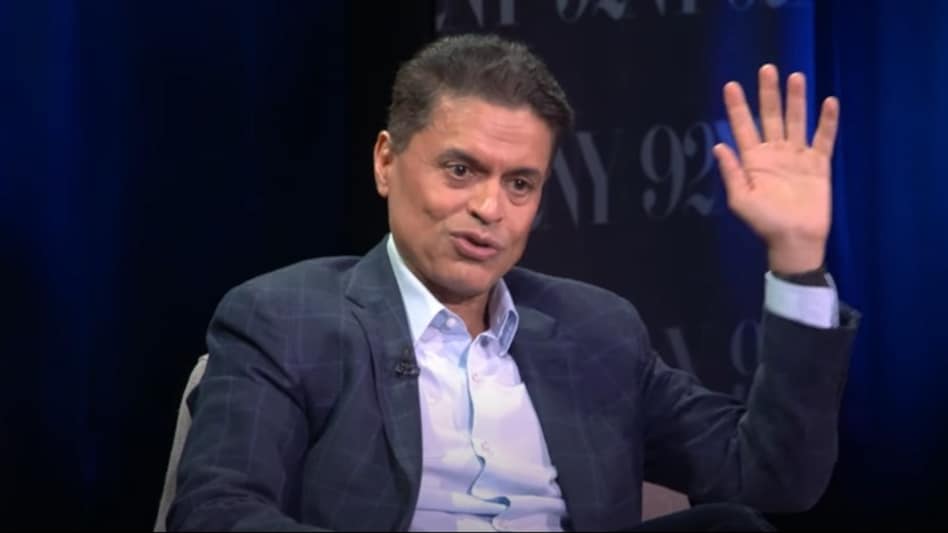
In a conversation with Canadian author and journalist Malcolm Gladwell at an event late last month in New York, Zakaria noted the economic upheaval in India in the last 10 years alongside a rise in Hindu nationalism.
- Apr 18, 2024,
- Updated Apr 18, 2024 12:25 PM IST
Veteran Indian-American journalist and political scientist Fareed Zakaria has said that he is very glad his father Dr. Rafiq Zakaria has not lived to see the rise of Hindu nationalism in India. Zakaria’s father, who was a Congress leader, Islamic scholar and a distinguished writer, had passed away in July, 2005. He was also the MLA from Aurangabad in the 1960s.
In a conversation with Canadian author and journalist Malcolm Gladwell at an event late last month in New York, Zakaria noted the economic upheaval in India in the last 10 years alongside a rise in Hindu nationalism.
He said India had become illiberal in recent years. “In the last 10 years it has been a very complicated story because the economic rise continues a pace and that continues to be dazzling and thrilling, but you're also seeing the rise of Hindu nationalism,” he said.
“And, in many ways -- my father died about 15 years ago -- I'm very glad he hasn't lived to see that because in a way his whole life's work was trying to build a secular India, an India pluralistic which tolerated and encouraged diversity. There's no other way to put it. India has moved in a very different direction. It's economically surging but politically becoming more intolerant, more illiberal.”
Zakaria said he wonders if India was getting closer to its authentic self.
“I wonder whether when India shed its socialist skin, I sort of was the first to celebrate because there was so much corruption and dysfunction and poverty associated with it but now that it's shedding its secular skin, I'm beginning to wonder was all of that the socialism, the secularism, the liberalism was that all basically a kind of veneer borrowed from the West?”
He said he hoped India was only going through a phase of Hindu nationalism and eventually find a more ‘authentic version’ of itself.
“India is in a way returning to a to a more perhaps more authentic place. Perhaps, you know this is a phase. This kind of Hindu nationalism. I hope it isn't the most authentic version of India because I always think of India and Hinduism in particular as being incredibly tolerant,” he said.
He praised the Hindu religion saying: “Hinduism is one of the most extraordinary religions in the world in that almost nothing is prescribed. You can be vegetarian and be a good Hindu, you can be non-vegetarian and be a good Hindu. You can believe in one God, you can believe in 300 million. You can also not believe in God and be a Hindu.
“It's this wonderfully absorptive religion and it doesn't feel to me like intolerance is part of its DNA.”
On being asked if he felt uncomfortable when in India, Zakaria said: “There are times at which I feel uncomfortable, only because of this [intolerance]. Otherwise, I feel incredibly comfortable. Because I've been back a lot. I still speak the language. But this piece of it is very awkward. Because there's a little bit of a kind of... um... people don't talk about it. In polite society, when people are talking about ‘oh, the growth is great, GDP numbers look amazing’, you just don't mention oh there's this small issue which is you know just left untalked about.”
Zakaria also said his father had chosen to side with Gandhi and Nehru's vision of India over Jinnah's vision of a separate state based on religion at a very young age.
“I think the one [worldview] that I probably inherited most strongly was a kind of a deep commitment to the founding idea of India, which was secular, liberal democracy. My father was a Muslim, and so growing up in India, the child of a Muslim politician was a particular experience. Muslims are a minority in India 10 to 12%."
"My father once said to me the most important political decision he made when he was 10 or 12 years old. As a young Muslim kid in India in the 20s [1920s] and 30s, I guess this was in the 30s, he had to choose between two alternate visions for his future: Nehru and Gandhi's vision of a secular democracy or Jinnah, the founder of Pakistan's, vision of a state run on the grounds of religious nationalism. And, he chose India. There was a great pride in that idea of India as a secular democracy."
Veteran Indian-American journalist and political scientist Fareed Zakaria has said that he is very glad his father Dr. Rafiq Zakaria has not lived to see the rise of Hindu nationalism in India. Zakaria’s father, who was a Congress leader, Islamic scholar and a distinguished writer, had passed away in July, 2005. He was also the MLA from Aurangabad in the 1960s.
In a conversation with Canadian author and journalist Malcolm Gladwell at an event late last month in New York, Zakaria noted the economic upheaval in India in the last 10 years alongside a rise in Hindu nationalism.
He said India had become illiberal in recent years. “In the last 10 years it has been a very complicated story because the economic rise continues a pace and that continues to be dazzling and thrilling, but you're also seeing the rise of Hindu nationalism,” he said.
“And, in many ways -- my father died about 15 years ago -- I'm very glad he hasn't lived to see that because in a way his whole life's work was trying to build a secular India, an India pluralistic which tolerated and encouraged diversity. There's no other way to put it. India has moved in a very different direction. It's economically surging but politically becoming more intolerant, more illiberal.”
Zakaria said he wonders if India was getting closer to its authentic self.
“I wonder whether when India shed its socialist skin, I sort of was the first to celebrate because there was so much corruption and dysfunction and poverty associated with it but now that it's shedding its secular skin, I'm beginning to wonder was all of that the socialism, the secularism, the liberalism was that all basically a kind of veneer borrowed from the West?”
He said he hoped India was only going through a phase of Hindu nationalism and eventually find a more ‘authentic version’ of itself.
“India is in a way returning to a to a more perhaps more authentic place. Perhaps, you know this is a phase. This kind of Hindu nationalism. I hope it isn't the most authentic version of India because I always think of India and Hinduism in particular as being incredibly tolerant,” he said.
He praised the Hindu religion saying: “Hinduism is one of the most extraordinary religions in the world in that almost nothing is prescribed. You can be vegetarian and be a good Hindu, you can be non-vegetarian and be a good Hindu. You can believe in one God, you can believe in 300 million. You can also not believe in God and be a Hindu.
“It's this wonderfully absorptive religion and it doesn't feel to me like intolerance is part of its DNA.”
On being asked if he felt uncomfortable when in India, Zakaria said: “There are times at which I feel uncomfortable, only because of this [intolerance]. Otherwise, I feel incredibly comfortable. Because I've been back a lot. I still speak the language. But this piece of it is very awkward. Because there's a little bit of a kind of... um... people don't talk about it. In polite society, when people are talking about ‘oh, the growth is great, GDP numbers look amazing’, you just don't mention oh there's this small issue which is you know just left untalked about.”
Zakaria also said his father had chosen to side with Gandhi and Nehru's vision of India over Jinnah's vision of a separate state based on religion at a very young age.
“I think the one [worldview] that I probably inherited most strongly was a kind of a deep commitment to the founding idea of India, which was secular, liberal democracy. My father was a Muslim, and so growing up in India, the child of a Muslim politician was a particular experience. Muslims are a minority in India 10 to 12%."
"My father once said to me the most important political decision he made when he was 10 or 12 years old. As a young Muslim kid in India in the 20s [1920s] and 30s, I guess this was in the 30s, he had to choose between two alternate visions for his future: Nehru and Gandhi's vision of a secular democracy or Jinnah, the founder of Pakistan's, vision of a state run on the grounds of religious nationalism. And, he chose India. There was a great pride in that idea of India as a secular democracy."