
'Wake up Kolkata': Navam Capital MD's pitch after PM Modi's massive infra push in Assam
'Wake up Kolkata, see what a double-engine government can deliver,' says Navam Capital's Rajeev Mantri
- Dec 21, 2025,
- Updated Dec 21, 2025 11:39 AM IST
Navam Capital's Managing Director Rajeev Mantri on Saturday issued a pointed political message aimed at West Bengal, posting, "Wake up Kolkata, see what a double engine government can deliver." The remark was widely read as an appeal to the people to elect the Bharatiya Janata Party (BJP) in West Bengal.
While Mantri did not elaborate further, the comment comes amid growing discussion among policymakers and economists about West Bengal's long-term economic performance, particularly when viewed against its historical potential. The post also lands less than a year before the state heads into Assembly elections scheduled for April–May 2026.
The fund manager commented on a post by Prime Minister Modi, who inaugurated a new terminal at Lokapriya Gopinath Bardoloi International Airport in Guwahati on Saturday. The project has been positioned by the government as a showcase of infrastructure-led development under a so-called "double engine" model, where the BJP governs at the Centre and the state.
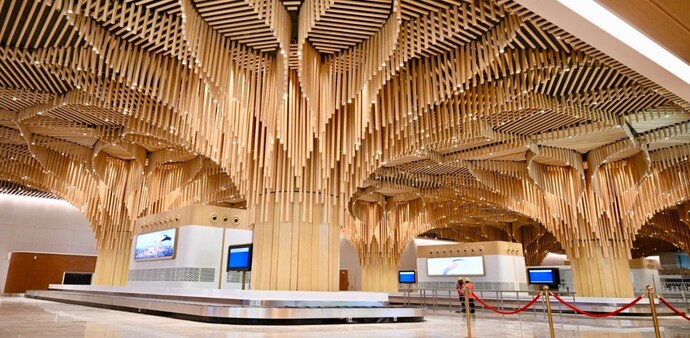
The new terminal, described as the country's first "nature-themed airport", has been designed to handle 13.1 million passengers per annum. Built at a total cost of Rs 5,000 crore, the project includes Rs 1,000 crore earmarked for Maintenance, Repair, and Overhaul (MRO) facilities. It has been developed by Guwahati International Airport Ltd, with operations led by Adani Airport Holdings Limited.
During the inauguration, Modi said the airport would emerge as a key aviation hub for Northeast India and a gateway to Southeast Asia, adding that it would open up new opportunities while preserving the region's cultural heritage. "Modern airport facilities and advanced connectivity infrastructure serve as gateways to new possibilities and opportunities for any state, and stand as pillars of growing confidence and trust among the people," he said.
The terminal, spread across 1,40,000 square metres, draws inspiration from Assam's biodiversity and cultural traditions. Modi said it would also help boost tourism and make it easier for devotees to have 'darshan' of Goddess Kamakhya. He noted that the design incorporates greenery and elements resembling an indoor forest, with extensive use of bamboo. Recalling a 2017 amendment to the Indian Forest Act, 1927, Modi said bamboo grown in non-forest areas had been reclassified as a "grass" rather than a "tree". "This decision has led to the creation of a wonderful structure in the form of a new terminal today," he said.
Against this backdrop, Mantri's comment has been seen as a direct contrast with West Bengal's economic trajectory. Once among India's most economically influential states, West Bengal's share of national output has steadily declined over the decades. In 1960–61, the state contributed 10.5% to India's GDP, ranking third nationally. That share has fallen to 5.6% in 2023–24, according to data from the Ministry of Statistics and Programme Implementation.
The relative decline is sharper when measured through per capita income. West Bengal, which once recorded per capita income at 127.5% of the national average, now stands at 83.7%. These findings are drawn from a working paper by the Economic Advisory Council to the Prime Minister, authored by Sanjeev Sanyal and Aakanksha Arora.
The Prime Minister will today lay the foundation stone for a Rs 10,600-crore brownfield ammonia-urea plant in Dibrugarh district, giving a fillip to the fertiliser requirement of the entire region. Modi arrived in Assam on Saturday on a two-day trip, during which he is set to unveil multiple projects worth Rs 15,600 crore, around three months before the state is due to go for assembly polls.
Navam Capital's Managing Director Rajeev Mantri on Saturday issued a pointed political message aimed at West Bengal, posting, "Wake up Kolkata, see what a double engine government can deliver." The remark was widely read as an appeal to the people to elect the Bharatiya Janata Party (BJP) in West Bengal.
While Mantri did not elaborate further, the comment comes amid growing discussion among policymakers and economists about West Bengal's long-term economic performance, particularly when viewed against its historical potential. The post also lands less than a year before the state heads into Assembly elections scheduled for April–May 2026.
The fund manager commented on a post by Prime Minister Modi, who inaugurated a new terminal at Lokapriya Gopinath Bardoloi International Airport in Guwahati on Saturday. The project has been positioned by the government as a showcase of infrastructure-led development under a so-called "double engine" model, where the BJP governs at the Centre and the state.
The new terminal, described as the country's first "nature-themed airport", has been designed to handle 13.1 million passengers per annum. Built at a total cost of Rs 5,000 crore, the project includes Rs 1,000 crore earmarked for Maintenance, Repair, and Overhaul (MRO) facilities. It has been developed by Guwahati International Airport Ltd, with operations led by Adani Airport Holdings Limited.
During the inauguration, Modi said the airport would emerge as a key aviation hub for Northeast India and a gateway to Southeast Asia, adding that it would open up new opportunities while preserving the region's cultural heritage. "Modern airport facilities and advanced connectivity infrastructure serve as gateways to new possibilities and opportunities for any state, and stand as pillars of growing confidence and trust among the people," he said.
The terminal, spread across 1,40,000 square metres, draws inspiration from Assam's biodiversity and cultural traditions. Modi said it would also help boost tourism and make it easier for devotees to have 'darshan' of Goddess Kamakhya. He noted that the design incorporates greenery and elements resembling an indoor forest, with extensive use of bamboo. Recalling a 2017 amendment to the Indian Forest Act, 1927, Modi said bamboo grown in non-forest areas had been reclassified as a "grass" rather than a "tree". "This decision has led to the creation of a wonderful structure in the form of a new terminal today," he said.
Against this backdrop, Mantri's comment has been seen as a direct contrast with West Bengal's economic trajectory. Once among India's most economically influential states, West Bengal's share of national output has steadily declined over the decades. In 1960–61, the state contributed 10.5% to India's GDP, ranking third nationally. That share has fallen to 5.6% in 2023–24, according to data from the Ministry of Statistics and Programme Implementation.
The relative decline is sharper when measured through per capita income. West Bengal, which once recorded per capita income at 127.5% of the national average, now stands at 83.7%. These findings are drawn from a working paper by the Economic Advisory Council to the Prime Minister, authored by Sanjeev Sanyal and Aakanksha Arora.
The Prime Minister will today lay the foundation stone for a Rs 10,600-crore brownfield ammonia-urea plant in Dibrugarh district, giving a fillip to the fertiliser requirement of the entire region. Modi arrived in Assam on Saturday on a two-day trip, during which he is set to unveil multiple projects worth Rs 15,600 crore, around three months before the state is due to go for assembly polls.