
'We grow with the world, not at anyone's cost': PM Modi on India's economic growth
Modi said that India seeks to expand its global economic influence through shared prosperity rather than doing so at the expense of other countries.
- Oct 13, 2026,
- Updated Oct 13, 2026 11:58 AM IST
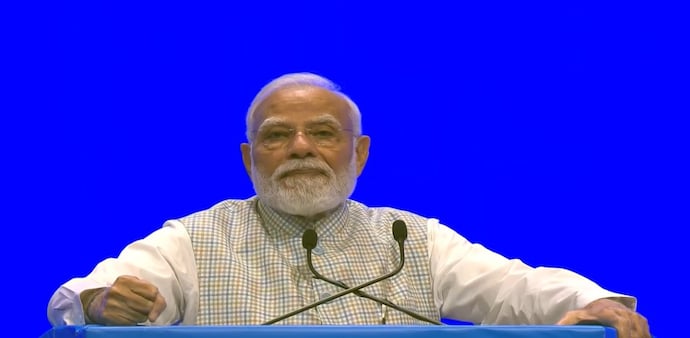
Prime Minister Narendra Modi on Tuesday said that India's economic growth was based on strong economic fundamentals and sustained reforms. While speaking at the Bloomberg Economic Forum, Modi said that India seeks to expand its global economic influence through shared prosperity rather than doing so at the expense of other countries.
While pitching India as a reliable trade partner amid geopolitical tensions, Modi said, "We do not grow at anyone's cost. We grow with the world. And for the world."
To bolster his pitch, the Prime Minister said cited 7.8% economic growth in the April-June quarter and over $700 billion in foreign exchange reserves. He also said that reforms in the areas of taxation, insolvency and labour laws as proof of its resilience.
"In this world full of uncertainties, India inspires reliability and stability," he said. He added, "This year, in the April to June quarter, India's economic growth was 7.8%. And this growth is taking place on a strong foundation."
Modi also mentioned that India's current account deficit went from over 4% 12-13 years back to about half a per cent now. PM Modi said that a country's economic and technological strength should not be measured by the power it commands but by how effectively it creates opportunities for others.
"The real question is not who has the power. The real question is, how is this power being used?" he said, summarising his approach as "power to empower".
He further mentioned how India's digital public infrastructure, startup ecosystem and clean energy capacity are examples of domestic capabilities supporting inclusive growth. The Prime Minister added that India shared its experience in digital identity, payments and public infrastructure with partner countries, especially in the Global South.
"For us, reforms are not a compulsion. Reforms are our conviction," he said.
Citing the example of the CoWIN platform, the Prime Minister said, "During the COVID period, we also developed the CoWIN platform, which was open source. In other words, our constant effort has been to ensure that India's capabilities open new doors of possibility for other countries as well. In other words, our strength should empower humanity."
Narendra Modi also warned that supply chains, energy, minerals, payment systems and technology are becoming means to pressurise and dominate countries at a time of global volatity.
"Supply chains, energy, minerals, payment systems, and technology are increasingly becoming instruments of pressure and dominance. The routes created by globalization over past decades have, in many cases, become chokepoints."
Furthermore, he mentioned that artificial intelligence (AI) is transforming the way industries function. He also added that many countries are facing huge challenges due to ageing populations.
"In such circumstances, the world is confronted with a fundamental question: trust. Trust that supplies will continue during times of need. Trust that promises made will also be fulfilled. Trust that a partner country will stand by you during moments of crisis."
Prime Minister Narendra Modi on Tuesday said that India's economic growth was based on strong economic fundamentals and sustained reforms. While speaking at the Bloomberg Economic Forum, Modi said that India seeks to expand its global economic influence through shared prosperity rather than doing so at the expense of other countries.
While pitching India as a reliable trade partner amid geopolitical tensions, Modi said, "We do not grow at anyone's cost. We grow with the world. And for the world."
To bolster his pitch, the Prime Minister said cited 7.8% economic growth in the April-June quarter and over $700 billion in foreign exchange reserves. He also said that reforms in the areas of taxation, insolvency and labour laws as proof of its resilience.
"In this world full of uncertainties, India inspires reliability and stability," he said. He added, "This year, in the April to June quarter, India's economic growth was 7.8%. And this growth is taking place on a strong foundation."
Modi also mentioned that India's current account deficit went from over 4% 12-13 years back to about half a per cent now. PM Modi said that a country's economic and technological strength should not be measured by the power it commands but by how effectively it creates opportunities for others.
"The real question is not who has the power. The real question is, how is this power being used?" he said, summarising his approach as "power to empower".
He further mentioned how India's digital public infrastructure, startup ecosystem and clean energy capacity are examples of domestic capabilities supporting inclusive growth. The Prime Minister added that India shared its experience in digital identity, payments and public infrastructure with partner countries, especially in the Global South.
"For us, reforms are not a compulsion. Reforms are our conviction," he said.
Citing the example of the CoWIN platform, the Prime Minister said, "During the COVID period, we also developed the CoWIN platform, which was open source. In other words, our constant effort has been to ensure that India's capabilities open new doors of possibility for other countries as well. In other words, our strength should empower humanity."
Narendra Modi also warned that supply chains, energy, minerals, payment systems and technology are becoming means to pressurise and dominate countries at a time of global volatity.
"Supply chains, energy, minerals, payment systems, and technology are increasingly becoming instruments of pressure and dominance. The routes created by globalization over past decades have, in many cases, become chokepoints."
Furthermore, he mentioned that artificial intelligence (AI) is transforming the way industries function. He also added that many countries are facing huge challenges due to ageing populations.
"In such circumstances, the world is confronted with a fundamental question: trust. Trust that supplies will continue during times of need. Trust that promises made will also be fulfilled. Trust that a partner country will stand by you during moments of crisis."