
‘We led India’s IT revolution, others only followed’: Priyank Kharge at BT AI Summit 2025
Karnataka IT Minister Priyank Kharge has asserted that the state continues to lead India’s technology revolution, despite intensifying competition from others. He said Karnataka not only pioneered India’s earliest IT and startup policies but still dominates in exports, innovation, and deep-tech talent — setting benchmarks others only follow.
- Oct 29, 2025,
- Updated Oct 29, 2025 8:39 PM IST
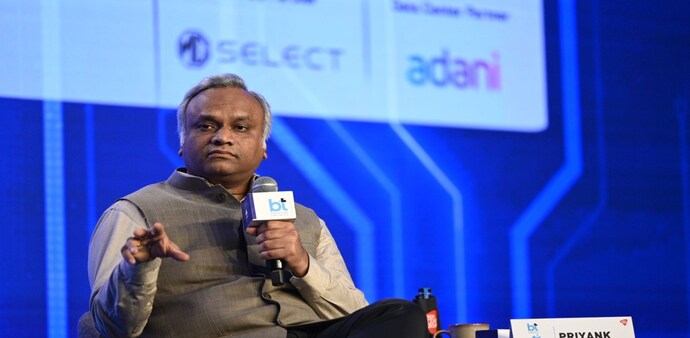
Karnataka continues to dominate India’s technology and innovation landscape despite growing competition from other states, Priyank Kharge, Minister for Information Technology and Biotechnology (IT & BT), said on Wednesday. He asserted that while several states have tried to emulate Karnataka’s policies, none have matched its depth, reach, or impact.
Speaking to Siddharth Zarabi, Group Editor of Business Today, Kharge said, “We love competition and we thrive on it. Many states have been competing with us for decades, but data speaks for itself.” Karnataka, he noted, recorded IT exports exceeding ₹4.5 lakh crore, while the next closest—Telangana—stood at around ₹2.2 lakh crore.
Highlighting Karnataka’s consistent leadership in India’s innovation economy, the minister said, “Of about 110 unicorns in the country, more than 47 are based in my state. Over half of India’s deep-tech startups are leveraging technology from Karnataka. Around 40% of the country’s engineering and R&D talent is from Karnataka, and 38% of semiconductor design comes from here. We are ranked fifth globally among AI cities and eighth in the global startup ecosystem. In aerospace and defence manufacturing, we contribute 65%.”
Kharge pointed out that Karnataka has historically been the first mover in policy innovation, laying the groundwork for India’s tech revolution. “When Karnataka first introduced its IT policy, people mocked it, asking, ‘aisi policy se hoga kya?’,” he recalled. “But we led the way—India’s first IT policy, biotech policy, startup policy, EV policy, ESDM policy, R&D policy, and even the draft spacetech policy came from Karnataka. Others followed our lead.”
Commenting on the ongoing competition among states to attract investors, Kharge said it ultimately benefits India’s economy. “Now we have Invest Maharashtra, Invest Andhra, Invest Chhattisgarh, even Invest Northeast—and that’s good for investors. They love window shopping,” he said, with a laugh. “Every investor I meet tells me they just came from Telangana or Maharashtra, listing all the incentives offered. But there’s one thing no one can replicate—our ecosystem. From being a pensioners’ paradise, Bengaluru has become one of the world’s most disruptive cities.”
The comments come after a political spat between Karnataka and Andhra Pradesh over a proposed $15 billion Google AI data centre in Visakhapatnam. Karnataka’s Congress government claims the project was originally planned for Bengaluru but was diverted to Andhra after “extravagant incentives”—including 15 years of free power, discounted water, 480 acres of land at throwaway prices, and full SGST reimbursement—were offered.
Andhra’s ruling TDP coalition and opposition YSR Congress Party, meanwhile, have traded credit for the investment, with each claiming their policies attracted Google. Andhra’s leaders dismissed Karnataka’s criticism, saying their neighbour’s “jealousy stems from its own stagnation.”
Despite the political rivalry, Kharge maintained that Karnataka’s long-term strength lies in its ecosystem, talent, and innovation-driven policy framework. “Others may compete on subsidies, but we compete on capability,” he said.
Karnataka continues to dominate India’s technology and innovation landscape despite growing competition from other states, Priyank Kharge, Minister for Information Technology and Biotechnology (IT & BT), said on Wednesday. He asserted that while several states have tried to emulate Karnataka’s policies, none have matched its depth, reach, or impact.
Speaking to Siddharth Zarabi, Group Editor of Business Today, Kharge said, “We love competition and we thrive on it. Many states have been competing with us for decades, but data speaks for itself.” Karnataka, he noted, recorded IT exports exceeding ₹4.5 lakh crore, while the next closest—Telangana—stood at around ₹2.2 lakh crore.
Highlighting Karnataka’s consistent leadership in India’s innovation economy, the minister said, “Of about 110 unicorns in the country, more than 47 are based in my state. Over half of India’s deep-tech startups are leveraging technology from Karnataka. Around 40% of the country’s engineering and R&D talent is from Karnataka, and 38% of semiconductor design comes from here. We are ranked fifth globally among AI cities and eighth in the global startup ecosystem. In aerospace and defence manufacturing, we contribute 65%.”
Kharge pointed out that Karnataka has historically been the first mover in policy innovation, laying the groundwork for India’s tech revolution. “When Karnataka first introduced its IT policy, people mocked it, asking, ‘aisi policy se hoga kya?’,” he recalled. “But we led the way—India’s first IT policy, biotech policy, startup policy, EV policy, ESDM policy, R&D policy, and even the draft spacetech policy came from Karnataka. Others followed our lead.”
Commenting on the ongoing competition among states to attract investors, Kharge said it ultimately benefits India’s economy. “Now we have Invest Maharashtra, Invest Andhra, Invest Chhattisgarh, even Invest Northeast—and that’s good for investors. They love window shopping,” he said, with a laugh. “Every investor I meet tells me they just came from Telangana or Maharashtra, listing all the incentives offered. But there’s one thing no one can replicate—our ecosystem. From being a pensioners’ paradise, Bengaluru has become one of the world’s most disruptive cities.”
The comments come after a political spat between Karnataka and Andhra Pradesh over a proposed $15 billion Google AI data centre in Visakhapatnam. Karnataka’s Congress government claims the project was originally planned for Bengaluru but was diverted to Andhra after “extravagant incentives”—including 15 years of free power, discounted water, 480 acres of land at throwaway prices, and full SGST reimbursement—were offered.
Andhra’s ruling TDP coalition and opposition YSR Congress Party, meanwhile, have traded credit for the investment, with each claiming their policies attracted Google. Andhra’s leaders dismissed Karnataka’s criticism, saying their neighbour’s “jealousy stems from its own stagnation.”
Despite the political rivalry, Kharge maintained that Karnataka’s long-term strength lies in its ecosystem, talent, and innovation-driven policy framework. “Others may compete on subsidies, but we compete on capability,” he said.