
What is China's Gaokao exam and why is it bigger than JEE and NEET combined?
The Gaokao is often compared to India's JEE and NEET, but on a much larger scale.
- Jun 10, 2026,
- Updated Jun 10, 2026 9:53 PM IST
Amid troubles in the conduct of India's NEET examination, the Chinese Embassy in India has spotlighted China's national college entrance test, the Gaokao, describing it as the world's largest examination and India's equivalent of JEE and NEET rolled into one.
Sharing a video on Wednesday, Yu Jing, spokesperson of the Chinese Embassy in India, wrote on X: "China's Gaokao — the world's largest exam & India's equivalent of JEE/NEET rolled into one — was conducted smoothly for 1.3 crore students in just 2 days 🎓 Factories paused. Roads quieted. The entire nation rallied for its students."
The post has drawn attention to the scale and significance of the examination, which plays a central role in China's higher education system.
In case you missed it: 'Worse than JEE?': The brutal truth about surviving China’s Gaokao exams
What is the Gaokao?
The Gaokao is China's national college entrance examination and the primary gateway to universities across the country.
The exam is so consequential that scores largely determine which universities students can attend.
Provincial governments receive admission quotas and set cutoff scores accordingly.
For millions of Chinese students, the exam represents the culmination of 12 years of schooling and preparation marked by hundreds, and often thousands, of practice tests.
The Gaokao is also the main route into China's most prestigious universities, including Peking University and Tsinghua University.
For many students, particularly those from less affluent backgrounds, a strong score can influence university admission, career opportunities, social mobility and future income.
Why is it bigger than JEE and NEET combined?
The Gaokao is often compared to India's JEE and NEET, but on a much larger scale.
Around 13 million students appeared for the Gaokao in 2026. By comparison, NEET-UG attracts around 2.3 million candidates annually, while JEE Main sees roughly 1.5 million registrations.
In 2026, 2.2 million candidates appeared for NEET-UG.
Even combined, the number of candidates taking India's two biggest entrance exams remains significantly lower than the Gaokao.
Unlike JEE and NEET, which are focused on engineering and medical admissions respectively, the Gaokao is the principal admission route for a vast range of undergraduate programmes.
The Gaokao exam is used for entry into engineering, medicine, law, economics, humanities, sciences, teaching and most university courses across China.
In India, students pursuing courses such as BA, BCom, or several other undergraduate degrees generally do not need to take JEE or NEET. In China, most university aspirants must pass through the Gaokao system.
The impact of a student's Gaokao score extends far beyond admission.
A single score can determine which universities a student can apply to, which majors they can pursue and whether they gain entry into elite institutions.
How does China support students during Gaokao?
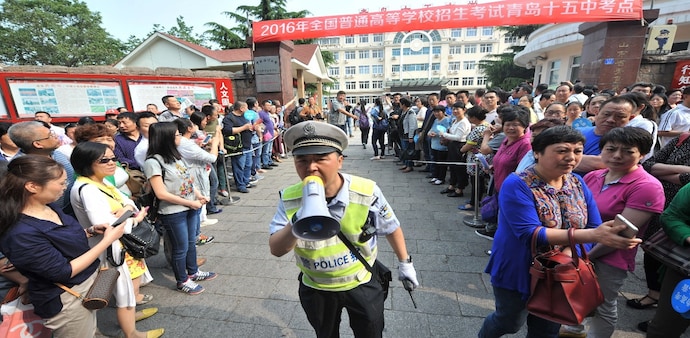
The examination period often sees extraordinary logistical arrangements across China.
According to a 2025 report by China Daily, local authorities were instructed to provide comprehensive support covering public security, transportation, accommodation, meals, healthcare and noise control.
Several cities postponed performances and entertainment events during the exam period. The Anhui Huangmei Opera Theatre suspended performances, while a concert by Hong Kong singer Jacky Cheung in Dongguan was postponed.
Local governments also sought to reduce noise disruptions. Authorities in Keshan county called on residents to avoid recreational activities that generated noise, while cities including Shanghai, Guangzhou, Nanjing and Hangzhou suspended nighttime construction work during the exam period.
For China, the Gaokao is more than an entrance test. It is a nationwide event that mobilises families, schools, local governments and communities.
Amid troubles in the conduct of India's NEET examination, the Chinese Embassy in India has spotlighted China's national college entrance test, the Gaokao, describing it as the world's largest examination and India's equivalent of JEE and NEET rolled into one.
Sharing a video on Wednesday, Yu Jing, spokesperson of the Chinese Embassy in India, wrote on X: "China's Gaokao — the world's largest exam & India's equivalent of JEE/NEET rolled into one — was conducted smoothly for 1.3 crore students in just 2 days 🎓 Factories paused. Roads quieted. The entire nation rallied for its students."
The post has drawn attention to the scale and significance of the examination, which plays a central role in China's higher education system.
In case you missed it: 'Worse than JEE?': The brutal truth about surviving China’s Gaokao exams
What is the Gaokao?
The Gaokao is China's national college entrance examination and the primary gateway to universities across the country.
The exam is so consequential that scores largely determine which universities students can attend.
Provincial governments receive admission quotas and set cutoff scores accordingly.
For millions of Chinese students, the exam represents the culmination of 12 years of schooling and preparation marked by hundreds, and often thousands, of practice tests.
The Gaokao is also the main route into China's most prestigious universities, including Peking University and Tsinghua University.
For many students, particularly those from less affluent backgrounds, a strong score can influence university admission, career opportunities, social mobility and future income.
Why is it bigger than JEE and NEET combined?
The Gaokao is often compared to India's JEE and NEET, but on a much larger scale.
Around 13 million students appeared for the Gaokao in 2026. By comparison, NEET-UG attracts around 2.3 million candidates annually, while JEE Main sees roughly 1.5 million registrations.
In 2026, 2.2 million candidates appeared for NEET-UG.
Even combined, the number of candidates taking India's two biggest entrance exams remains significantly lower than the Gaokao.
Unlike JEE and NEET, which are focused on engineering and medical admissions respectively, the Gaokao is the principal admission route for a vast range of undergraduate programmes.
The Gaokao exam is used for entry into engineering, medicine, law, economics, humanities, sciences, teaching and most university courses across China.
In India, students pursuing courses such as BA, BCom, or several other undergraduate degrees generally do not need to take JEE or NEET. In China, most university aspirants must pass through the Gaokao system.
The impact of a student's Gaokao score extends far beyond admission.
A single score can determine which universities a student can apply to, which majors they can pursue and whether they gain entry into elite institutions.
How does China support students during Gaokao?
The examination period often sees extraordinary logistical arrangements across China.
According to a 2025 report by China Daily, local authorities were instructed to provide comprehensive support covering public security, transportation, accommodation, meals, healthcare and noise control.
Several cities postponed performances and entertainment events during the exam period. The Anhui Huangmei Opera Theatre suspended performances, while a concert by Hong Kong singer Jacky Cheung in Dongguan was postponed.
Local governments also sought to reduce noise disruptions. Authorities in Keshan county called on residents to avoid recreational activities that generated noise, while cities including Shanghai, Guangzhou, Nanjing and Hangzhou suspended nighttime construction work during the exam period.
For China, the Gaokao is more than an entrance test. It is a nationwide event that mobilises families, schools, local governments and communities.