
Why can't you choose between pure petrol, E10, E20? Here's what every vehicle owner should know
Here's everything you need to know — before your next trip to the pump.
- Jul 10, 2026,
- Updated Jul 10, 2026 11:19 AM IST
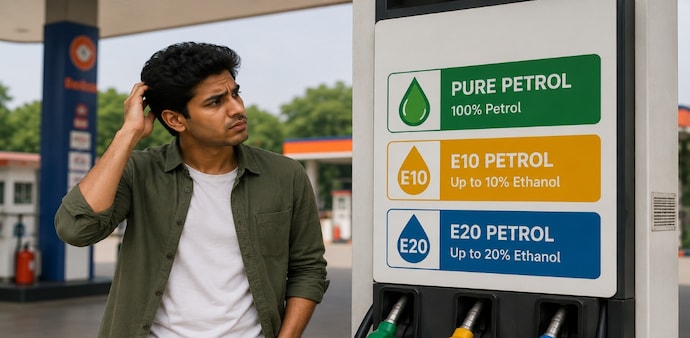
The next time you pull into a petrol station, you might notice something new on the pump — E10 and E20, sitting right next to the regular fuel you've always used. But what exactly are they? And more importantly, should you be using them in your car?
India is quietly in the middle of a massive fuel transition, and most vehicle owners have no idea what it means for their engine, their mileage, or their wallet. Whether you drive a brand-new car or a trusty old two-wheeler, the fuel you pick today could matter more than you think.
Here's everything you need to know — before your next trip to the pump.
Why is the consumer not the king in this scenario?
According to the Ministry of Petroleum and Natural Gas, the fuel policy can't be based solely on the consumers' choice. While consumers are an important stakeholder, public policy must also account for energy security, environmental sustainability, farmer welfare and efficient use of national resources.
Why the discussion over providing the choice to consumers?
The Opposition has also taken aim at the Centre for rolling out E20 petrol even though nearly 30 crore vehicles on Indian roads are not built to run on the higher ethanol blend. Critics of the government's ethanol-blending push have urged the Centre to ensure E10 petrol is available at fuel stations, saying vehicles sold before April 2023 should be able to use the fuel grade listed in their owner's manuals.
How much has India invested in building an ethanol ecosystem so far?
Public sector banks have financed nearly ₹1 lakh crore annually in ethanol production and related infrastructure. Thus, going back to lower ethanol blends would render these investments useless and undermine a national policy aimed at cutting crude oil imports, cutting emissions and supporting farmers.
Will your car's mileage be affected?
The mileage of your car will be impacted marginally, and that too, in some cases, according to the government. Some vehicles are likely to see a 3-5% reduction in fuel economy with E20 petrol. It, however, argues that mileage is only one aspect of performance.
Why can't petrol pumps stock pure petrol, E10 and E20 simultaneously?
As per the Petroleum Ministry, maintaining all three grades nationwide is logistically impractical and expensive. It said that India operates more than 1 lakh retail outlets, supported by refineries, terminals, depots and pipelines.
“Maintaining multiple grades of base petrol across this vast supply chain would create an enormous logistical challenge, increase handling costs, complicate inventory management and reduce operational efficiency,” it added.
Why is the government pressing for E20?
The government claims that E20 offers higher octane, better anti-knock properties, faster combustion, smoother acceleration, improved engine operation and significantly lower emissions. Citing field data from Maruti Suzuki and Hero MotoCorp, it said that no E20-related corrosion or abnormal engine wear has been reported in real-world use, including in older vehicles.
The next time you pull into a petrol station, you might notice something new on the pump — E10 and E20, sitting right next to the regular fuel you've always used. But what exactly are they? And more importantly, should you be using them in your car?
India is quietly in the middle of a massive fuel transition, and most vehicle owners have no idea what it means for their engine, their mileage, or their wallet. Whether you drive a brand-new car or a trusty old two-wheeler, the fuel you pick today could matter more than you think.
Here's everything you need to know — before your next trip to the pump.
Why is the consumer not the king in this scenario?
According to the Ministry of Petroleum and Natural Gas, the fuel policy can't be based solely on the consumers' choice. While consumers are an important stakeholder, public policy must also account for energy security, environmental sustainability, farmer welfare and efficient use of national resources.
Why the discussion over providing the choice to consumers?
The Opposition has also taken aim at the Centre for rolling out E20 petrol even though nearly 30 crore vehicles on Indian roads are not built to run on the higher ethanol blend. Critics of the government's ethanol-blending push have urged the Centre to ensure E10 petrol is available at fuel stations, saying vehicles sold before April 2023 should be able to use the fuel grade listed in their owner's manuals.
How much has India invested in building an ethanol ecosystem so far?
Public sector banks have financed nearly ₹1 lakh crore annually in ethanol production and related infrastructure. Thus, going back to lower ethanol blends would render these investments useless and undermine a national policy aimed at cutting crude oil imports, cutting emissions and supporting farmers.
Will your car's mileage be affected?
The mileage of your car will be impacted marginally, and that too, in some cases, according to the government. Some vehicles are likely to see a 3-5% reduction in fuel economy with E20 petrol. It, however, argues that mileage is only one aspect of performance.
Why can't petrol pumps stock pure petrol, E10 and E20 simultaneously?
As per the Petroleum Ministry, maintaining all three grades nationwide is logistically impractical and expensive. It said that India operates more than 1 lakh retail outlets, supported by refineries, terminals, depots and pipelines.
“Maintaining multiple grades of base petrol across this vast supply chain would create an enormous logistical challenge, increase handling costs, complicate inventory management and reduce operational efficiency,” it added.
Why is the government pressing for E20?
The government claims that E20 offers higher octane, better anti-knock properties, faster combustion, smoother acceleration, improved engine operation and significantly lower emissions. Citing field data from Maruti Suzuki and Hero MotoCorp, it said that no E20-related corrosion or abnormal engine wear has been reported in real-world use, including in older vehicles.