
‘Will study the implications’: Govt on Pakistan-Saudi Arabia mutual defence pact
The response comes after Pakistan and Saudi Arabia signed the 'Strategic Mutual Defence Agreement' during Shehbaz Sharif’s state visit to Riyadh.
- Sep 18, 2025,
- Updated Sep 18, 2025 10:55 AM IST
The government was aware of Pakistan and Saudi Arabia signing a defence pact under which aggression against either of the countries would be treated as an act of aggression against both. The Ministry of External Affairs said it would study the implications of the development.
MEA official spokesperson Randhir Jaiswal said, "We have seen reports of the signing of a strategic mutual defence pact between Saudi Arabia and Pakistan. The government was aware that this development, which formalises a long-standing arrangement between the two countries, had been under consideration. We will study the implications of this development for our national security as well as for regional and global stability. The government remains committed to protecting India's national interests and ensuring comprehensive national security in all domains."
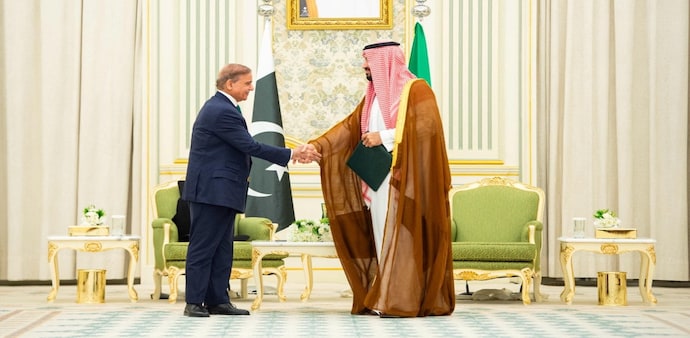
The response comes after Pakistan and Saudi Arabia signed the 'Strategic Mutual Defence Agreement' during Shehbaz Sharif’s state visit to Riyadh. Sharif was received by Crown Prince and Prime Minister Mohammed bin Salman at Al-Yamamah Palace.
“Building on a partnership extending nearly eight decades, and grounded in bonds of brotherhood, Islamic solidarity and shared strategic interests, the two sides signed the Strategic Mutual Defence Agreement,” said the countries in a joint statement.
The pact was signed to enhance bilateral security ties and contribute to regional and global peace, said the statement.
Sharif was accompanied by Foreign Minister Ishaq Dar, Defence Minister Khawaja Asif, Finance Minister Muhammad Aurangzeb, Information Minister Attaullah Tarar, Environment Minister Musadik Malik, and Special Assistant Tariq Fatemi. The Pakistan Foreign Office, ahead of Sharif’s departure, said that both the countries shared a historic relationship based on common faith, values, and mutual trust.
The pact comes on the heels of a summit in Doha that saw the participation of 40 Islamic nations, including Pakistan, where leaders pushed for a NATO-like alliance after Israel’s attack on Qatar, targeting Hamas leaders last week.
The signing of the pact assumes greater significance on the backdrop of the Pahalgam attack, and the subsequent Operation Sindoor with which India targeted terrorist headquarters.
The government was aware of Pakistan and Saudi Arabia signing a defence pact under which aggression against either of the countries would be treated as an act of aggression against both. The Ministry of External Affairs said it would study the implications of the development.
MEA official spokesperson Randhir Jaiswal said, "We have seen reports of the signing of a strategic mutual defence pact between Saudi Arabia and Pakistan. The government was aware that this development, which formalises a long-standing arrangement between the two countries, had been under consideration. We will study the implications of this development for our national security as well as for regional and global stability. The government remains committed to protecting India's national interests and ensuring comprehensive national security in all domains."
The response comes after Pakistan and Saudi Arabia signed the 'Strategic Mutual Defence Agreement' during Shehbaz Sharif’s state visit to Riyadh. Sharif was received by Crown Prince and Prime Minister Mohammed bin Salman at Al-Yamamah Palace.
“Building on a partnership extending nearly eight decades, and grounded in bonds of brotherhood, Islamic solidarity and shared strategic interests, the two sides signed the Strategic Mutual Defence Agreement,” said the countries in a joint statement.
The pact was signed to enhance bilateral security ties and contribute to regional and global peace, said the statement.
Sharif was accompanied by Foreign Minister Ishaq Dar, Defence Minister Khawaja Asif, Finance Minister Muhammad Aurangzeb, Information Minister Attaullah Tarar, Environment Minister Musadik Malik, and Special Assistant Tariq Fatemi. The Pakistan Foreign Office, ahead of Sharif’s departure, said that both the countries shared a historic relationship based on common faith, values, and mutual trust.
The pact comes on the heels of a summit in Doha that saw the participation of 40 Islamic nations, including Pakistan, where leaders pushed for a NATO-like alliance after Israel’s attack on Qatar, targeting Hamas leaders last week.
The signing of the pact assumes greater significance on the backdrop of the Pahalgam attack, and the subsequent Operation Sindoor with which India targeted terrorist headquarters.