
'Won't allow disruptive forces': Will Jammu & Kashmir see elections soon? Here's what CEC said
Addressing a press conference, he emphasized that no internal or external forces would be allowed to derail the electoral process.
- Aug 9, 2024,
- Updated Aug 9, 2024 6:01 PM IST
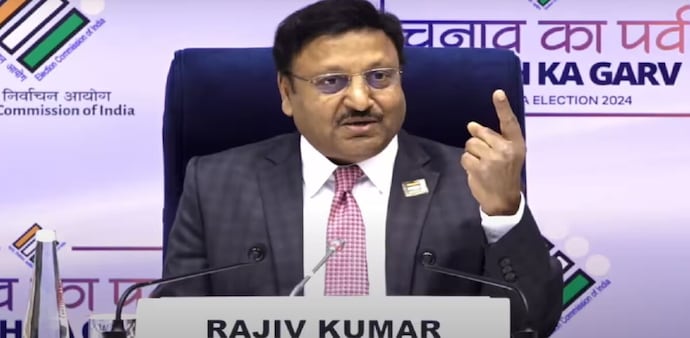
India's Chief Election Commissioner (CEC) Rajiv Kumar reaffirmed on Friday the Election Commission's commitment to conducting assembly elections in the Union Territory of Jammu and Kashmir "at the earliest."
Addressing a press conference, he emphasized that no internal or external forces would be allowed to derail the electoral process.
"We are determined to hold elections in Jammu and Kashmir as soon as possible, and we will not let any internal or external factors interfere with this process," Kumar stated at a press conference in Jammu, as quoted by PTI. He also noted that all political parties in the region are strongly advocating for timely assembly elections.
The Election Commission's three-member panel is currently in Jammu and Kashmir to assess the readiness of the administration and security agencies for the upcoming elections. On the second day of their visit, the delegation engaged in discussions with Jammu and Kashmir's Chief Secretary Atal Dulloo and Director General of Police R.R. Swain.
The panel's visit occurs amid an uptick in terror-related incidents in the Union Territory. Despite this, Jammu and Kashmir Lieutenant Governor Manoj Sinha dismissed concerns that these threats would pose a challenge to holding peaceful elections. In an interview with Hindustan Times, Sinha expressed confidence in the region's preparedness.
"The Election Commission team is visiting on August 8 and 9. Once they make their decision, the Jammu and Kashmir administration is fully prepared to conduct the elections," Sinha stated.
Jammu and Kashmir last held assembly elections in 2014. The assembly was dissolved in 2018, with elections initially scheduled for 2019. However, the electoral process was delayed following the Narendra Modi government's decision in 2019 to abrogate Article 370 and bifurcate the state into two Union Territories: Jammu and Kashmir, and Ladakh.
Subsequent challenges, including a delimitation exercise completed in 2022, have further postponed the elections. Despite these hurdles, the Election Commission is now signaling a renewed focus on bringing the democratic process back to the region as soon as conditions allow.
India's Chief Election Commissioner (CEC) Rajiv Kumar reaffirmed on Friday the Election Commission's commitment to conducting assembly elections in the Union Territory of Jammu and Kashmir "at the earliest."
Addressing a press conference, he emphasized that no internal or external forces would be allowed to derail the electoral process.
"We are determined to hold elections in Jammu and Kashmir as soon as possible, and we will not let any internal or external factors interfere with this process," Kumar stated at a press conference in Jammu, as quoted by PTI. He also noted that all political parties in the region are strongly advocating for timely assembly elections.
The Election Commission's three-member panel is currently in Jammu and Kashmir to assess the readiness of the administration and security agencies for the upcoming elections. On the second day of their visit, the delegation engaged in discussions with Jammu and Kashmir's Chief Secretary Atal Dulloo and Director General of Police R.R. Swain.
The panel's visit occurs amid an uptick in terror-related incidents in the Union Territory. Despite this, Jammu and Kashmir Lieutenant Governor Manoj Sinha dismissed concerns that these threats would pose a challenge to holding peaceful elections. In an interview with Hindustan Times, Sinha expressed confidence in the region's preparedness.
"The Election Commission team is visiting on August 8 and 9. Once they make their decision, the Jammu and Kashmir administration is fully prepared to conduct the elections," Sinha stated.
Jammu and Kashmir last held assembly elections in 2014. The assembly was dissolved in 2018, with elections initially scheduled for 2019. However, the electoral process was delayed following the Narendra Modi government's decision in 2019 to abrogate Article 370 and bifurcate the state into two Union Territories: Jammu and Kashmir, and Ladakh.
Subsequent challenges, including a delimitation exercise completed in 2022, have further postponed the elections. Despite these hurdles, the Election Commission is now signaling a renewed focus on bringing the democratic process back to the region as soon as conditions allow.