
Fresh export challenge for MSMEs: EU plans to expand carbon tax to 180 more steel, aluminium products
The EU plans to expand its Carbon Border Adjustment Mechanism (CBAM) to 180 additional steel and aluminium-based products from 2028. Indian MSMEs to be impacted by reliance on coal power.
- Apr 20, 2026,
- Updated Apr 20, 2026 5:40 PM IST
About one-third of the Indian steel exports in downstream products are dominated by micro, small, and medium enterprises (MSMEs) players, and they will be the worst impacted under the European Union’s plans to expand its Carbon Border Adjustment Mechanism to products by 2028.
The EU has planned to bring 180 additional steel and aluminium-based products from 2028 under the CBAM, thus pushing carbon taxes deep into manufacturing supply chains.
"It is a very serious challenge, especially for the MSMEs, for their reliance on gross power which is largely produced through coal-based thermal plants," says Anil Bhardwaj, Secretary General, Federation of Indian Micro and Small & Medium Enterprises (FISME).
He says that the federation will take it up with the government to provide green power to the MSMEs as they depend on the grid, unlike big companies, which have captive power plants.
Any analysis of the impact of draft role on India by TULIP Consulting, a Geneva-based trade consulting firm, shows that MSMEs will come under the CBAM ambit with downstream products.
"Flat steel products constitute 44% of India's exports but are produced by integrated steel producers. One third of downstream products, steel products, are made by MSMEs," said Colette van der Ven, founder of TULIP Consulting.
At present, CBAM applies to imports of iron and steel, aluminium, cement, fertilisers, hydrogen, electricity, and selected steel/aluminium products.
It now touches engineering goods, auto components, machinery, and fabricated metals—core pillars of India’s exports to Europe. Scrap-based producers lose edge as India’s recycled steel and aluminium sectors—once considered low-carbon—may now face higher costs as the EU tightens emission accounting.
According to the Global Trade Research Initiative (GTRI), most Indian engineering goods, auto parts, machinery, and fabricated metal exports to the EU will be affected.
Even India’s scrap-based steel and recycled aluminium producers may lose their current carbon-cost advantage under stricter EU rules.
The proposed rules also reject the use of international carbon credits for CBAM compliance and are examining the expansion of CBAM to indirect emissions from electricity use across more sectors.
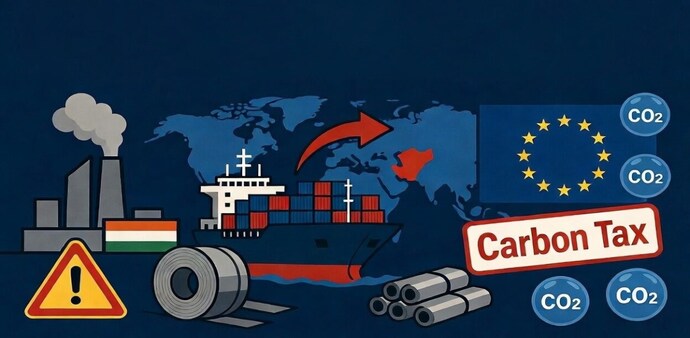
CBAM is the EU’s border carbon tax that charges importers for emissions embedded in goods produced outside Europe. It effectively places a carbon price on foreign manufacturers selling into the EU. The mechanism acts as a climate-linked trade barrier on carbon-intensive imports.
Further, the EU is examining whether to extend CBAM to indirect emissions—that is, emissions generated from the electricity consumed during production rather than from on-site fuel combustion. This may be applicable from the end of 2027.
About one-third of the Indian steel exports in downstream products are dominated by micro, small, and medium enterprises (MSMEs) players, and they will be the worst impacted under the European Union’s plans to expand its Carbon Border Adjustment Mechanism to products by 2028.
The EU has planned to bring 180 additional steel and aluminium-based products from 2028 under the CBAM, thus pushing carbon taxes deep into manufacturing supply chains.
"It is a very serious challenge, especially for the MSMEs, for their reliance on gross power which is largely produced through coal-based thermal plants," says Anil Bhardwaj, Secretary General, Federation of Indian Micro and Small & Medium Enterprises (FISME).
He says that the federation will take it up with the government to provide green power to the MSMEs as they depend on the grid, unlike big companies, which have captive power plants.
Any analysis of the impact of draft role on India by TULIP Consulting, a Geneva-based trade consulting firm, shows that MSMEs will come under the CBAM ambit with downstream products.
"Flat steel products constitute 44% of India's exports but are produced by integrated steel producers. One third of downstream products, steel products, are made by MSMEs," said Colette van der Ven, founder of TULIP Consulting.
At present, CBAM applies to imports of iron and steel, aluminium, cement, fertilisers, hydrogen, electricity, and selected steel/aluminium products.
It now touches engineering goods, auto components, machinery, and fabricated metals—core pillars of India’s exports to Europe. Scrap-based producers lose edge as India’s recycled steel and aluminium sectors—once considered low-carbon—may now face higher costs as the EU tightens emission accounting.
According to the Global Trade Research Initiative (GTRI), most Indian engineering goods, auto parts, machinery, and fabricated metal exports to the EU will be affected.
Even India’s scrap-based steel and recycled aluminium producers may lose their current carbon-cost advantage under stricter EU rules.
The proposed rules also reject the use of international carbon credits for CBAM compliance and are examining the expansion of CBAM to indirect emissions from electricity use across more sectors.
CBAM is the EU’s border carbon tax that charges importers for emissions embedded in goods produced outside Europe. It effectively places a carbon price on foreign manufacturers selling into the EU. The mechanism acts as a climate-linked trade barrier on carbon-intensive imports.
Further, the EU is examining whether to extend CBAM to indirect emissions—that is, emissions generated from the electricity consumed during production rather than from on-site fuel combustion. This may be applicable from the end of 2027.