
India’s installed power capacity to quadruple by 2047; grid connectivity the biggest challenge
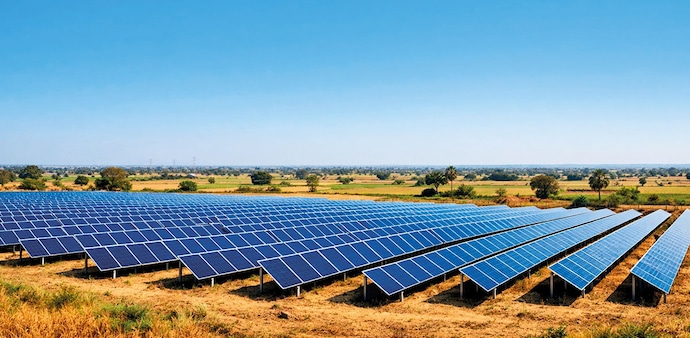
Solar alone will be the biggest driver, expected to leap from 119 GW to over 1,100 GW. Still, India needs to build a grid and market architecture that can integrate renewables, storage, and new technologies at scale
- Sep 1, 2026,
- Updated Sep 1, 2026 6:12 PM IST
India’s installed electricity capacity is projected to soar beyond 2,000 GW by 2047, nearly four times today’s levels, driven by a dramatic expansion in clean energy, says an energy outlook report.
The report ‘India’s Power & Energy Transformation Outlook’ released today reveals that solar power alone is expected to leap from 119 GW to over 1,100 GW, underscoring the scale of infrastructure, innovation, and policy support required for the nation’s Viksit Bharat vision.
READ THIS: Solar may remain king, but India’s next renewable boom could be in batteries and transmission
The report by the Energy & Climate Initiatives Society (ENCIS), a non-for-profit organisation, details how non-fossil sources have already reached 53% of India’s 540 GW installed capacity, five years ahead of target, while peak electricity demand has nearly tripled since 2000 and is forecast to reach 366 GW by 2032, a 34% jump, driven by new loads from data centres, e-mobility, and green hydrogen.
“India is experiencing phenomenal growth in the power sector, with record annual capacity additions and a rapid shift toward clean energy. But it’s not just about adding megawatts; our real challenge now is to build a grid and market architecture that can integrate renewables, storage, and new technologies at scale, ensuring reliability, flexibility, and affordability for a future-ready economy,” said Ghanshyam Prasad, Chairperson, Central Electricity Authority (CEA).
The report further highlights that India must nearly triple its renewable energy deployment by 2030, reaching 500 GW of non-fossil capacity while maintaining system reliability. Grid-scale storage will need to increase fortyfold to 200 GWh by 2030, marking the most significant infrastructure leap in the sector’s history.
ALSO READ: $935 billion opportunity: Why recycling solar old panels is the next big market
The report notes that nationwide smart meter deployment is on track to reach 250 million units by FY2028, enabling real-time management of 90% of consumer demand and pushing average Aggregate Technical and Commercial (AT&C) losses below 10% nationally for the first time. Although digital reforms have already reduced AT&C losses to 15%, the distribution segment remains a critical bottleneck, with 44 GW of renewables stuck in contract or financing limbo.
Coal will continue to provide grid stability, with plants needing to operate at 40% minimum technical load and 3% ramp rates by 2030. Overall, India’s power sector investment requirement is pegged at $0.5 trillion by 2030, and more than one million new skilled workers will be needed to deliver the digital and clean energy transformation.
India’s installed electricity capacity is projected to soar beyond 2,000 GW by 2047, nearly four times today’s levels, driven by a dramatic expansion in clean energy, says an energy outlook report.
The report ‘India’s Power & Energy Transformation Outlook’ released today reveals that solar power alone is expected to leap from 119 GW to over 1,100 GW, underscoring the scale of infrastructure, innovation, and policy support required for the nation’s Viksit Bharat vision.
READ THIS: Solar may remain king, but India’s next renewable boom could be in batteries and transmission
The report by the Energy & Climate Initiatives Society (ENCIS), a non-for-profit organisation, details how non-fossil sources have already reached 53% of India’s 540 GW installed capacity, five years ahead of target, while peak electricity demand has nearly tripled since 2000 and is forecast to reach 366 GW by 2032, a 34% jump, driven by new loads from data centres, e-mobility, and green hydrogen.
“India is experiencing phenomenal growth in the power sector, with record annual capacity additions and a rapid shift toward clean energy. But it’s not just about adding megawatts; our real challenge now is to build a grid and market architecture that can integrate renewables, storage, and new technologies at scale, ensuring reliability, flexibility, and affordability for a future-ready economy,” said Ghanshyam Prasad, Chairperson, Central Electricity Authority (CEA).
The report further highlights that India must nearly triple its renewable energy deployment by 2030, reaching 500 GW of non-fossil capacity while maintaining system reliability. Grid-scale storage will need to increase fortyfold to 200 GWh by 2030, marking the most significant infrastructure leap in the sector’s history.
ALSO READ: $935 billion opportunity: Why recycling solar old panels is the next big market
The report notes that nationwide smart meter deployment is on track to reach 250 million units by FY2028, enabling real-time management of 90% of consumer demand and pushing average Aggregate Technical and Commercial (AT&C) losses below 10% nationally for the first time. Although digital reforms have already reduced AT&C losses to 15%, the distribution segment remains a critical bottleneck, with 44 GW of renewables stuck in contract or financing limbo.
Coal will continue to provide grid stability, with plants needing to operate at 40% minimum technical load and 3% ramp rates by 2030. Overall, India’s power sector investment requirement is pegged at $0.5 trillion by 2030, and more than one million new skilled workers will be needed to deliver the digital and clean energy transformation.