
A late entrant in India’s quick-commerce space, here’s how Amazon is scaling up fast
Amazon India is increasing direct sourcing from farmers and is rapidly adding new collection and fulfilment centres as it looks to expand its quick commerce service Amazon Now to 100 cities this year.
- May 30, 2026,
- Updated May 31, 2026 3:56 PM IST
It’s mid-day. The sun is blazing. Still, several farmers have queued up here at a collection centre set up by Amazon in Manchar, near Pune, bringing in different types of vegetables. The produce will be weighed sorted and within hours moved to local processing centre in nearby Chakan and then to the micro-fulfilment centres in and around Pune and beyond, from where it will reach your doorstep. Amazon may have a formidable presence in the e-commerce market, it has been a late entrant in the highly competitive quick commerce market, dominated by the likes of Zepto, Blinkit and Swiggy Instamart. As it plays catch up, Amazon is rapidly scaling up its quick commerce platform Amazon Now and it’s this network of collection centres and fulfilment centres that will be key to its growth. “Even if you take Pune as an example, in January or February, we didn’t have a single store (dark stores or micro-fulfilment centres as Amazon calls them). Today in May we are already touching 40,” Karan Chugh, Director of operations at Amazon India, tells Business Today. On a national level, the company currently has 360 micro-fulfilment centres (MFCs), with plans to have close to 1,000 by the end of the year. Roughly it is opening two new MFCs per day, Chugh says.
Amazon's reach Similarly, Amazon is also scaling up its collection centres as it looks to increase its sourcing of fresh produce directly from farmers. Just in Maharashtra, its collection centres will more than double from the current 10 this year, according to Srikant Sree Ram, Director Amazon Fresh at Amazon India. “We now have a facility in Pollachi in Tamil Nadu, to source coconuts. Similarly, we have opened a facility in Solan, Himachal Pradesh, Paota in Rajasthan, in Haryana and we also recently opened in Madhya Pradesh and Bihar,” said Sree Ram. Prices at which Amazon buys this produce from farmers are typically linked to local markets or APMCs (agricultural produce marketing committees) and the farmers typically receive their payments in their bank accounts within hours. All the backend expansion Amazon now is doing is a crucial step as a part of the company’s stated intent to scale Amazon Now to 100 cities by the end of this year. Last year, Amazon had announced an investment of Rs 2,000 crore in infrastructure, associates, wellness and safety initiatives. This year, the company has announced investment of Rs 2,800 crore, Chugh said.
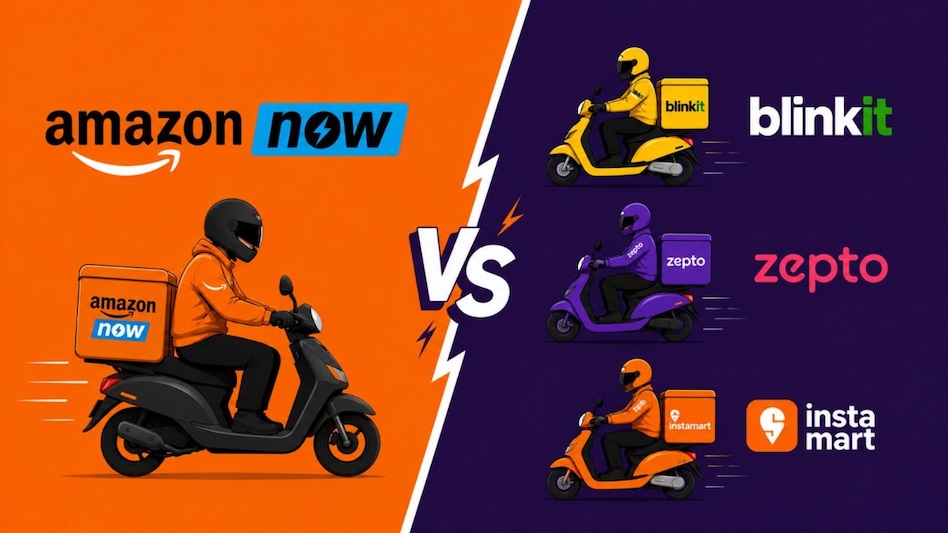
Amazon vs Blinkit vs Swiggy Instamart Amazon’s big push into the quick commerce market is not surprising, given how rapidly the segment has grown. According to consultants Redseer, in January 2026, quick commerce GMV (gross merchandise value) reached Rs 11,000 crore, growing 100 per cent year-on-year, while order volumes climbed 95 per cent to 7.8 million orders per day. It further noted that monthly transacting users expanded 95 per cent YoY to 5.2 crore. Blinkit, owned by Eternal, is the market leader in this space operating 2,243 dark stores, serving over 200 cities. Swiggy Instamart operates in 129 cities and has doubled its dark store count to 1,143 in the year ended March 2026, from 523 earlier. Swiggy went public in 2024 and rival Zepto is also expected to file papers for an IPO estimated to be around $1 billion in coming months. Even Mukesh Ambani’s Reliance Retail is scaling hyper-local commerce rapidly on its JioMart platform, with its average daily orders showing a four-fold increase in the January-March quarter, according to Isha Ambani, executive director at Reliance Retail Ventures. JioMart has a presence across 1,200 cities, serviced by over 3,100 stores.
Amazon Now’s expansion Clearly, Amazon has a lot of ground to cover. What could help Amazon Now’s expansion is the large Prime member base Amazon already has. Andy Jassy, the president and CEO of Amazon said recently that Amazon Now orders are increasing 25 per cent month-over-month, with Prime members tripling their shopping frequency, once they start using it. Amazon Now may have been an answer by Amazon to the Instamart, Blinkit and Zepto. But, its now being scaled in other countries too, such as the UAE, select cities in the USA and the UK and also in Brazil, Mexico and Japan, according to Chugh. While Amazon Now scales up, the company will continue to focus on its other offerings such as Amazon Fresh, where you can create a grocery basket and get scheduled deliveries, Bazaar, Pharmacy etc. Each of this serves a unique use case from a consumer standpoint, according to Sree Ram. “The actions that we take are typically consumer-oriented. We have enough mechanisms to listen to consumers. We are fortunate that we have a very large consumer base and a very large Prime member base. So, we have enough and more signals that we get from consumers and what they are looking for. Now, it is up to us on how we interpret signals and make those products available,” said Sree Ram.
It’s mid-day. The sun is blazing. Still, several farmers have queued up here at a collection centre set up by Amazon in Manchar, near Pune, bringing in different types of vegetables. The produce will be weighed sorted and within hours moved to local processing centre in nearby Chakan and then to the micro-fulfilment centres in and around Pune and beyond, from where it will reach your doorstep. Amazon may have a formidable presence in the e-commerce market, it has been a late entrant in the highly competitive quick commerce market, dominated by the likes of Zepto, Blinkit and Swiggy Instamart. As it plays catch up, Amazon is rapidly scaling up its quick commerce platform Amazon Now and it’s this network of collection centres and fulfilment centres that will be key to its growth. “Even if you take Pune as an example, in January or February, we didn’t have a single store (dark stores or micro-fulfilment centres as Amazon calls them). Today in May we are already touching 40,” Karan Chugh, Director of operations at Amazon India, tells Business Today. On a national level, the company currently has 360 micro-fulfilment centres (MFCs), with plans to have close to 1,000 by the end of the year. Roughly it is opening two new MFCs per day, Chugh says.
Amazon's reach Similarly, Amazon is also scaling up its collection centres as it looks to increase its sourcing of fresh produce directly from farmers. Just in Maharashtra, its collection centres will more than double from the current 10 this year, according to Srikant Sree Ram, Director Amazon Fresh at Amazon India. “We now have a facility in Pollachi in Tamil Nadu, to source coconuts. Similarly, we have opened a facility in Solan, Himachal Pradesh, Paota in Rajasthan, in Haryana and we also recently opened in Madhya Pradesh and Bihar,” said Sree Ram. Prices at which Amazon buys this produce from farmers are typically linked to local markets or APMCs (agricultural produce marketing committees) and the farmers typically receive their payments in their bank accounts within hours. All the backend expansion Amazon now is doing is a crucial step as a part of the company’s stated intent to scale Amazon Now to 100 cities by the end of this year. Last year, Amazon had announced an investment of Rs 2,000 crore in infrastructure, associates, wellness and safety initiatives. This year, the company has announced investment of Rs 2,800 crore, Chugh said.
Amazon vs Blinkit vs Swiggy Instamart Amazon’s big push into the quick commerce market is not surprising, given how rapidly the segment has grown. According to consultants Redseer, in January 2026, quick commerce GMV (gross merchandise value) reached Rs 11,000 crore, growing 100 per cent year-on-year, while order volumes climbed 95 per cent to 7.8 million orders per day. It further noted that monthly transacting users expanded 95 per cent YoY to 5.2 crore. Blinkit, owned by Eternal, is the market leader in this space operating 2,243 dark stores, serving over 200 cities. Swiggy Instamart operates in 129 cities and has doubled its dark store count to 1,143 in the year ended March 2026, from 523 earlier. Swiggy went public in 2024 and rival Zepto is also expected to file papers for an IPO estimated to be around $1 billion in coming months. Even Mukesh Ambani’s Reliance Retail is scaling hyper-local commerce rapidly on its JioMart platform, with its average daily orders showing a four-fold increase in the January-March quarter, according to Isha Ambani, executive director at Reliance Retail Ventures. JioMart has a presence across 1,200 cities, serviced by over 3,100 stores.
Amazon Now’s expansion Clearly, Amazon has a lot of ground to cover. What could help Amazon Now’s expansion is the large Prime member base Amazon already has. Andy Jassy, the president and CEO of Amazon said recently that Amazon Now orders are increasing 25 per cent month-over-month, with Prime members tripling their shopping frequency, once they start using it. Amazon Now may have been an answer by Amazon to the Instamart, Blinkit and Zepto. But, its now being scaled in other countries too, such as the UAE, select cities in the USA and the UK and also in Brazil, Mexico and Japan, according to Chugh. While Amazon Now scales up, the company will continue to focus on its other offerings such as Amazon Fresh, where you can create a grocery basket and get scheduled deliveries, Bazaar, Pharmacy etc. Each of this serves a unique use case from a consumer standpoint, according to Sree Ram. “The actions that we take are typically consumer-oriented. We have enough mechanisms to listen to consumers. We are fortunate that we have a very large consumer base and a very large Prime member base. So, we have enough and more signals that we get from consumers and what they are looking for. Now, it is up to us on how we interpret signals and make those products available,” said Sree Ram.