
Why are international air travellers from non-metro cities still not opting for the hub-and-spoke facility?
Guwahati airport will become the fourth Indian airport to begin hub-and-spoke operations on October 27. The model is designed to provide seamless international connectivity for passengers from smaller cities.
- Oct 21, 2026,
- Updated Oct 21, 2026 4:21 PM IST
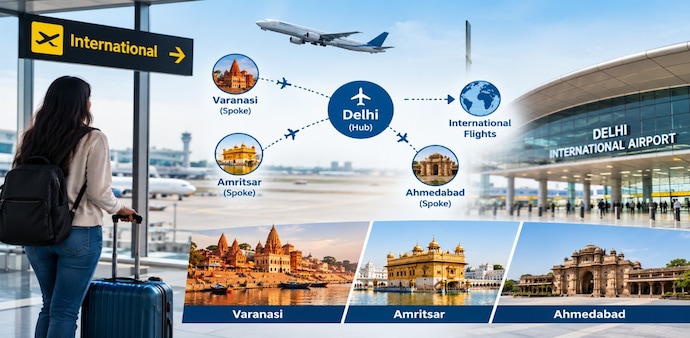
About 7,359 passengers travelling abroad from Varanasi, Amritsar and Ahmedabad airports have used the hub-and-spoke facility. It was launched in June this year to provide seamless international travel for passengers from Tier II and Tier III cities.
According to the latest data, Varanasi airport received a lukewarm response, with only 976 international travellers choosing the option, compared with 4,293 at Amritsar airport and 2,090 at Ahmedabad airport.
The Ministry of Civil Aviation, however, said, “The passenger numbers indicate growing acceptance of the facility.”
However, the scheme has had a slow start in the first three months since its launch. An operational lapse occurred at Amritsar airport on September 4, when three Italian passengers travelling from Amritsar to Delhi boarded a connecting Lufthansa flight to Munich without completing the mandatory immigration formalities.
India’s first international hub-and-spoke operation was launched on June 25, 2026, with Varanasi as the spoke airport and Delhi as the hub airport. As part of the initiative’s phased expansion, hub-and-spoke operations from Amritsar and Ahmedabad airports were launched on July 28, 2026, and September 1, 2026, respectively.
The initiative is a key component of the government’s International Aviation Hub Strategy, which aims to position India as a preferred aviation hub for Indian travellers by 2030 and as a leading global aviation hub by 2047.
What does the hub-and-spoke model mean?
In a hub-and-spoke system, flights from smaller “spoke” airports connect passengers to a major “hub” airport, from where they board onward international flights. The Ministry of Civil Aviation introduced the model to improve international connectivity for passengers from Tier II and Tier III cities.
Under this framework, international passengers complete check-in, immigration and customs formalities at the originating spoke airport. At the hub airport, they can transfer to their international flight without completing immigration and customs clearance again.
Flights from the spoke airport carry both domestic and international passengers. Domestic passengers receive boarding passes marked “D”, while international passengers receive boarding passes marked “I” for both the spoke-to-hub journey and the onward international flight.
The ministry is working to bring all international airports in India under the hub-and-spoke framework. Operations from Guwahati airport are proposed to begin on October 27.