
'A bit of feudal history': Economist Shamika Ravi on why Indians remain obsessed with sarkari jobs
Shamika Ravi says the preference for government jobs is partly linked to their traditional association with prestige and power
- Nov 8, 2026,
- Updated Nov 8, 2026 8:39 PM IST
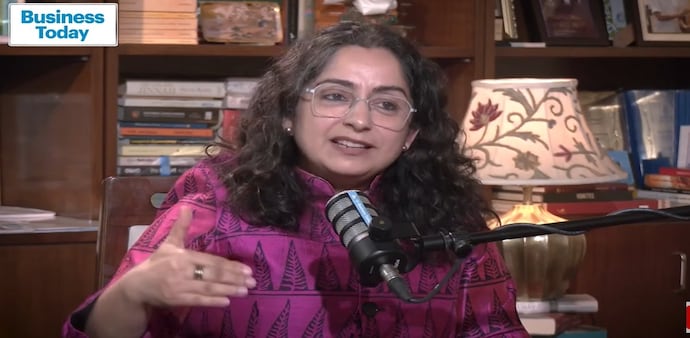
India's fascination with government jobs is partly rooted in its feudal past, where public employment is associated with prestige and power beyond salaries, according to economist Shamika Ravi, a member of the Prime Minister's Economic Advisory Council (EAC-PM).
The preference for government jobs remained particularly strong in states where economic growth and the transition to private-sector employment had been slower, Ravi said during a podcast conversation with Business Today Group Editor Siddharth Zarabi.
"I think there is a bit of the feudal history that we have carried with us where government jobs are more than the direct earnings that you mentioned," she said when asked whether the preference for government jobs was higher in states that are lagging in industrial development.
"It's a matter of prestige; it's a matter of power. And I think in societies and economies which aren't growing as much, where this transition has not happened, what you're talking about, there, if you just look at the proclivity of younger people to spend close to a decade taking exams, we do find that," Ravi said.
Don't Miss: Poverty down to 3.9%, so why free ration for 80 crore? PM's economic advisor explains
However, she stressed that the trend was not uniform across the country. She pointed to Gujarat, Maharashtra, Karnataka and Telangana as states where the preference for government employment was less pronounced.
The economist cited a study from Tamil Nadu, published in the Journal of Public Economics, which examined the lifetime earnings of people preparing for government recruitment examinations compared with those who entered the labour market without spending years on such preparations.
"There is a fantastic paper that came out of Tamil Nadu. It's published in the Journal of Public Economics, which shows that the lifetime earnings- so it is not just a couple of years, the lifetime earnings of people who never sat for government exams are higher than their cohort - people who are similar to them who have spent more than X number of years taking government exams for jobs," she said.
Ravi argued that young people who spend five to seven years preparing for government examinations lose valuable time that could otherwise be spent gaining professional experience and developing marketable skills.
"So which means there is actual loss of value that when you're going to spend five, six, seven years in your 20s, which is the most productive part of your life, when you're picking up actual skills in the market, just taking exams, the market doesn't put any value to that. And that is getting reflected in their lifetime earnings as well," she added.
Kerala at 12%, Gujarat at 0.9%: Ravi on unemployment divide
The discussion also turned to concerns among young Indians over the availability and quality of jobs, particularly low starting salaries for engineering graduates.
Ravi said India's national unemployment rate was around 3% to 3.1%, according to the Periodic Labour Force Survey (PLFS) figures she had last examined. However, she cautioned against relying solely on the national average to assess employment conditions.
"But it's very meaningless to talk of unemployment rate at the all-India level. You have to ideally look at it at least at the state level, and there is a direct, in fact, negative relationship and a strong one in states' ease of doing business, climate and the unemployment rate," Ravi said.
The economist cited Gujarat, Karnataka and Chhattisgarh as examples of states with relatively low unemployment rates.
"In fact, while all India is around three, Gujarat is 0.9, Karnataka is 1.2, Chhattisgarh is 1.9. So you see states that are growing also have low unemployment. That's number one. So remember this, all-India level hides more than it tells you. So you ought to look at labor market outcomes, particularly unemployment at the state level," she said.
Ravi compared these figures with Kerala, where she said the unemployment rate was substantially higher.
"Now let me also tell you at this point, a state I grew up in, and I feel, it's my home. Kerala's unemployment rate is 12% while the all-India rate is three," she said.