
AI boom is helping offset oil shock, but global economy still faces risks, warns IMF
Oil and gas reserves are shrinking, while winter in the Northern Hemisphere is approaching, says Kristalina Georgieva. "This means the energy shock is not over."
- Aug 26, 2026,
- Updated Aug 26, 2026 3:12 PM IST
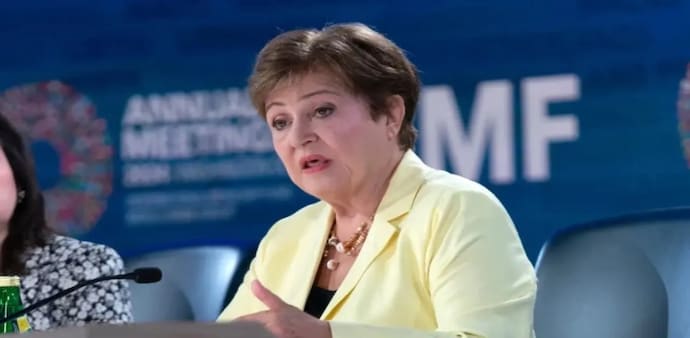
The global economy is being pulled in opposite directions by the oil shock from the closure of the Strait of Hormuz and a boom in artificial intelligence investment, IMF Managing Director Kristalina Georgieva said Tuesday.
The energy shock has so far proved less damaging than expected, while spending on AI and data centres is giving growth a boost, Georgieva said.
"What started out as a US phenomenon with AI is now becoming a growth engine for the global economy, with other countries ramping up construction of data centres and other infrastructure," she told reporters.
Georgieva was speaking ahead of next week's G-20 finance ministers' meeting in Asheville, North Carolina.
Don't Miss: Scaling up India's manufacturing ambitions
Energy Shock Has Not Ended
The IMF chief said the global economy had "weathered the energy shock caused by the closure of the Strait of Hormuz better than we feared".
She attributed that resilience to drawdowns of oil and gas reserves and higher supplies from outside the Gulf.
But she warned that the pressure could return.
Oil and gas reserves are shrinking, she said, while winter in the Northern Hemisphere is approaching.
"This means the energy shock is not over: a renewed rise in oil prices could fuel inflation, forcing central banks to retain a restrictive policy stance, with knock-on implications for debt service and economic activity," Georgieva said.
She said the global economy was facing a tug-of-war between a negative supply shock from the West Asia conflict and a positive demand shock from AI investment.
The impact will vary by country depending on exposure to energy disruptions, economic vulnerabilities, and their position in the AI supply chain, she said.
Must Read: 'Rice exporters likely to be hit hard': How US sanctions on Iran could hurt India
AI Boom Brings Its Own Risks
AI investment has been particularly strong in the United States, where corporate earnings and consumer demand remain strong, the IMF MD said. But she said the economic impact of AI remains uncertain and could create risks for financial stability.
"Should the outlook deteriorate, it will further widen the dispersion of growth prospects around the world," she said.
Developing economies could face a particular challenge if they fall behind in AI. "The risk of falling behind on AI is also more prominent in the developing world," Georgieva said.
Poorer Countries Face Greater Pressure
Low-income countries that rely heavily on imported fuel are already in a difficult position, Georgieva said.
Disruptions to oil, gas and other key commodities, including fertiliser, could worsen food insecurity. Extreme weather could make the situation worse, she said.
Meanwhile, fiscal pressures are rising.
Georgieva pointed to higher bond yields and a stalled decline in inflation as concerns for policymakers and financial markets.
She said risks to the global outlook were more balanced than at the IMF's Spring Meetings but remained tilted to the downside, with uncertainty still high.
IMF Growth Outlook
The IMF cut its forecast for global growth in 2026 to 3% in July.
It warned at the time about risks from the West Asia conflict, trade fragmentation, and uncertainty around AI.
The IMF is due to update its growth outlook in mid-October during the annual meetings of the IMF and World Bank in Bangkok.
(With inputs from PTI)
The global economy is being pulled in opposite directions by the oil shock from the closure of the Strait of Hormuz and a boom in artificial intelligence investment, IMF Managing Director Kristalina Georgieva said Tuesday.
The energy shock has so far proved less damaging than expected, while spending on AI and data centres is giving growth a boost, Georgieva said.
"What started out as a US phenomenon with AI is now becoming a growth engine for the global economy, with other countries ramping up construction of data centres and other infrastructure," she told reporters.
Georgieva was speaking ahead of next week's G-20 finance ministers' meeting in Asheville, North Carolina.
Don't Miss: Scaling up India's manufacturing ambitions
Energy Shock Has Not Ended
The IMF chief said the global economy had "weathered the energy shock caused by the closure of the Strait of Hormuz better than we feared".
She attributed that resilience to drawdowns of oil and gas reserves and higher supplies from outside the Gulf.
But she warned that the pressure could return.
Oil and gas reserves are shrinking, she said, while winter in the Northern Hemisphere is approaching.
"This means the energy shock is not over: a renewed rise in oil prices could fuel inflation, forcing central banks to retain a restrictive policy stance, with knock-on implications for debt service and economic activity," Georgieva said.
She said the global economy was facing a tug-of-war between a negative supply shock from the West Asia conflict and a positive demand shock from AI investment.
The impact will vary by country depending on exposure to energy disruptions, economic vulnerabilities, and their position in the AI supply chain, she said.
Must Read: 'Rice exporters likely to be hit hard': How US sanctions on Iran could hurt India
AI Boom Brings Its Own Risks
AI investment has been particularly strong in the United States, where corporate earnings and consumer demand remain strong, the IMF MD said. But she said the economic impact of AI remains uncertain and could create risks for financial stability.
"Should the outlook deteriorate, it will further widen the dispersion of growth prospects around the world," she said.
Developing economies could face a particular challenge if they fall behind in AI. "The risk of falling behind on AI is also more prominent in the developing world," Georgieva said.
Poorer Countries Face Greater Pressure
Low-income countries that rely heavily on imported fuel are already in a difficult position, Georgieva said.
Disruptions to oil, gas and other key commodities, including fertiliser, could worsen food insecurity. Extreme weather could make the situation worse, she said.
Meanwhile, fiscal pressures are rising.
Georgieva pointed to higher bond yields and a stalled decline in inflation as concerns for policymakers and financial markets.
She said risks to the global outlook were more balanced than at the IMF's Spring Meetings but remained tilted to the downside, with uncertainty still high.
IMF Growth Outlook
The IMF cut its forecast for global growth in 2026 to 3% in July.
It warned at the time about risks from the West Asia conflict, trade fragmentation, and uncertainty around AI.
The IMF is due to update its growth outlook in mid-October during the annual meetings of the IMF and World Bank in Bangkok.
(With inputs from PTI)