
BT Explainer: China’s critical mineral refining edge - What India must do to catch up
BT Explainer: China’s critical mineral refining edge - What India must do to catch up
China’s dominance in critical mineral refining leaves India vulnerable to supply disruptions even as it steps up overseas mining investments. Building domestic processing capacity, diversifying suppliers and securing reliable mineral supplies will be crucial to reducing this dependence.
Business Today Desk
- Oct 22, 2026,
- Updated Oct 22, 2026 2:30 AM IST
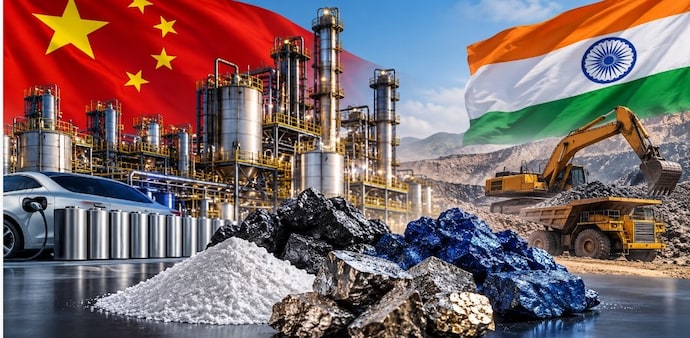
India’s push to secure critical minerals through overseas mining investments may help diversify its sources of raw materials, but acquiring mineral deposits alone will not guarantee supply-chain security. China’s dominance in processing lithium, cobalt, graphite and rare earths means that even minerals extracted outside its borders can remain dependent on Chinese refining capacity, technology and industrial infrastructure.
Advertisement
The challenge is becoming more pressing as India expands its electric vehicle (EV), battery manufacturing, renewable energy, electronics and defence industries. The government’s ₹34,300-crore National Critical Mineral Mission, launched to strengthen domestic capabilities and secure overseas resources, aims to reduce vulnerabilities in supplies of minerals essential to strategic sectors.
However, the gap between extracting ores and converting them into usable industrial materials remains a major obstacle.
China’s advantage lies beyond mining
China’s influence over critical minerals extends well beyond its domestic mineral reserves. Its strength lies in processing raw materials into battery-grade chemicals, refined metals, permanent magnets and other industrial inputs required by manufacturers.
According to the International Energy Agency (IEA), China accounts for around 90% of rare earth element refining and processing, while also holding dominant positions in several other critical mineral supply chains. Its share of global lithium refining is around 70%, while cobalt refining exceeds 75%, according to estimates cited in the IEA’s critical minerals analysis. Exact shares vary by mineral, processing stage and reporting year.
Advertisement
This concentration gives China considerable influence over the availability and cost of materials used in batteries, electric motors, wind turbines and advanced electronics.
For instance, lithium extracted from an overseas mine must undergo processing to produce chemicals suitable for battery manufacturing. Similarly, cobalt ore requires refining before it can be incorporated into battery materials. Rare earth elements require complex separation processes to produce materials used in high-performance permanent magnets.
Advertisement
The result is a supply chain in which the country extracting the mineral is not necessarily the country controlling its industrial value.
Why overseas mining deals may not be enough
India’s overseas mineral acquisition strategy seeks to secure long-term access to resources and reduce excessive dependence on concentrated suppliers. But ownership of a mine does not automatically guarantee that its output can be exported to India, processed economically or delivered without disruption.
ALSO READ: Global trade realignment: India’s export push faces rising imports, China challenge
Host countries can impose export restrictions, increase local processing requirements or change regulations to retain more value from their natural resources. Operational delays, infrastructure shortages, financing constraints and geopolitical tensions can also affect production and shipments.
The distinction is between securing a claim on mineral output and controlling the complete supply chain. An overseas mining investment may provide an offtake agreement or a financial hedge against price volatility, but it cannot necessarily override a host government’s export policy or guarantee supplies at discounted prices.
Advertisement
These risks are reflected in the growing use of export licensing and restrictions on critical minerals and related technologies. The IEA’s tracking of export controls announced, proposed or updated in 2025 and 2026 highlights how governments are increasingly treating mineral processing capabilities as strategic assets.
For India, overseas investments will therefore need to be supported by enforceable supply agreements, diversified sourcing, logistics arrangements and access to processing capacity.
Read more!