
BT Explainer | What is universal high income, why is Musk advocating for it, how will it impact you
Artificial intelligence is reshaping the global economy at an unprecedented speed, threatening jobs that millions depend on.
- Apr 17, 2026,
- Updated Apr 17, 2026 4:57 PM IST
Imagine waking up tomorrow and finding money in your bank account from the government — no strings attached. Artificial intelligence is reshaping the global economy at an unprecedented speed, threatening jobs that millions depend on.
Sounds too fantastical to be true? Elon Musk does not think so. As AI swallows jobs whole and machines outwork humans at nearly everything, a radical question is emerging: should simply being alive entitle you to an income? The answer may reshape how you work, spend, and define your own worth.
What is universal high income?
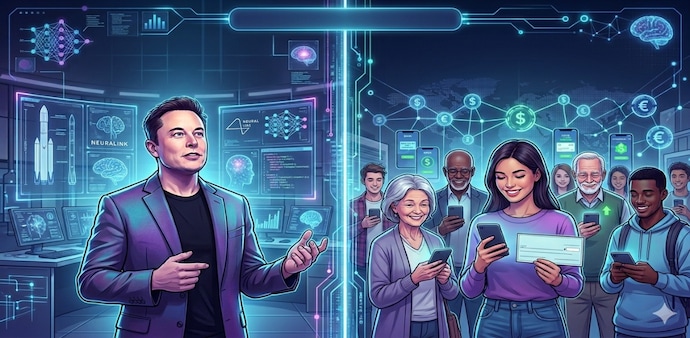
Proposed by Elon Musk, the concept is an evolution of the universal basic income (UBI). Universal high income (UHI) focuses on a future where AI and robotics create extreme productivity and super abundance that governments can provide high-level income checks to all citizens, rather than subsistence-level payouts.
Why is Musk advocating for it?
The tech billionaire is advocating for UHI via federal government checks to address AI-induced unemployment, arguing that AI and robotics will generate goods and services exceeding any money supply growth, preventing inflation.
In his post, he suggested that work would become like a hobby, something you do because you enjoy it not because you have to.
Replying to Musk's post, finfluencer Ankur Warikoo wrote that humans were never meant to show up to work the way billions do every day.
He added, "We were meant to pursue interests, build things, connect with people, understand ourselves, and debate aimlessly. What is classified as unproductive today was how the average person grew intellectually, morally, and spiritually a few centuries back."
What does this mean for India?
For India, Musk's vision is wildly utopian but also relevant. India faces the challenges of a rapidly growing population and limited economic opportunities.
Economist and author Sanjeev Sanyal argues that UHI could bankrupt the country if attempted before "super abundance" is actually achieved. Providing a basic UHI of ₹7,500 per year for every citizen could cost ₹10.5 lakh crore, nearly 10 times the current health budget.
Calling it a "dystopian view," Zoho's Sridhar Vembu said that Musk's take assumes technology will displace all paid work so that humans have to be paid by the government to consume the output generated via automated factories and AI.
What if UHI is implemented successfully?
If UHI is implemented successfully, young Indians could move from low-paying manual labour and traditional jobs to creative and high-skills fields such as AI, research, art or social work, without the fear of poverty.
According to economists, if AI displaces jobs faster than UHI can be implemented, the young workforce could face unemployment like never before. This would lead to widespread social unrest instead of growth.
It could also act as a buffer when the economy transitions from labour-intensive agriculture and low-end IT to high-value manufacturing and specialised services.
How will universal high income impact you?
With basic and high-level needs being met, the focus would now shift from earning a living to choosing a life. A universal high income will give individuals the leverage to refuse poor working conditions or toxic environments without fear of financial consequences.
According to Musk, goods and services become so abundant and inexpensive due to AI-generated output that access replaces ownership as the definition of wealth. A guaranteed high income could act as a shock absorber for the economy, maintaining consumer demand even if millions of traditional jobs disappear.
Imagine waking up tomorrow and finding money in your bank account from the government — no strings attached. Artificial intelligence is reshaping the global economy at an unprecedented speed, threatening jobs that millions depend on.
Sounds too fantastical to be true? Elon Musk does not think so. As AI swallows jobs whole and machines outwork humans at nearly everything, a radical question is emerging: should simply being alive entitle you to an income? The answer may reshape how you work, spend, and define your own worth.
What is universal high income?
Proposed by Elon Musk, the concept is an evolution of the universal basic income (UBI). Universal high income (UHI) focuses on a future where AI and robotics create extreme productivity and super abundance that governments can provide high-level income checks to all citizens, rather than subsistence-level payouts.
Why is Musk advocating for it?
The tech billionaire is advocating for UHI via federal government checks to address AI-induced unemployment, arguing that AI and robotics will generate goods and services exceeding any money supply growth, preventing inflation.
In his post, he suggested that work would become like a hobby, something you do because you enjoy it not because you have to.
Replying to Musk's post, finfluencer Ankur Warikoo wrote that humans were never meant to show up to work the way billions do every day.
He added, "We were meant to pursue interests, build things, connect with people, understand ourselves, and debate aimlessly. What is classified as unproductive today was how the average person grew intellectually, morally, and spiritually a few centuries back."
What does this mean for India?
For India, Musk's vision is wildly utopian but also relevant. India faces the challenges of a rapidly growing population and limited economic opportunities.
Economist and author Sanjeev Sanyal argues that UHI could bankrupt the country if attempted before "super abundance" is actually achieved. Providing a basic UHI of ₹7,500 per year for every citizen could cost ₹10.5 lakh crore, nearly 10 times the current health budget.
Calling it a "dystopian view," Zoho's Sridhar Vembu said that Musk's take assumes technology will displace all paid work so that humans have to be paid by the government to consume the output generated via automated factories and AI.
What if UHI is implemented successfully?
If UHI is implemented successfully, young Indians could move from low-paying manual labour and traditional jobs to creative and high-skills fields such as AI, research, art or social work, without the fear of poverty.
According to economists, if AI displaces jobs faster than UHI can be implemented, the young workforce could face unemployment like never before. This would lead to widespread social unrest instead of growth.
It could also act as a buffer when the economy transitions from labour-intensive agriculture and low-end IT to high-value manufacturing and specialised services.
How will universal high income impact you?
With basic and high-level needs being met, the focus would now shift from earning a living to choosing a life. A universal high income will give individuals the leverage to refuse poor working conditions or toxic environments without fear of financial consequences.
According to Musk, goods and services become so abundant and inexpensive due to AI-generated output that access replaces ownership as the definition of wealth. A guaranteed high income could act as a shock absorber for the economy, maintaining consumer demand even if millions of traditional jobs disappear.