
Factories fire up: India's industrial output jumps 5.1% YoY in May as manufacturing leads the way
The Ministry of Statistics and Programme Implementation (MoSPI) announced that the Index of Industrial Production (IIP) will now use the newly introduced Output Producer Price Index (Output PPI) instead of the Wholesale Price Index (WPI) to adjust value-based production data.
- Jun 29, 2026,
- Updated Jun 29, 2026 5:17 PM IST
India's industrial sector posted a healthy 5.1% year-on-year (YoY) expansion in May 2026, signalling resilient factory activity despite global economic uncertainty. Manufacturing, which accounts for over three-fourths of the IIP basket, expanded 5.5% in May and remained the principal driver of overall industrial growth.
Electricity and gas supply registered an even stronger 9.9% increase, reflecting sustained demand for power during the summer months. Water supply and waste management also grew 5.5%, while mining and quarrying contracted 1.6%, making it the only major sector to shrink during the month.
Overall, the IIP rose to 122.7 in May 2026 from 116.7 a year earlier.
Auto makers, electrical equipment and metals lead the way
Within manufacturing, 16 of the 23 industry groups recorded positive growth.
Three industries stood out:
- Motor vehicles, trailers and semi-trailers: 14.5% growth, driven by higher production of passenger cars, commercial vehicles and auto components.
- Electrical equipment: 20.8% growth, supported by strong demand for switchgear, transformers and power electronics.
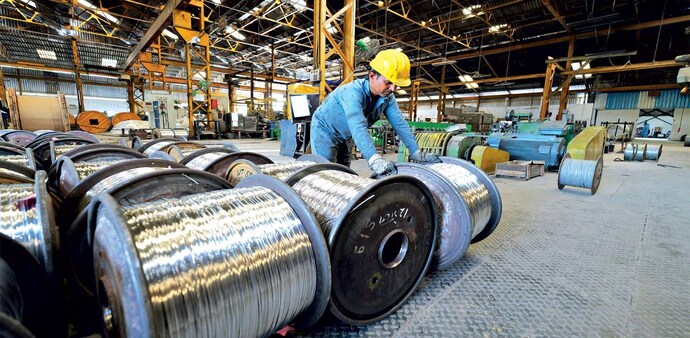
- Basic metals: 4.6% growth, aided by higher production of steel coils, plates and alloy steel products.
The data suggests that investment-oriented sectors and infrastructure-linked manufacturing continue to outperform consumer-focused industries.
Investment demand appears resilient
The use-based classification offers another clue about the economy's direction. Capital goods, widely viewed as a proxy for private investment, recorded the strongest growth at 12.9%. Infrastructure and construction goods grew 5.9%, while intermediate goods rose 5.8%.
Consumer durables expanded 7.2%, whereas consumer non-durables posted a relatively modest 3.6% increase, indicating that discretionary spending remains healthier than everyday consumption.
Why the methodology change matters
But beneath the headline growth lies an even more consequential development: India has fundamentally changed the way it measures industrial production, making the country's most-watched manufacturing indicator more accurate and globally comparable.
The Ministry of Statistics and Programme Implementation (MoSPI) announced that the Index of Industrial Production (IIP) will now use the newly introduced Output Producer Price Index (Output PPI) instead of the Wholesale Price Index (WPI) to adjust value-based production data. The revised methodology has been applied retrospectively to the entire 2022-23 base series, replacing the version released earlier this month.
To understand the significance, it helps to know how the IIP is calculated.
Industrial production is measured using hundreds of products across mining, manufacturing, electricity and utilities. While many industries report output in physical units — such as tonnes of steel or number of vehicles — others report production only in monetary value. To estimate actual production volumes, statisticians must remove the effect of inflation using a price index.
Until now, India relied on the Wholesale Price Index for this purpose.
The government has now shifted to the Output Producer Price Index, arguing that it better reflects prices received by manufacturers and offers a much more detailed picture of producer-level inflation. The change affects 234 of the 463 item groups in the IIP basket, representing 36.02% of the index's total weight.
Officials say the move aligns India's industrial statistics with international best practices and improves the estimation of real industrial output — an important input while calculating quarterly GDP.
Because industrial production is a key ingredient in estimating India's Gross Domestic Product (GDP), a more accurate measure of factory output can improve the reliability of official economic growth estimates. It also enables policymakers, economists and investors to better distinguish between genuine increases in production and changes driven merely by price movements.
India's industrial sector posted a healthy 5.1% year-on-year (YoY) expansion in May 2026, signalling resilient factory activity despite global economic uncertainty. Manufacturing, which accounts for over three-fourths of the IIP basket, expanded 5.5% in May and remained the principal driver of overall industrial growth.
Electricity and gas supply registered an even stronger 9.9% increase, reflecting sustained demand for power during the summer months. Water supply and waste management also grew 5.5%, while mining and quarrying contracted 1.6%, making it the only major sector to shrink during the month.
Overall, the IIP rose to 122.7 in May 2026 from 116.7 a year earlier.
Auto makers, electrical equipment and metals lead the way
Within manufacturing, 16 of the 23 industry groups recorded positive growth.
Three industries stood out:
- Motor vehicles, trailers and semi-trailers: 14.5% growth, driven by higher production of passenger cars, commercial vehicles and auto components.
- Electrical equipment: 20.8% growth, supported by strong demand for switchgear, transformers and power electronics.
- Basic metals: 4.6% growth, aided by higher production of steel coils, plates and alloy steel products.
The data suggests that investment-oriented sectors and infrastructure-linked manufacturing continue to outperform consumer-focused industries.
Investment demand appears resilient
The use-based classification offers another clue about the economy's direction. Capital goods, widely viewed as a proxy for private investment, recorded the strongest growth at 12.9%. Infrastructure and construction goods grew 5.9%, while intermediate goods rose 5.8%.
Consumer durables expanded 7.2%, whereas consumer non-durables posted a relatively modest 3.6% increase, indicating that discretionary spending remains healthier than everyday consumption.
Why the methodology change matters
But beneath the headline growth lies an even more consequential development: India has fundamentally changed the way it measures industrial production, making the country's most-watched manufacturing indicator more accurate and globally comparable.
The Ministry of Statistics and Programme Implementation (MoSPI) announced that the Index of Industrial Production (IIP) will now use the newly introduced Output Producer Price Index (Output PPI) instead of the Wholesale Price Index (WPI) to adjust value-based production data. The revised methodology has been applied retrospectively to the entire 2022-23 base series, replacing the version released earlier this month.
To understand the significance, it helps to know how the IIP is calculated.
Industrial production is measured using hundreds of products across mining, manufacturing, electricity and utilities. While many industries report output in physical units — such as tonnes of steel or number of vehicles — others report production only in monetary value. To estimate actual production volumes, statisticians must remove the effect of inflation using a price index.
Until now, India relied on the Wholesale Price Index for this purpose.
The government has now shifted to the Output Producer Price Index, arguing that it better reflects prices received by manufacturers and offers a much more detailed picture of producer-level inflation. The change affects 234 of the 463 item groups in the IIP basket, representing 36.02% of the index's total weight.
Officials say the move aligns India's industrial statistics with international best practices and improves the estimation of real industrial output — an important input while calculating quarterly GDP.
Because industrial production is a key ingredient in estimating India's Gross Domestic Product (GDP), a more accurate measure of factory output can improve the reliability of official economic growth estimates. It also enables policymakers, economists and investors to better distinguish between genuine increases in production and changes driven merely by price movements.