
For every Rs 100 Tamil Nadu builds with, it pays Rs 138 in interest
The new Tamil Nadu budget reports a ₹690 crore cut in the state's debt. Here is what that number does, and does not, tell you.
Dipu Rai
- Aug 5, 2026,
- Updated Aug 5, 2026 8:12 PM IST
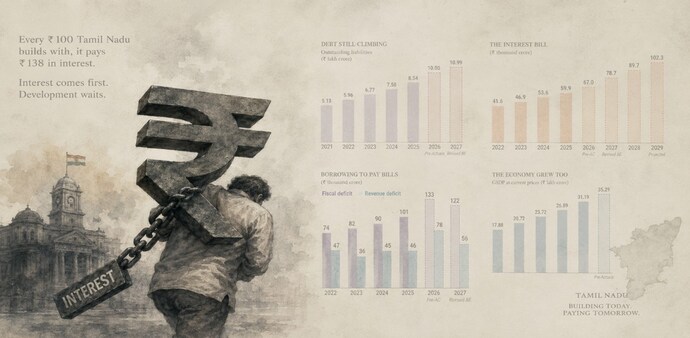
Tamil Nadu will spend ₹78,683 crore this year paying interest on money it has already borrowed. It will spend ₹56,985 crore building anything new.
That works out to ₹138 handed to lenders for every ₹100 that goes into roads, hospitals, schools and power lines. The interest is contracted. It gets paid first, before a single new scheme is decided.
Advertisement
Both figures are in the Budget speech Finance Minister N. Marie Wilson read to the Assembly on Wednesday, the first from the Tamilaga Vettri Kazhagam-led coalition government.
So has the debt actually come down?
Barely.
Wilson said outstanding liabilities would be ₹10,98,768 crore in 2026-27, some ₹690 crore below the interim Budget figure he stated in February.
That is a cut of 0.06 per cent. On a chart, it is thinner than the line drawn around the bar.
The same Budget adds ₹98,936 crore to the debt against last year. That is 143 times larger than the reduction being reported.
If debt doubled, why is there no crisis?
Advertisement
Because the economy doubled too.
Between 2020-21 and 2025-26, the state's debt rose 95 per cent, from ₹5.13 lakh crore to ₹10 lakh crore, according to the government's own white paper. Over exactly the same years, Tamil Nadu's output rose 97 per cent, according to the Ministry of Statistics and Programme Implementation.
Debt matters in relation to the economy it is drawn from, just as a home loan matters in relation to what the borrower earns. Measured that way, Tamil Nadu's debt went from 28.7 per cent of the economy to 28.3 per cent. It moved less than half a percentage point in five years.
Then what is the real problem?
Advertisement
Interest does not shrink when the economy grows. It compounds.
The bill has gone from ₹41,564 crore in 2021-22 to ₹78,683 crore this year. The government's own medium-term plan, published with this Budget, projects ₹89,698 crore in 2027-28 and ₹1,02,256 crore in 2028-29.
That is the state's own forecast, not an outside estimate. Within three years, more than ₹1 lakh crore a year will leave the treasury before anything is built or run.
How much of the borrowing builds anything?
Less than half.
Tamil Nadu will borrow ₹1,21,819 crore more than it repays in 2026-27. Of that, ₹55,775 crore covers day-to-day running costs: salaries, pensions, subsidies and the ordinary business of government.
Borrowing to build leaves an asset behind. Borrowing to pay bills leaves only the repayment.
What has to go right?
The Budget expects the debt ratio to ease to 26.10 per cent by 2028-29 even as interest crosses ₹1 lakh crore.
Advertisement
That works only if the economy keeps growing at close to the pace of the past five years.
Wilson has levied a privilege fee on liquor manufacturers he expects to raise up to ₹1,000 crore a year, and says faceless GST assessment, faceless registration and computerised mining checks will bring in about ₹15,000 crore more. A Revenue Augmentation Committee headed by economist Montek Singh Ahluwalia has been set up to find further sources.
AIADMK leader Edappadi K. Palaniswami called the revenue methods vague and asked whether constituting a committee would generate money, according to The Federal.
For five years, Tamil Nadu's debt and its economy have climbed at the same speed. The Budget assumes they will keep doing so. That assumption is carrying more weight than any number in it.
Tamil Nadu will spend ₹78,683 crore this year paying interest on money it has already borrowed. It will spend ₹56,985 crore building anything new.
That works out to ₹138 handed to lenders for every ₹100 that goes into roads, hospitals, schools and power lines. The interest is contracted. It gets paid first, before a single new scheme is decided.
Advertisement
Both figures are in the Budget speech Finance Minister N. Marie Wilson read to the Assembly on Wednesday, the first from the Tamilaga Vettri Kazhagam-led coalition government.
So has the debt actually come down?
Barely.
Wilson said outstanding liabilities would be ₹10,98,768 crore in 2026-27, some ₹690 crore below the interim Budget figure he stated in February.
That is a cut of 0.06 per cent. On a chart, it is thinner than the line drawn around the bar.
The same Budget adds ₹98,936 crore to the debt against last year. That is 143 times larger than the reduction being reported.
If debt doubled, why is there no crisis?
Advertisement
Because the economy doubled too.
Between 2020-21 and 2025-26, the state's debt rose 95 per cent, from ₹5.13 lakh crore to ₹10 lakh crore, according to the government's own white paper. Over exactly the same years, Tamil Nadu's output rose 97 per cent, according to the Ministry of Statistics and Programme Implementation.
Debt matters in relation to the economy it is drawn from, just as a home loan matters in relation to what the borrower earns. Measured that way, Tamil Nadu's debt went from 28.7 per cent of the economy to 28.3 per cent. It moved less than half a percentage point in five years.
Then what is the real problem?
Advertisement
Interest does not shrink when the economy grows. It compounds.
The bill has gone from ₹41,564 crore in 2021-22 to ₹78,683 crore this year. The government's own medium-term plan, published with this Budget, projects ₹89,698 crore in 2027-28 and ₹1,02,256 crore in 2028-29.
That is the state's own forecast, not an outside estimate. Within three years, more than ₹1 lakh crore a year will leave the treasury before anything is built or run.
How much of the borrowing builds anything?
Less than half.
Tamil Nadu will borrow ₹1,21,819 crore more than it repays in 2026-27. Of that, ₹55,775 crore covers day-to-day running costs: salaries, pensions, subsidies and the ordinary business of government.
Borrowing to build leaves an asset behind. Borrowing to pay bills leaves only the repayment.
What has to go right?
The Budget expects the debt ratio to ease to 26.10 per cent by 2028-29 even as interest crosses ₹1 lakh crore.
Advertisement
That works only if the economy keeps growing at close to the pace of the past five years.
Wilson has levied a privilege fee on liquor manufacturers he expects to raise up to ₹1,000 crore a year, and says faceless GST assessment, faceless registration and computerised mining checks will bring in about ₹15,000 crore more. A Revenue Augmentation Committee headed by economist Montek Singh Ahluwalia has been set up to find further sources.
AIADMK leader Edappadi K. Palaniswami called the revenue methods vague and asked whether constituting a committee would generate money, according to The Federal.
For five years, Tamil Nadu's debt and its economy have climbed at the same speed. The Budget assumes they will keep doing so. That assumption is carrying more weight than any number in it.
Read more!