
India-US trade talks 'reached a plateau', compromise difficult: FM Sitharaman
Indian officials have sought assurances from Washington that India would receive a favourable tariff rate compared with its peers, according to Bloomberg
- Oct 5, 2026,
- Updated Oct 5, 2026 5:41 PM IST
India-US trade deal talks have "reached a plateau" beyond which compromise could be difficult, Finance Minister Nirmala Sitharaman said on Monday.
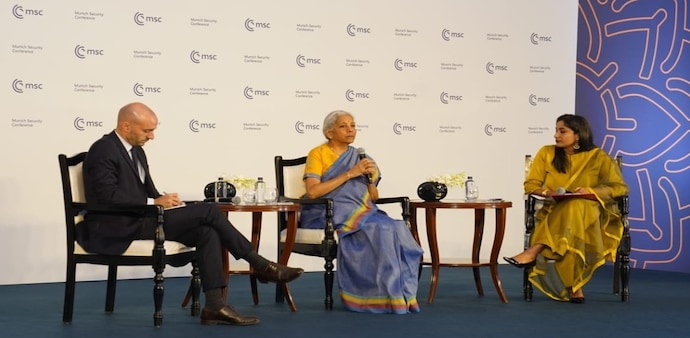
"It's been a hard and very rigorously negotiated agreement. The negotiations are still ongoing. Although we'd like to believe that both sides have reached a plateau beyond which giving or taking might be very very difficult," Sitharaman said while speaking at the Munich Security Conference. "But maybe if there are rooms to operate from both sides would do it."
Sitharaman said the US wants to reduce the trade imbalance with India, with the bilateral trade balance currently favouring New Delhi. "The trade balance is very much in our favour. Naturally the deficit is there on their side or the balance is going unfavourably for the US," she said.
The FM said Washington would want to reduce that imbalance, while India's approach was to use negotiations to address differences and open markets on a reciprocal basis. She added trade negotiations traditionally allowed countries to highlight imbalances and seek greater access to each other's markets.
"Negotiation used to be the only platform through which countries could highlight the discrepancies, highlight the lopsidedness, and say would we want to correct this. And how would you correct it because you have demand in your country, I can supply, so open up on that," she said.
But she said tariffs had increasingly become a tool for addressing trade imbalances. "Now the imbalance is being sought to be addressed through other means, where you rightly said tariff has become weaponised," Sitharaman said during the conversation moderated by India Today's Geeta Mohan.
She contrasted this with India's trade relationship with China, where she said the imbalance had grown "exponentially" since 2014. "The trade imbalance with China for India, for instance, since 2014 has been growing exponentially," she said. "So I can probably take the same position with China because it's so lopsided it is terribly against me. But, no - you can't. You will have to talk it out. You will have to negotiate. You will have to have some give and take. That's the difference."
On Friday, United States Trade Representative Jamieson Greer said that the trade deal was in its final stages, but was not "imminent".
India and the US agreed to an interim trade deal earlier this year and have since been negotiating a broader agreement.
Bloomberg reported that Indian officials have sought assurances from Washington that India would receive a favourable tariff rate compared with its peers. They have also sought assurances that India would not face additional penalties after the trade deal is signed.
The talks have also faced another complication: a new US law allows President Donald Trump to impose tariffs of up to 100% on countries that are major buyers of Russian oil and gas.
India is a major importer of Russian energy. New Delhi has warned that such measures could hurt bilateral ties with the US and disrupt global energy markets.
India-US trade deal talks have "reached a plateau" beyond which compromise could be difficult, Finance Minister Nirmala Sitharaman said on Monday.
"It's been a hard and very rigorously negotiated agreement. The negotiations are still ongoing. Although we'd like to believe that both sides have reached a plateau beyond which giving or taking might be very very difficult," Sitharaman said while speaking at the Munich Security Conference. "But maybe if there are rooms to operate from both sides would do it."
Sitharaman said the US wants to reduce the trade imbalance with India, with the bilateral trade balance currently favouring New Delhi. "The trade balance is very much in our favour. Naturally the deficit is there on their side or the balance is going unfavourably for the US," she said.
The FM said Washington would want to reduce that imbalance, while India's approach was to use negotiations to address differences and open markets on a reciprocal basis. She added trade negotiations traditionally allowed countries to highlight imbalances and seek greater access to each other's markets.
"Negotiation used to be the only platform through which countries could highlight the discrepancies, highlight the lopsidedness, and say would we want to correct this. And how would you correct it because you have demand in your country, I can supply, so open up on that," she said.
But she said tariffs had increasingly become a tool for addressing trade imbalances. "Now the imbalance is being sought to be addressed through other means, where you rightly said tariff has become weaponised," Sitharaman said during the conversation moderated by India Today's Geeta Mohan.
She contrasted this with India's trade relationship with China, where she said the imbalance had grown "exponentially" since 2014. "The trade imbalance with China for India, for instance, since 2014 has been growing exponentially," she said. "So I can probably take the same position with China because it's so lopsided it is terribly against me. But, no - you can't. You will have to talk it out. You will have to negotiate. You will have to have some give and take. That's the difference."
On Friday, United States Trade Representative Jamieson Greer said that the trade deal was in its final stages, but was not "imminent".
India and the US agreed to an interim trade deal earlier this year and have since been negotiating a broader agreement.
Bloomberg reported that Indian officials have sought assurances from Washington that India would receive a favourable tariff rate compared with its peers. They have also sought assurances that India would not face additional penalties after the trade deal is signed.
The talks have also faced another complication: a new US law allows President Donald Trump to impose tariffs of up to 100% on countries that are major buyers of Russian oil and gas.
India is a major importer of Russian energy. New Delhi has warned that such measures could hurt bilateral ties with the US and disrupt global energy markets.