
India vs China manufacturing: Where India stands as Jefferies flags scale, energy and capex gaps
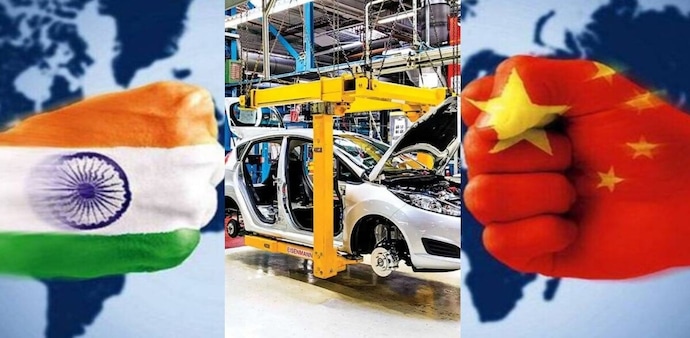
India is expanding its manufacturing footprint across sectors such as steel, electronics, solar modules and semiconductors, but China continues to operate at a much larger production scale. Jefferies examines India’s manufacturing progress, rising private investment and the infrastructure and energy requirements needed for further growth.
- Sep 25, 2026,
- Updated Sep 25, 2026 2:30 PM IST
India has made significant progress in manufacturing, but the country still faces a wide gap with China in production scale. A new report from Jefferies, “GREED & fear – The virtues of small over large”, highlights both India’s growing manufacturing capabilities and the challenges it faces as it tries to become a larger global manufacturing hub.
According to the report, India ranks second globally after China in several traditional manufacturing categories, including crude steel, cement, ammonia, mobile phones and solar modules. However, the difference in production volumes remains substantial.
For example, China produced 960.8 million tonnes (Mt) of crude steel last year, compared with 164.9 Mt in India. In cement, China’s production stood at around 1,700 Mt, while India produced approximately 470 Mt. The numbers underline the scale of China’s manufacturing ecosystem compared with India.
Six sectors identified as key growth areas
Jefferies said India’s manufacturing push is being supported by growing private-sector participation and government policies. The brokerage identified six areas with significant growth potential — space, semiconductors, solar manufacturing, data centres, electronics and aerospace.
Government support includes incentive schemes, tax holidays and localisation requirements, according to the report.
MUST READ: Can Gujarat become a leader in renewable hydrogen production?
Energy is the key
The report also links India’s manufacturing ambitions to the country’s energy transition. Jefferies sees renewable energy, particularly solar, as an important structural growth area. It points to China’s experience, where large-scale grid development and advances in battery storage have helped bring down the cost of solar power.
For India, cheaper and more reliable electricity could become important for expanding manufacturing. Hitachi Energy India estimates that India’s total final energy demand could rise 50% by 2035, while electricity demand could double to 3,365 TWh. The share of electricity in total final energy demand is projected to rise from 19% in 2023 to 25% in 2035.
| Key area | India | China |
|---|---|---|
| Global manufacturing position | Second globally in several categories | First in the categories highlighted |
| Crude steel production | 164.9 Mt | 960.8 Mt |
| Cement production | 470 Mt | 1,700 Mt |
| Key growth sectors identified by Jefferies | Space, semiconductors, solar manufacturing, data centres, electronics, aerospace | — |
| Electricity demand outlook | Expected to double to 3,365 TWh by 2035 | — |
| Gross fixed capital formation/GDP | Rose from 31.4% to 32.4% | — |
| Machinery imports | US$29 bn in FY21 → US$62 bn in FY26; US$66 bn in 12 months to Aug 2026 | — |
| Manufacturing advantage | Expanding capacity and attracting private investment | Much larger production scale |
| Energy transition | Solar and battery storage seen as important for manufacturing | Large-scale grid and battery-storage experience |
| Key challenge | Closing the scale, technology and infrastructure gap | Maintaining its existing manufacturing scale |
Source: Jefferies
Private investment shows signs of picking up
There are also signs that private investment is beginning to increase. India’s annualised gross fixed capital formation as a percentage of nominal GDP increased from 31.4% in the four quarters to December to 32.4% in the four quarters to June.
Machinery imports have also risen sharply, from US$29 billion in FY21 to US$62 billion in FY26, and reached US$66 billion in the 12 months to August 2026.
ALSO READ: Insurance distribution under IRDAI lens: Why certified advisers can help consumers choose wisely
India is expanding, but...
The report presents a picture of an Indian manufacturing sector expanding across multiple areas, but from a much smaller base than China. Closing that gap will depend on investment, energy infrastructure, technology, scale and continued policy support.
Jefferies’ analysis suggests manufacturing could become an increasingly important part of India’s broader growth story, even as the country continues to build capacity across both traditional and newer industries.
DO READ: Oil rises as Iran threat to widen war dims hopes of Strait of Hormuz deal
India has made significant progress in manufacturing, but the country still faces a wide gap with China in production scale. A new report from Jefferies, “GREED & fear – The virtues of small over large”, highlights both India’s growing manufacturing capabilities and the challenges it faces as it tries to become a larger global manufacturing hub.
According to the report, India ranks second globally after China in several traditional manufacturing categories, including crude steel, cement, ammonia, mobile phones and solar modules. However, the difference in production volumes remains substantial.
For example, China produced 960.8 million tonnes (Mt) of crude steel last year, compared with 164.9 Mt in India. In cement, China’s production stood at around 1,700 Mt, while India produced approximately 470 Mt. The numbers underline the scale of China’s manufacturing ecosystem compared with India.
Six sectors identified as key growth areas
Jefferies said India’s manufacturing push is being supported by growing private-sector participation and government policies. The brokerage identified six areas with significant growth potential — space, semiconductors, solar manufacturing, data centres, electronics and aerospace.
Government support includes incentive schemes, tax holidays and localisation requirements, according to the report.
MUST READ: Can Gujarat become a leader in renewable hydrogen production?
Energy is the key
The report also links India’s manufacturing ambitions to the country’s energy transition. Jefferies sees renewable energy, particularly solar, as an important structural growth area. It points to China’s experience, where large-scale grid development and advances in battery storage have helped bring down the cost of solar power.
For India, cheaper and more reliable electricity could become important for expanding manufacturing. Hitachi Energy India estimates that India’s total final energy demand could rise 50% by 2035, while electricity demand could double to 3,365 TWh. The share of electricity in total final energy demand is projected to rise from 19% in 2023 to 25% in 2035.
| Key area | India | China |
|---|---|---|
| Global manufacturing position | Second globally in several categories | First in the categories highlighted |
| Crude steel production | 164.9 Mt | 960.8 Mt |
| Cement production | 470 Mt | 1,700 Mt |
| Key growth sectors identified by Jefferies | Space, semiconductors, solar manufacturing, data centres, electronics, aerospace | — |
| Electricity demand outlook | Expected to double to 3,365 TWh by 2035 | — |
| Gross fixed capital formation/GDP | Rose from 31.4% to 32.4% | — |
| Machinery imports | US$29 bn in FY21 → US$62 bn in FY26; US$66 bn in 12 months to Aug 2026 | — |
| Manufacturing advantage | Expanding capacity and attracting private investment | Much larger production scale |
| Energy transition | Solar and battery storage seen as important for manufacturing | Large-scale grid and battery-storage experience |
| Key challenge | Closing the scale, technology and infrastructure gap | Maintaining its existing manufacturing scale |
Source: Jefferies
Private investment shows signs of picking up
There are also signs that private investment is beginning to increase. India’s annualised gross fixed capital formation as a percentage of nominal GDP increased from 31.4% in the four quarters to December to 32.4% in the four quarters to June.
Machinery imports have also risen sharply, from US$29 billion in FY21 to US$62 billion in FY26, and reached US$66 billion in the 12 months to August 2026.
ALSO READ: Insurance distribution under IRDAI lens: Why certified advisers can help consumers choose wisely
India is expanding, but...
The report presents a picture of an Indian manufacturing sector expanding across multiple areas, but from a much smaller base than China. Closing that gap will depend on investment, energy infrastructure, technology, scale and continued policy support.
Jefferies’ analysis suggests manufacturing could become an increasingly important part of India’s broader growth story, even as the country continues to build capacity across both traditional and newer industries.
DO READ: Oil rises as Iran threat to widen war dims hopes of Strait of Hormuz deal