
Is Trump killing the China+1 strategy? Why global manufacturers may consider moving back to China
According to a report, the proposed tariffs could erode the competitive advantages enjoyed by alternative manufacturing destinations, particularly in Southeast Asia, forcing companies to reassess their investment and supply-chain strategies.
- Nov 26, 2026,
- Updated Nov 26, 2026 6:26 PM IST
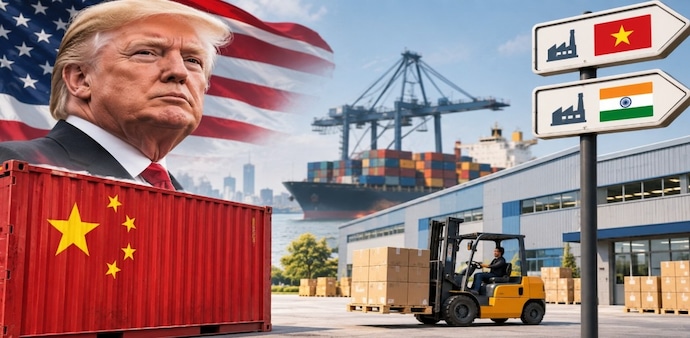
US President Donald Trump's latest tariff offensive threatens to undermine the China+1 strategy, which has reshaped global manufacturing since the US-China trade war began in 2018. With Washington targeting 14 economies across Asia and Europe, multinational companies may find fewer incentives to diversify production away from China.
According to a Bloomberg report, the proposed tariffs could erode the competitive advantages enjoyed by alternative manufacturing destinations, particularly in Southeast Asia, forcing companies to reassess their investment and supply-chain strategies.
Vietnam faces proposed tariffs of up to 35%, while India, Cambodia, Indonesia, Malaysia and Thailand could face duties of up to 25%. China faces a 20% levy on top of existing tariffs, with potentially higher duties if its trade truce with Washington breaks down.
Is manufacturing relocation losing its appeal?
The China+1 strategy gained momentum after Washington imposed tariffs on Chinese goods in 2018. Global manufacturers expanded operations in alternative Asian markets while retaining production facilities and supplier networks in China.
However, rising compliance costs, regulatory uncertainty and frequent tariff changes could make further diversification commercially unattractive.
A lot of firms “will say: ‘Well, screw it, we’re just going to go back to China,’” Deborah Elms, head of trade policy at the Hinrich Foundation in Singapore, told Bloomberg.
“‘Why would we be dealing with this massive amount of paperwork, compliance costs and tariff changes with the threat ahead if we don’t need to.”
Southeast Asia's $246 billion investment boom at risk
Southeast Asia has been among the biggest beneficiaries of manufacturing diversification. Foreign direct investment (FDI) into the region reached a record $246 billion in 2025, surpassing East Asia for the first time since the early 1990s.
Manufacturing FDI surged nearly 50% to $40 billion, driven by investments in electronics, semiconductors and automobiles.
Vietnam, in particular, emerged as a major electronics manufacturing hub. Its trade surplus with the US reached $191 billion during the first nine months of 2026, exceeding the $178 billion recorded throughout 2025.
However, Vietnam's manufacturing expansion has also deepened its dependence on China. UN Comtrade data cited by Bloomberg shows machinery exports from China and Hong Kong to Vietnam rising from approximately $7 billion in 2014 to around $20 billion in 2025.
Companies may prioritise automation over relocation
Rather than shifting factories again, multinational companies could increasingly focus on cost optimisation, automation and consolidation.
Dan Wang, a director at Eurasia Group’s China team, told Bloomberg: “It’s a year for many companies to rethink their cost synergy, and that means more layoffs, more automation, more AI application and consolidation of different markets. So moving things into a different region is not desirable.”
While existing manufacturing networks may be difficult to dismantle, prolonged tariff uncertainty could discourage fresh investments outside China, potentially reinforcing the manufacturing dominance Washington initially sought to reduce.