
Japanese infra projects in India still face significant hurdles, say top execs
The top executives were speaking at the India Today Indo-Japan Conclave 2022 about the challenges in implementing infrastructure projects in India.
- Dec 19, 2022,
- Updated Dec 19, 2022 12:59 PM IST
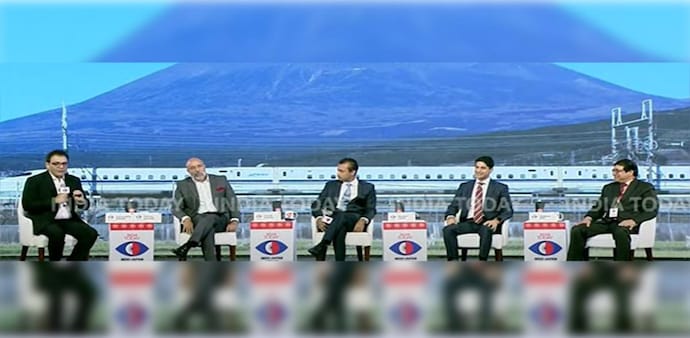
While there is a strong sense of understanding between the governments of India and Japan in terms of infrastructure development projects, more work needs to be done in terms of infusing that understanding and sense of urgency at the frontline level, said Aalok Kumar, president and CEO, NEC Corporation India. He was speaking at the India Today Indo-Japan Conclave 2022 about the challenges in implementing infrastructure projects in India.
“The word infrastructure has many subjects in it. Some of them are central subjects and some are state level subjects. For any company, the rules of the game are different at different levels. If the rules keep changing, an organisation needs to be that much more nimble, resilient to be able to successfully execute projects,” he added.
Speaking at the same session -- titled ‘Infrastructure: The new silver bullet?’ -- Faisal Ashraf, MD, Mitsui & Co. India, agreed and said that the execution of mega projects is a challenge. The panelists pointed that while there is an intention, there is a need to build ability at the ground level.
The panel also discussed the significant improvements in infrastructure in the country. Here, speakers highlighted that infrastructure also involves improving the overall user experience. “The execution capacity has gone through the roof. The kind of projects that we are delivering both at the Government and private level is tremendous,” Bharat Joshi, chairman, Joshi Konoike Transport and Infrastructure Pvt. Ltd, stated.
However, Ashraf pointed out that in terms of per capita consumption from an infrastructure perspective, India has perhaps reached one third of the infrastructure lifecycle over the last 100 years. “The next one third will probably take another 20 years. All the technologies are in place and the template for delivery is available. We are now a society which is looking for outcomes and delivery,” he added.
The session also delved into the importance of a low carbon future. Citing an example, Mangal Dev, head, Hitachi Rail Systems India and South Asia, and director, Hitachi India Pvt Ltd, said that in railways and otherwise, a phenomenal step has been taken to move from diesel traction to electric traction. “We have completed almost 80-90% of the electrification in a very short time,” he added.
Talking about unit economics, Dev said that creating mobility as a service is an answer which will not only make travel seamless but also will make the entire experience more affordable. He said that this could be done by “using digital as the backbone.”
Earlier today, External Affairs Minister Dr S Jaishankar said that while many Japanese companies had their businesses in India, they could not scale as much here as they did in other countries. Speaking at the same event, he added that Japanese businesses make "far more serious investments" in other ASEAN countries and China compared to India.
While there is a strong sense of understanding between the governments of India and Japan in terms of infrastructure development projects, more work needs to be done in terms of infusing that understanding and sense of urgency at the frontline level, said Aalok Kumar, president and CEO, NEC Corporation India. He was speaking at the India Today Indo-Japan Conclave 2022 about the challenges in implementing infrastructure projects in India.
“The word infrastructure has many subjects in it. Some of them are central subjects and some are state level subjects. For any company, the rules of the game are different at different levels. If the rules keep changing, an organisation needs to be that much more nimble, resilient to be able to successfully execute projects,” he added.
Speaking at the same session -- titled ‘Infrastructure: The new silver bullet?’ -- Faisal Ashraf, MD, Mitsui & Co. India, agreed and said that the execution of mega projects is a challenge. The panelists pointed that while there is an intention, there is a need to build ability at the ground level.
The panel also discussed the significant improvements in infrastructure in the country. Here, speakers highlighted that infrastructure also involves improving the overall user experience. “The execution capacity has gone through the roof. The kind of projects that we are delivering both at the Government and private level is tremendous,” Bharat Joshi, chairman, Joshi Konoike Transport and Infrastructure Pvt. Ltd, stated.
However, Ashraf pointed out that in terms of per capita consumption from an infrastructure perspective, India has perhaps reached one third of the infrastructure lifecycle over the last 100 years. “The next one third will probably take another 20 years. All the technologies are in place and the template for delivery is available. We are now a society which is looking for outcomes and delivery,” he added.
The session also delved into the importance of a low carbon future. Citing an example, Mangal Dev, head, Hitachi Rail Systems India and South Asia, and director, Hitachi India Pvt Ltd, said that in railways and otherwise, a phenomenal step has been taken to move from diesel traction to electric traction. “We have completed almost 80-90% of the electrification in a very short time,” he added.
Talking about unit economics, Dev said that creating mobility as a service is an answer which will not only make travel seamless but also will make the entire experience more affordable. He said that this could be done by “using digital as the backbone.”
Earlier today, External Affairs Minister Dr S Jaishankar said that while many Japanese companies had their businesses in India, they could not scale as much here as they did in other countries. Speaking at the same event, he added that Japanese businesses make "far more serious investments" in other ASEAN countries and China compared to India.