
Scaling up India's manufacturing ambitions
India's ambition to become a manufacturing hub is yet to fructify. But on-ground efforts by several states and companies are bearing fruit. Will these make India the world's next factory?
Surabhi
- Aug 21, 2026,
- Updated Aug 21, 2026 12:49 PM IST
Land, labour, capital and entrepreneurship. These are the four factors of production taught in a basic economic theory class. But reality is far different, and India is a prime case study.
Despite being one of the largest economies, the seventh-largest in the world, with a total area of 3.287 million square kms and having some of the top industry leaders and a labour force of over 610 million, manufacturing in the country is yet to pick up pace. Successive governments have tried to increase the share of manufacturing in the GDP to 25%. It remains around 16%.
Advertisement
As BT highlighted in an earlier edition, the economy continues to rely heavily on imports, and the West Asia crisis has again shown the need for greater self-reliance and ramping up manufacturing.
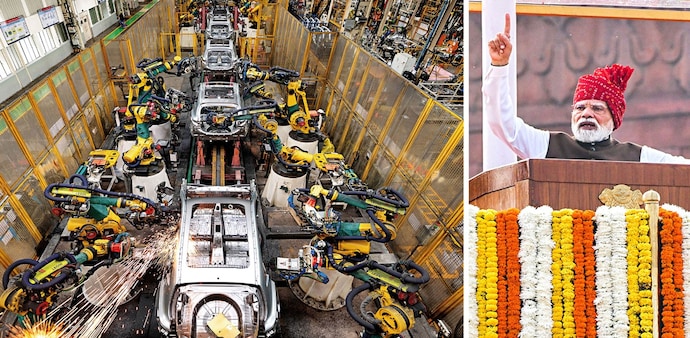
Prime Minister Narendra Modi, in his Independence Day speech, also said that India needs to significantly advance the manufacturing sector and make everything from small components to large-scale products. “The entire value chain should be ours and we should move ahead with it. From design to manufacturing, India must emerge as a trusted hub in the global supply chain,” he underlined.
Advertisement
Scaling up
Policymakers and economists remain concerned about manufacturing not taking off in a big way despite efforts ranging from liberalisation of foreign investment norms, a competitive corporate tax rate, deregulation and decriminalisation of minor offences to lowering of compliance burden and labour reforms.
We need to improve competitiveness. We have done capital, market & labour reforms, but land reforms are still in the nascent stage.
-NR BHANUMURTHY,DIRECTOR, MADRAS SCHOOL OF ECONOMICS
Rakesh Mohan, Part-Time Member of the EAC-PM and former Deputy Governor, Reserve Bank of India, who was closely associated with the 1991 economic reforms, finds it puzzling that the share of manufacturing in India’s GDP has not increased in the last 35 years. “Development experience and history demonstrate that, in this period of development, the share of manufacturing should have grown faster,” he says.
Advertisement
A lack of R&D and innovation, inability to scale up, inadequate land reforms and delays in clearances continue to plague entrepreneurs who wish to set up factories in the country, say experts.
Sanjay Kathuria, Visiting Senior Fellow, Centre for Social and Economic Progress and Co-Founder, Trade Sentinel, says India hasn’t met the target of scaling up manufacturing to 25% of GDP because it has not addressed the core problems of land, labour, regulations and skills. India continues to face the problem of a very large informal sector and the Missing Middle (medium-sized enterprises) that can provide good quality inputs to larger firms, he says.
“The main issue remains whether we have changed the disincentives against firms to gain scale. While there have been serious attempts by the government at deregulation in the last one year, we are yet to see a turnaround in private investments; and net FDI in the last few years has been in a dismal state,” he says, adding that we have not done enough to make land acquisition easier for factories. “The other issue is around trade. We remain reluctant liberalisers.”
Advertisement
While China remains the leader in manufacturing, even smaller countries like Vietnam and Bangladesh seem to have cracked the code and are producing at scale and competitive prices.
N.R. Bhanumurthy, Director, Madras School of Economics, concurs and says manufacturing has been an area India has not been able to crack. “We need to improve our competitiveness. We have done capital market and labour reforms, but land reforms are still in the nascent stage,” he says.
While there have been serious attempts at deregulation in the last one year, we are yet to see a turnaround in private investments.
-SANJAY KATHURIA,VISITING SENIOR FELLOW,CENTER FOR SOCIAL AND ECONOMIC PROGRESS
Besides ensuring greater self-reliance, a broad-based ramp-up of manufacturing will also boost economic growth that has slowed down in recent years and give meaningful employment to the workforce.
With this in mind, the government launched the Make in India campaign in September 2014, hoping to turn the country into a global manufacturing hub. Over the years, it took several initiatives—Production Linked Incentives, Employment Linked Incentives, a Rs 1 lakh crore Research Development and Innovation Fund, two rounds of the Jan Vishwas Act to lessen the fear of jail for minor offences, semiconductor a policy, support to MSMEs, Labour Codes for easier hiring and retrenchment, and plug & play industrial parks. Make in India 2.0 now focusses on 27 sectors, including 24 sub-sectors such as furniture, air-conditioners, leather and footwear, auto components, aluminium, electronics, agro-chemicals, robotics, televisions, close circuit cameras, toys, drones, medical devices and sporting devices, among others.
Advertisement
Recently, Finance Minister Nirmala Sitharaman announced tax sops to boost contract manufacturing, electronics and data centres, all of which are turning into the new growth and employment drivers.
Winds of Change?
Some of these measures have had an impact. India is now the world’s second-largest mobile phone manufacturer with at least one in four such devices being made in the country. This was highlighted in a recent official release, which noted that over the last 11 years, electronics production has increased seven-fold, electronics exports 11-fold, mobile phone production 32-fold and mobile phone exports 165-fold. India is also making inroads into the semiconductor supply chain; 12 semiconductor projects have been approved across six states.
At the national level, data for FY26 shows that manufacturing saw an upswing despite the US tariffs on the back of measures undertaken by the government to boost domestic consumption. (See Winds of Change).
Gross value added in manufacturing registered nearly 11% growth last fiscal. Exports too are on an upward trajectory with merchandise exports closing FY26 at a record $441.8 billion and remaining robust this fiscal despite the West Asia war and blockage of the Strait of Hormuz. India’s free trade agreements are also expected to give a boost to goods exports; the potential from the deals with the UK and the European Union are seen to be substantial.
Advertisement
Amid these developments, BT decided to look beyond the obvious numbers to assess the developments in manufacturing on the ground and study trends at the macro and micro level across the government and the private sector, both listed and unlisted firms.
Over the last six months, we crunched data from the Annual Survey of Industries, the Reserve Bank of India and the department of commerce to understand state-wise trends in production, exports and factory jobs among various parameters. We also worked with external partners, including How India Lives and Deloitte, to further gauge what’s happening in districts where actual factories are based and companies that are working in manufacturing. The results are truly surprising and point to what is possible over the next two decades if these trends continue and expand into other sectors (See Pockets of Growth Across States, Industries, Sectors).
States are increasingly competing for private investment and new states are in the running to become factory hubs while others like Tamil Nadu still hold the distinction of being home to the largest number of factories and creating most jobs in the sector. A blended scorecard of states, designed and developed internally across various parameters, shows that Gujarat is the country’s top manufacturing state, followed by Uttar Pradesh, with Tamil Nadu in the third rank.
Among 11 hilly states, Uttarakhand has the highest number of workers, invested capital, and contribution of manufacturing in the state economy. It also recorded 143% growth in GSVA from construction over the past 10 years.
India has the capacity to grow the manufacturing sector at 12% consistently over the next 25 years.
-SP SHARMA,CHIEF ECONOMIST, ASSOCHAM
More states are coming up with industrial policies to suit their ambitions and others like West Bengal are once again getting into the race to attract investors. The coming years will show how the manufacturing map of India changes.
Going a step deeper, an analysis by How India Lives points to the kind of industrial activity taking place in districts. The results are encouraging and sometimes surprising. Ten districts accounted for close to 40% of manufacturing exports in FY26. Jamnagar in Gujarat is the biggest exporting district with close to $36.6 billion in exports, followed by Kanchipuram in Tamil Nadu.
A closer look at India Inc’s performance through the BT-Deloitte India Manufacturing Giants list shows significant strides in both the listed and unlisted universe across sectors ranging from textiles to food processing, consumer durables, metals and refineries.
Fresh opportunities
Experts and officials believe India can fulfil its manufacturing ambitions. A recent study by industry chamber Assocham reveals that while China remains the world's largest manufacturing economy, new manufacturing investments and production capacity are increasingly being distributed across multiple economies as global firms adopt China+1, nearshoring and friendshoring strategies to build resilient and diversified supply chains.
According to the report, India's average manufacturing growth rose from 3.44% in the pre-pandemic period (2016-19) to 4.15% in 2022-25, moving from below the world average to nearly two percentage points above the global benchmark. “This remarkable improvement reflects India’s growing competitiveness in the evolving global manufacturing landscape,” it says.
S. P. Sharma, Chief Economist, Assocham, says India has the capacity to grow the manufacturing sector at 12% consistently over the next 25 years. “The share of manufacturing in the economy may have been the same in recent years but there are several positives and the future remains bright. It can slowly grow to 25% in the next decade,” he says, noting that internal demand is strong, exports are robust and several reforms have been undertaken by the government to improve the competitiveness of the sector.
A recent report by Morgan Stanley projects India’s manufacturing opportunity at $1.5 trillion by 2035. It outlines three drivers that will lift manufacturing; the active industrial policy since 2019 through targeted incentives and public capex; efforts to lift India’s export share and deepen global supply-chain integration; and multinational firms’ diversification strategies, which create opportunities to attract investment and build capacity. Supportive demographics, urbanisation, and improving infrastructure reinforce these trends.
The report highlights that the composition of manufacturing in India has changed over the last five years with competitiveness becoming increasingly concentrated in higher-value, more capital-intensive sectors with stronger global value-chain linkages. Chemicals, basic and fabricated metals, and refined petroleum products remain structural leaders, but electrical and optical equipment has shown the strongest momentum. At the same time, traditional sectors such as textiles, food, beverages, and tobacco have weakened, underscoring the uneven nature of the transition. “We expect advanced manufacturing sectors such as electronics, defence manufacturing, and energy-transition-related manufacturing to gain share and lift headline manufacturing share,” Upasana Chachra, Chief India Economist, Morgan Stanley, says in the report. While questions remain about a full revival of the private sector capex, a precondition for greater manufacturing activity, some nascent signals hint at higher private investments, at least in some sectors. Indian companies are also increasingly looking towards future technology and adoption of AI to boost efficiency and growth. R&D spends have also been on the rise with private sector expenditure outpacing that of the government for the first time in FY24.
Gross expenditure on R&D as percentage of GDP rose to a record 0.84% in FY24 but remained below the NITI Aayog recommendation of 2%. Rakesh Mohan and Kathuria both underline that R&D initiatives are a must to become a hub for hi-tech manufacturing. Kathuria says India has the potential to become a manufacturing hub with the changing global trade dynamics. “The two major global economies, the US and China, are proving to be increasingly whimsical and are weaponising trade. This provides India another opportunity on both trade and manufacturing. It should stand up to be counted as a serious and reliable partner for the middle powers,” he says, adding that even doubling our merchandise exports will increase India’s share in global goods exports to 4% from 1.8%.
“This is not inconceivable—in fact, it is necessary —and a focus on manufactured exports will also provide good quality employment.”
But reforms will have to continue to ensure that India is home to more factories that create jobs for its workforce. The government is also upbeat that manufacturing in India will continue to grow over the next few years. Measures taken till now are already bearing fruit and will show more results going forward. “In any case, this is a top priority for the government, and more measures will be taken as and when the need arises. This is a continuous process and not a one-stop shop,” says a senior official.
Over the next few pages, walk with BT as we take you on a journey around the country, giving you a peek into states and companies building and strengthening their manufacturing ambitions and taking Make in India to newer frontiers.
@surabhi
Land, labour, capital and entrepreneurship. These are the four factors of production taught in a basic economic theory class. But reality is far different, and India is a prime case study.
Despite being one of the largest economies, the seventh-largest in the world, with a total area of 3.287 million square kms and having some of the top industry leaders and a labour force of over 610 million, manufacturing in the country is yet to pick up pace. Successive governments have tried to increase the share of manufacturing in the GDP to 25%. It remains around 16%.
Advertisement
As BT highlighted in an earlier edition, the economy continues to rely heavily on imports, and the West Asia crisis has again shown the need for greater self-reliance and ramping up manufacturing.
Prime Minister Narendra Modi, in his Independence Day speech, also said that India needs to significantly advance the manufacturing sector and make everything from small components to large-scale products. “The entire value chain should be ours and we should move ahead with it. From design to manufacturing, India must emerge as a trusted hub in the global supply chain,” he underlined.
Advertisement
Scaling up
Policymakers and economists remain concerned about manufacturing not taking off in a big way despite efforts ranging from liberalisation of foreign investment norms, a competitive corporate tax rate, deregulation and decriminalisation of minor offences to lowering of compliance burden and labour reforms.
We need to improve competitiveness. We have done capital, market & labour reforms, but land reforms are still in the nascent stage.
-NR BHANUMURTHY,DIRECTOR, MADRAS SCHOOL OF ECONOMICS
Rakesh Mohan, Part-Time Member of the EAC-PM and former Deputy Governor, Reserve Bank of India, who was closely associated with the 1991 economic reforms, finds it puzzling that the share of manufacturing in India’s GDP has not increased in the last 35 years. “Development experience and history demonstrate that, in this period of development, the share of manufacturing should have grown faster,” he says.
Advertisement
A lack of R&D and innovation, inability to scale up, inadequate land reforms and delays in clearances continue to plague entrepreneurs who wish to set up factories in the country, say experts.
Sanjay Kathuria, Visiting Senior Fellow, Centre for Social and Economic Progress and Co-Founder, Trade Sentinel, says India hasn’t met the target of scaling up manufacturing to 25% of GDP because it has not addressed the core problems of land, labour, regulations and skills. India continues to face the problem of a very large informal sector and the Missing Middle (medium-sized enterprises) that can provide good quality inputs to larger firms, he says.
“The main issue remains whether we have changed the disincentives against firms to gain scale. While there have been serious attempts by the government at deregulation in the last one year, we are yet to see a turnaround in private investments; and net FDI in the last few years has been in a dismal state,” he says, adding that we have not done enough to make land acquisition easier for factories. “The other issue is around trade. We remain reluctant liberalisers.”
Advertisement
While China remains the leader in manufacturing, even smaller countries like Vietnam and Bangladesh seem to have cracked the code and are producing at scale and competitive prices.
N.R. Bhanumurthy, Director, Madras School of Economics, concurs and says manufacturing has been an area India has not been able to crack. “We need to improve our competitiveness. We have done capital market and labour reforms, but land reforms are still in the nascent stage,” he says.
While there have been serious attempts at deregulation in the last one year, we are yet to see a turnaround in private investments.
-SANJAY KATHURIA,VISITING SENIOR FELLOW,CENTER FOR SOCIAL AND ECONOMIC PROGRESS
Besides ensuring greater self-reliance, a broad-based ramp-up of manufacturing will also boost economic growth that has slowed down in recent years and give meaningful employment to the workforce.
With this in mind, the government launched the Make in India campaign in September 2014, hoping to turn the country into a global manufacturing hub. Over the years, it took several initiatives—Production Linked Incentives, Employment Linked Incentives, a Rs 1 lakh crore Research Development and Innovation Fund, two rounds of the Jan Vishwas Act to lessen the fear of jail for minor offences, semiconductor a policy, support to MSMEs, Labour Codes for easier hiring and retrenchment, and plug & play industrial parks. Make in India 2.0 now focusses on 27 sectors, including 24 sub-sectors such as furniture, air-conditioners, leather and footwear, auto components, aluminium, electronics, agro-chemicals, robotics, televisions, close circuit cameras, toys, drones, medical devices and sporting devices, among others.
Advertisement
Recently, Finance Minister Nirmala Sitharaman announced tax sops to boost contract manufacturing, electronics and data centres, all of which are turning into the new growth and employment drivers.
Winds of Change?
Some of these measures have had an impact. India is now the world’s second-largest mobile phone manufacturer with at least one in four such devices being made in the country. This was highlighted in a recent official release, which noted that over the last 11 years, electronics production has increased seven-fold, electronics exports 11-fold, mobile phone production 32-fold and mobile phone exports 165-fold. India is also making inroads into the semiconductor supply chain; 12 semiconductor projects have been approved across six states.
At the national level, data for FY26 shows that manufacturing saw an upswing despite the US tariffs on the back of measures undertaken by the government to boost domestic consumption. (See Winds of Change).
Gross value added in manufacturing registered nearly 11% growth last fiscal. Exports too are on an upward trajectory with merchandise exports closing FY26 at a record $441.8 billion and remaining robust this fiscal despite the West Asia war and blockage of the Strait of Hormuz. India’s free trade agreements are also expected to give a boost to goods exports; the potential from the deals with the UK and the European Union are seen to be substantial.
Advertisement
Amid these developments, BT decided to look beyond the obvious numbers to assess the developments in manufacturing on the ground and study trends at the macro and micro level across the government and the private sector, both listed and unlisted firms.
Over the last six months, we crunched data from the Annual Survey of Industries, the Reserve Bank of India and the department of commerce to understand state-wise trends in production, exports and factory jobs among various parameters. We also worked with external partners, including How India Lives and Deloitte, to further gauge what’s happening in districts where actual factories are based and companies that are working in manufacturing. The results are truly surprising and point to what is possible over the next two decades if these trends continue and expand into other sectors (See Pockets of Growth Across States, Industries, Sectors).
States are increasingly competing for private investment and new states are in the running to become factory hubs while others like Tamil Nadu still hold the distinction of being home to the largest number of factories and creating most jobs in the sector. A blended scorecard of states, designed and developed internally across various parameters, shows that Gujarat is the country’s top manufacturing state, followed by Uttar Pradesh, with Tamil Nadu in the third rank.
Among 11 hilly states, Uttarakhand has the highest number of workers, invested capital, and contribution of manufacturing in the state economy. It also recorded 143% growth in GSVA from construction over the past 10 years.
India has the capacity to grow the manufacturing sector at 12% consistently over the next 25 years.
-SP SHARMA,CHIEF ECONOMIST, ASSOCHAM
More states are coming up with industrial policies to suit their ambitions and others like West Bengal are once again getting into the race to attract investors. The coming years will show how the manufacturing map of India changes.
Going a step deeper, an analysis by How India Lives points to the kind of industrial activity taking place in districts. The results are encouraging and sometimes surprising. Ten districts accounted for close to 40% of manufacturing exports in FY26. Jamnagar in Gujarat is the biggest exporting district with close to $36.6 billion in exports, followed by Kanchipuram in Tamil Nadu.
A closer look at India Inc’s performance through the BT-Deloitte India Manufacturing Giants list shows significant strides in both the listed and unlisted universe across sectors ranging from textiles to food processing, consumer durables, metals and refineries.
Fresh opportunities
Experts and officials believe India can fulfil its manufacturing ambitions. A recent study by industry chamber Assocham reveals that while China remains the world's largest manufacturing economy, new manufacturing investments and production capacity are increasingly being distributed across multiple economies as global firms adopt China+1, nearshoring and friendshoring strategies to build resilient and diversified supply chains.
According to the report, India's average manufacturing growth rose from 3.44% in the pre-pandemic period (2016-19) to 4.15% in 2022-25, moving from below the world average to nearly two percentage points above the global benchmark. “This remarkable improvement reflects India’s growing competitiveness in the evolving global manufacturing landscape,” it says.
S. P. Sharma, Chief Economist, Assocham, says India has the capacity to grow the manufacturing sector at 12% consistently over the next 25 years. “The share of manufacturing in the economy may have been the same in recent years but there are several positives and the future remains bright. It can slowly grow to 25% in the next decade,” he says, noting that internal demand is strong, exports are robust and several reforms have been undertaken by the government to improve the competitiveness of the sector.
A recent report by Morgan Stanley projects India’s manufacturing opportunity at $1.5 trillion by 2035. It outlines three drivers that will lift manufacturing; the active industrial policy since 2019 through targeted incentives and public capex; efforts to lift India’s export share and deepen global supply-chain integration; and multinational firms’ diversification strategies, which create opportunities to attract investment and build capacity. Supportive demographics, urbanisation, and improving infrastructure reinforce these trends.
The report highlights that the composition of manufacturing in India has changed over the last five years with competitiveness becoming increasingly concentrated in higher-value, more capital-intensive sectors with stronger global value-chain linkages. Chemicals, basic and fabricated metals, and refined petroleum products remain structural leaders, but electrical and optical equipment has shown the strongest momentum. At the same time, traditional sectors such as textiles, food, beverages, and tobacco have weakened, underscoring the uneven nature of the transition. “We expect advanced manufacturing sectors such as electronics, defence manufacturing, and energy-transition-related manufacturing to gain share and lift headline manufacturing share,” Upasana Chachra, Chief India Economist, Morgan Stanley, says in the report. While questions remain about a full revival of the private sector capex, a precondition for greater manufacturing activity, some nascent signals hint at higher private investments, at least in some sectors. Indian companies are also increasingly looking towards future technology and adoption of AI to boost efficiency and growth. R&D spends have also been on the rise with private sector expenditure outpacing that of the government for the first time in FY24.
Gross expenditure on R&D as percentage of GDP rose to a record 0.84% in FY24 but remained below the NITI Aayog recommendation of 2%. Rakesh Mohan and Kathuria both underline that R&D initiatives are a must to become a hub for hi-tech manufacturing. Kathuria says India has the potential to become a manufacturing hub with the changing global trade dynamics. “The two major global economies, the US and China, are proving to be increasingly whimsical and are weaponising trade. This provides India another opportunity on both trade and manufacturing. It should stand up to be counted as a serious and reliable partner for the middle powers,” he says, adding that even doubling our merchandise exports will increase India’s share in global goods exports to 4% from 1.8%.
“This is not inconceivable—in fact, it is necessary —and a focus on manufactured exports will also provide good quality employment.”
But reforms will have to continue to ensure that India is home to more factories that create jobs for its workforce. The government is also upbeat that manufacturing in India will continue to grow over the next few years. Measures taken till now are already bearing fruit and will show more results going forward. “In any case, this is a top priority for the government, and more measures will be taken as and when the need arises. This is a continuous process and not a one-stop shop,” says a senior official.
Over the next few pages, walk with BT as we take you on a journey around the country, giving you a peek into states and companies building and strengthening their manufacturing ambitions and taking Make in India to newer frontiers.
@surabhi
Read more!