
A slew of luxe brands is championing India’s craft heritage on the international stage
A slew of luxe brands is championing India’s craft heritage on the international stage
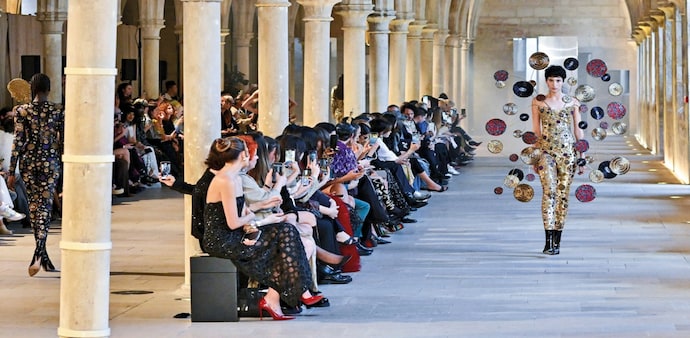
A slew of luxe brands is championing India's craft heritage on the international stage, swiftly solidifying the country's status as a creator of artisanal couture.
Simi Kuriakose
- Oct 8, 2025,
- Updated Oct 13, 2025 2:54 PM IST
In a catalogue of developing nations acting as close-lipped contributors to Europe’s uber-elite maisons, India’s name would be scribbled in invisible ink. Inputs of the subcontinent’s skilled craftspersons are an integral—and oft-ignored—part of production processes for luxury labels like Dior, Isabel Marant, Chanel and Hermès (to name a few).
Hey!
Already a subscriber? Sign In
THIS IS A PREMIUM STORY FROM BUSINESS TODAY.
Subscribe to Business Today Digital and continue enjoying India's premier business offering uninterrupted
only FOR
₹999 / Year
Unlimited Digital Access + Ad Lite Experience
Cancel Anytime
-
 Unlimited access to Business Today website
 -
 Exclusive insights on Corporate India's working, every quarter
 -
 Access to our special editions, features, and priceless archives
 -
 Get front-seat access to events such as BT Best Banks, Best CEOs and Mindrush
In a catalogue of developing nations acting as close-lipped contributors to Europe’s uber-elite maisons, India’s name would be scribbled in invisible ink. Inputs of the subcontinent’s skilled craftspersons are an integral—and oft-ignored—part of production processes for luxury labels like Dior, Isabel Marant, Chanel and Hermès (to name a few).
Advertisement
That tide has been shifting in recent years. India’s artisanship truly came to light in March 2023 at Dior’s grand Pre-Fall show at Mumbai’s Gateway of India, which aimed the spotlight on karigars of the Chanakya School of Craft—helmed by founders Karishma Swali and Monica Shah—under the stewardship of then Creative Director Maria Grazia Chiuri. This watershed moment was an acknowledgement from the West of the silent labour behind Indian craft.
Earlier this year, British brand Vivienne Westwood followed suit with its own Gateway show that celebrated India’s heritage textiles.
Such newfound interest in Indian craft is honour delayed. Long before organised fashion, India was the global textile capital—a tag it lost, not least because of colonial plunder. Diving into history, couturier Rahul Mishra explains that the momentum of our textiles was such that “our chintz was banned in France” and partially in Britain in the 17th century to safeguard domestic industries.
Advertisement
In recent years, India has reclaimed its legacy as a market of craft connoisseurs. Now, it is rising up the rungs of the global luxury ladder to secure a spot as a leader. A clutch of designers is taking the Indian story to the world and is being feted at flagship events where its craft was but a footnote. These designers are not just shaping legacies as global powerhouses; they are weaving an India-proud narrative.
That story has been boosted by the growing market back home. India’s luxury market is projected to touch $12 billion by 2028, outpacing even China, a report by consultancy firm Kearney suggests. This is surprising given luxury has seen a sharp decline globally after the pandemic, owing to factors including, but not limited to, economic slowdown in developed countries, steep price rise, and now, the tariff wars.
Advertisement
In India, the fashion scene has seen a steady rise over the past two decades. In the early aughts, a string of Indian designers made it big on the international stage. Tarun Tahiliani showcased at Milan Fashion Week (2003), Sabyasachi Mukherjee debuted on the same stage in 2004, showcased again in 2006, and later at the New York Fashion Week (2006). Anamika Khanna, who recently made her London Fashion Week debut with her brand AK|OK Anamika Khanna on September 22, was India’s first female designer at Paris Fashion Week (2007). Almost a decade later, Rahul Mishra won the International Woolmark Prize, which recognises outstanding fashion talents from around the globe, in 2014, and has since been a global force—his was the first Indian brand to be part of the Paris Haute Couture Week (2020).
The couturier recalls the lull prior to his win: “When Divya [Bhatt Mishra, co-founder and Rahul’s wife] and I were competing at the Woolmark Prize, the global press hardly noticed us. But once the jury declared me the winner, everything changed—the spotlight was suddenly on India. Once seen as a service provider for luxury embroidery, India is now writing its own story on the global stage.” With a flagship in Mumbai, Rahul will announce a Parisian address next year, one that Divya says will carry the brand’s DNA but speak to an international clientele.
Advertisement
In the luxury fashion race, you cannot miss names like Sabyasachi, Gaurav Gupta, Vaishali Shadangule, Manish Malhotra. Often compared to Ralph Lauren on home soil, Sabyasachi’s 25-year-old eponymous brand aims to become a $2 billion enterprise by 2030. Fine credentials back up his India-to-the-world story—a store in New York that opened in 2022; collaborations with Christian Louboutin, Morgenthal Frederics, and H&M; high jewellery lines exclusive to Bergdorf Goodman, Neiman Marcus San Francisco, and Harrods; a lipstick collection with Estée Lauder; a soon-to-launch fragrance line. Sabyasachi ticks every box for front row representation in global fashion.
Another regular at Paris Haute Couture Week is Gupta, whose “brand has existed in a global dialogue from Couture Week to Met Gala”. While a physical presence in Europe or North America would feel like the next chapter in their story, Gupta wants the expansion “to feel organic”. The challenge, Gupta shares, is creating a space that retains India’s spirit yet feels completely at home on Madison Avenue in New York or Avenue Montaigne in Paris. “For me, the store must educate, engage an audience who may not have grown up with Indian craft, but are excited to experience it.”
Advertisement
With stores in both Mumbai and Paris, Shadangule (the first Indian female designer to showcase at Paris Haute Couture Week in 2021) says, “Niche Indian luxury brands are new and our brand was lucky to start selling from the first month after the Paris Couture show.” However, there are challenges aplenty, as people want to know the brand and see consistency in quality. “Paris has a small diaspora share, so our store is mostly suited for Middle Eastern and American clients, both receptive towards Indian workmanship,” she adds.
Though the West may have been late in giving Indian labels their due, that’s not been the case with other regions like the Middle East. It is closer to home and one where Indian sensibilities find common ground. According to a 2024 report by market research company IMARC, the luxury goods market in the region is expected to reach $11.44 billion by 2033.
Malhotra, who launched his Dubai store in 2023, saw potential early on. “The idea was to create a space where my work could travel naturally to an audience that values craftsmanship. At the same time, it unites Indian artistry with the global language of couture.” He is in no rush to take the brick-and-mortar route in Europe and America. “Expansion is about timing and finding the right way to tell our story.”
Advertisement
ewellery and beauty brands from India were pioneers of retail internationalisation. In the former market, Jaipur-based Amrapali has withstood the test of time. Launched by Rajiv Arora and Rajesh Ajmera in the 1970s, the silver jewellery brand forayed into luxury, debuting at London’s Selfridges in the 2000s. Now, they boast stores in India, London, and Dubai.
CEO & Creative Director Tarang Arora tells BT that Amrapali’s diaspora loyalists say their international clientele was familiarised with Indian artisanship after “Amrapali introduced their jewellery in these markets.”
For India’s affluent and international celebrities—Beyoncé, Meryl Streep, Rihanna, Cher, and more—Hanut Singh is the jeweller of choice. With a Delhi store launched in 2002, and retailing from Fred Leighton New York and Roseark, Los Angeles, Singh’s avant-garde designs have helped ignite a global appreciation for Indian luxe jewellery.
On the beauty front, Forest Essentials and Kama Ayurveda took the onus to drive global influence—retailing in India and the UK. Was it challenging to convince global consumers to view these brands on an equal footing with their international counterparts? Vivek Sahni, who founded Kama Ayurveda in 2002, thinks the only way to tackle this is to push authentic Ayurveda in its holistic sense.
“The concern was around awareness and efficacy of formulations, which we solved by doing clinical trials for products before they were sold in the UK. We also became the first Indian beauty brand to be awarded the Butterfly Mark certification for Positive Luxury by meeting sustainability’s highest standards,” says Sahni.
For Forest Essentials, the challenge was making Ayurveda feel aspirational, says Executive Director Samrath Bedi. Founded in 2000, the team deduced a workable solution; “to maintain the highest standards while investing in packaging, design, and communication that speak the language of global luxury.” Bedi says, “Consumers recognise we spend 18 months to two years on a product. That rigour, combined with our farm-to-bottle authenticity, places us on a par with international peers.”
That both succeeded in their quests is testified by the interest they elicited from global beauty giants. Spanish conglomerate Puig acquired a majority stake in Kama Ayurveda in 2019 and Estée Lauder Companies bought a minority stake in Forest Essentials in 2008.
A fail-safe brand will pique inter-generational curiosity. While Ayurveda has, for long, commanded the attention of Gen X and millennials alike, attracting a younger demographic can be difficult. Bedi feels Gen Z has fundamentally reshaped luxury, “They demand authenticity, purpose, and transparency. Gen Z resonates with a deeper sense of personalisation and knowledge, and values sustainability and clean formulations.”
Here is a belief in fashion circles that it is only India’s diaspora that advocates for homegrown designers. Malhotra stresses that people respond to great craft when they see one. “When we showcased at the Harrods Private Shopping Penthouse in London (2024), I saw firsthand how curious clients were—they wanted to hear the story behind each piece. And it’s not just Indians abroad, everyone is recognising the beauty of handwork.”
Rahul feels craftsmanship alone isn’t enough because “every second outfit showcased at couture shows is made in India. Storytelling is important”. For an international audience, appeal goes beyond just exporting craft. “It is about exporting an evolved idea of Indian luxury that is avant-garde, global, and future-facing,” says Gupta.
Tarang of Amrapali highlights the dependence on the diaspora since it appreciates Indian craftsmanship more than people of other nationalities. “They understand the traditional parts and want to reconnect with their origin through jewellery, especially during special occasions.”
Paris-based Indian designer Mohanjeet Grewal, who set up her store at the city’s Rue de Bac in 1964, is elated to see that India is acknowledged on global platforms. However, she stresses that brands must harp on their ‘Indian-ness’, “Brands branching out of India must become an entity on their own, so they continue after.”
Indian luxury labels are well aware of this, and brands like Rahul Mishra “look to carry forward the legacy through textiles, embroidery, and handwork”. Though proud of their origin, homegrown designers have realised the key to world domination is blending Indian craft with international sensibilities. Gupta sums it up, adding that his mission is to present Indian couture as futuristic and subversive. “I want to show that Indian couture can sit next to Balenciaga or Schiaparelli and hold its own.” (With inputs from Sakshi Batra)
Craft Deserves Credit
The global design fraternity has relentlessly drawn inspiration from communities it has romanticised through literature and history. However, the line between appreciation and appropriation is crossed when the receiver plunders cultural pasts to satiate creative visions without crediting the source. While a few brands have expressed regret in the past—Rodarte (2012), when accused of insensitivity towards Australian aboriginal culture, licensed the artwork and shared proceeds with the respective party, and Marc Jacobs (2017) responded with an apology when models donned dreadlocks—others like Gucci (2018) refused to issue apologies.
The recent row over Prada’s 2026 men’s collection featuring a version of Kolhapuris, the traditional handcrafted leather sandals that has received a GI-tag covering artisans from Maharashtra and Karnataka, is yet another case of appropriation. After social media outcry, the brand acknowledged the sandal’s origin and met Kolhapuri artisans, later hinting at a collaboration. However, such borrowing is detrimental to commerce for the artisans. Rahul Mishra points out that India is “a mix of America’s innovation, France’s craftsmanship, and China’s scale. What is missing is protecting our IPs.” Malhotra says the way forward is “through respectful collaboration. You have to give credit to the craft and the people behind it, and honour the communities that keep it alive.”
(With inputs by Sakshi Batra)
Read more!