
ABDL: What ABDL’s Recent Moves Mean for its Growth
Allied Blenders and Distillers has made some interesting moves recently, positioning itself for a compelling growth story
Krishna Gopalan
- Mar 25, 2026,
- Updated Mar 25, 2026 7:43 PM IST
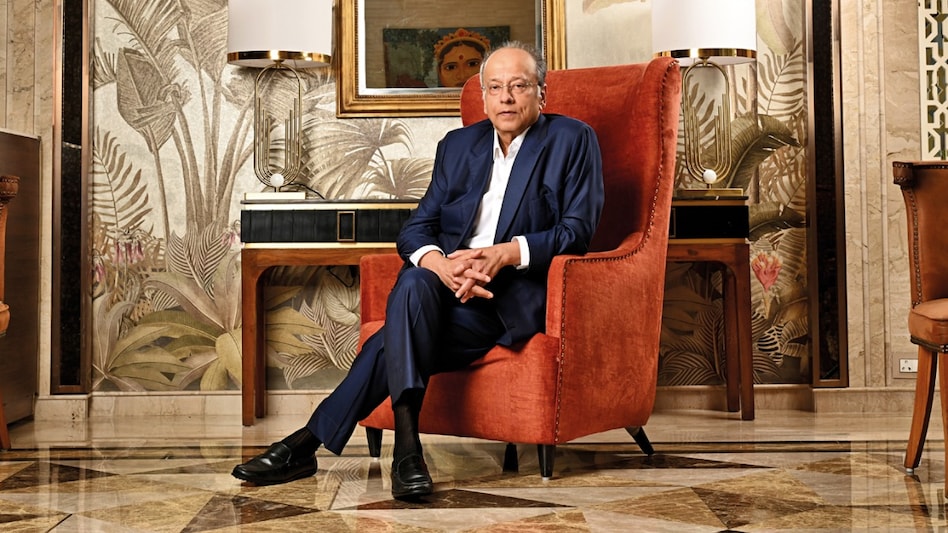
It is hard to pin down Kishore Chhabria for a conversation, and when the opportunity comes, you seize it. Sitting in his home in Malabar Hill, a part of tony south Mumbai, the 71-year-old sips tea gently. The packaged water bottles on the table stand in stark contrast to the corner of the room, where there are neatly arranged bottles of liquor.
Advertisement
All the brands belong to Chhabria’s company, Allied Blenders and Distillers (ABD), including Officer’s Choice, Sterling Reserve, Iconiq whisky and Zoya gin, among others.
Chhabria is curious about our tastes and shifts the conversation from the present to the past, without venturing to predict what lies ahead. For over four decades, Chhabria has seen the Indian spirits industry grow despite unpredictable regulations and through his own corporate battles. Be it with brother, Manu Chhabria, or the later run-in with one-time liquor baron, Vijay Mallya, for control over BDA, a company they set up together, this feisty man has lived to tell a long tale.
Advertisement
In July 2024, ABD went public, and the issue was subscribed 23 times. Currently, it has a market capitalisation of Rs 14,000 crore and is the third-largest player in the Indian-made foreign liquor (IMFL) market.
For Chhabria, a major achievement during this successful period has been allowing his core team to run the organisation. “You need to create an institution where people are allowed to make decisions. I intended to professionalise the company and empower the team,” he says.
That process started in 2007-08. In 2019, when capital was needed, Chhabria decided to sell a part of his holding. “I wanted to create wealth for the family, but did not get the desired valuation. Going public then became logical, and not selling out turned out to be a good decision.”
Advertisement
With ABD’s multi-pronged strategy—premiumisation, backward integration and investing in brands—he is hungry for more. “Innovation excites me,” he says calmly. By the looks of it, he is backing that view in more ways than one.
The Core Strategy
Alok Gupta, ABD’s Managing Director, says his team follows the principle of E = mc2, but with a difference. Here, “e” stands for enterprise value, achieved through margin enhancement (m) and the two Cs, capital discipline and consumer centricity.
We chose Rangapur since we had land, power and labour. It became possible to get to top capacity for PET bottles in just about 12 months. It’s not just about backward integration but ensuring it is margin accretive.
-Alok Gupta, MD, ABD
In late October 2024, ABD acquired Minakshi Agro Industries for Rs Rs 72 crore. Not a big amount by any stretch, but it brought home a distillery in Aurangabad that manufactured grain spirit. With an installed capacity of 11 million litres per annum (mlpa) and land for expansion, it was strategically critical. Soon, ABD announced a capex outlay of Rs 525 crore that included Rs 260 crore to achieve 100% captive ENA (extra neutral alcohol, the base ingredient for alcoholic beverages) at Minakshi’s plant and that it would expand capacity to 61 mlpa by FY27.
Advertisement
This forms the first phase of ABD’s backward integration to enhance gross margins by around 3% by FY28 from 42% in FY25. This includes PET bottle manufacturing and commissioning a single malt distillery, both in Telangana’s Rangapur, about 150 km from Hyderabad. “We chose Rangapur since we had land, power and labour. It became possible to get to top capacity for PET bottles in just about 12 months,” says Gupta. To him, it’s not just about backward integration but ensuring it is margin accretive. The PET bottle project is part of its overall capex.
In January, ABD bought a non-operational distillery in Uttar Pradesh’s Moradabad for Rs 70 crore from National Industrial Corporation, with the intention of investing Rs 40 crore to upgrade the bottling unit. The state is among ABD’s top three markets and, like Maharashtra, opens the possibility of expanding ENA distillation. Company trackers appear to back the backward integration strategy. “These initiatives reduce the dependence on inputs, improve cost control and structurally enhance margins and earnings quality,” says Manoj Menon, Head of Research at ICICI Securities. Recently, ABD announced that it would acquire a 50% stake in Kion Blenders Industries, a company in the business of distilling, blending, bottling, packaging and distributing alcohol. The deal will entail setting up a distillery in Andhra Pradesh at an investment of Rs 300 crore. ABD has a significant presence in Andhra Pradesh, Telangana, UP and Maharashtra, which are among the top five to six markets in India.
Advertisement
In addition to margin enhancement, ABD has been working towards optimising costs to include reducing interest costs, an exercise done post-listing. This is an important component of overall capital discipline, with the thrust being on generating more cash. Chetan Mahadik, Associate Vice President, Systematix Research, underscores that strict gross margin discipline at the unit level is central to ABD’s strategy. “The company evaluates profitability at a state-brand SKU (stock keeping unit) level for all brands and exits variants that fail to meet its threshold gross margin,” he says. In Uttar Pradesh—a key alcohol-consuming market—the 750 ml SKU of Officer’s Choice was phased out because it did not meet the required gross margin criteria.
Going public helped the company to reduce debt, creating headroom for strategic capex. The decision to invest in a malt distillery has been driven by the desire to optimise costs and capitalise on the emerging opportunity in the single malt market, the aim being to achieve “margin security.” Potentially, it also provides the company a chance to participate in the global single malt story.
Advertisement
“For ABD, the profitability story lies in its backward integration strategy. Apart from just good visibility on profitability, the simplicity of that strategy is a huge plus,” says Abhijeet Kundu, Co-Head of Research, Institutional equities, at Antique Stock Broking.
For ABD, the profitability story lies in its backward integration strategy. Apart from just good visibility on profitability, the simplicity of that strategy is a huge plus.
-Abhijeet Kundu, Co-head of Research, Institutional Equities, Antique Stock Broking
The Portfolio Piece
Of ABD’s 33 million cases (one case is 9 litres) sold in FY25, Officer’s Choice whisky in the mass premium segment (launched in 1988) accounted for 18.3 million cases. However, Iconiq White whisky has been the real success. The idea behind Iconiq is to reduce dependence on Officer’s Choice.
Launched in 2022, it sold 5.7 million cases in FY25, and 7.7 million cases in the first nine months of the current fiscal. Speaking of the gap in the market, Gupta points to consumer feedback on why most whisky brands looked the same.
“If you think about it, it’s really about black, blue and red, making it somewhat predictable,” he explains. When it came to blends or tastes, it was clear consumers were willing to try something new. “Finally, we went for a white label, kept the language on the bottle simple and just made it an uncomplicated offering,” says Gupta.
At ABD, each brand is looked at closely, regardless of how old it may be. It perhaps explains why Officer’s Choice in the mass premium segment delivers gross margins upwards of 45%. This is at a time when that space is growing the slowest on the back of a more aspirational bunch of consumers moving on to more expensive options.
Kundu says healthy margins are the result of ABD building on its strengths across key markets, ensuring brand recall is very high. “It is a good example of sensible capital allocation.”
Super Premium and Beyond
Last March, ABD shifted its premium brands portfolio to a new entity called ABD Maestro. The parent put in Rs 70 crore for an 80% holding, with the other 20% being picked up by actor Ranveer Singh, who came aboard as co-founder and creative partner.
Bikram Basu, MD of ABD Maestro, says it was possible to sell super-premium and luxury brands through a different vertical within the company. Instead, it chose to make a focused subsidiary and build a portfolio of brands. “The move to have a superstar like Ranveer Singh is strategic and mutually beneficial.”
The landscape for consumer experience has changed very quickly. With ABD Maestro, we have been able to build this skill set and culture, given the premium focus of our portfolio.
-Bikram Basu, MD, ABD Maestro
Historically, ABD’s brands have played in the mass-premium to premium segments. According to Basu, there was never a separate team for modern on-trade, namely star hotels, upscale fine or casual dining, pubs, bars or social clubs, nor for modern retail formats. “In both these spaces, the landscape for consumer experience has changed very quickly. With ABD Maestro, we have been able to build this skill set and culture, given the premium focus of our portfolio,” he explains.
Today, ABD Maestro has a play across spirits—among them are Arthaus blended scotch, Yello designer whisky, Rangeela Indian vodka, Zoya gin, plus imported Russian Standard vodka.
Through the acquisition of Goa-based Fullarton Distilleries’ brands (Woodburns Indian whisky, Pumori gin and Segredo Aldeia), the existing portfolio was widened. This February, ABD Maestro launched The Collective Limited Editions, a single malt priced at Rs 11 lakh per bottle.
The numbers justify ABD’s overall premiumisation push. In the mass and premium segments, whisky accounts for around 65% of the overall market. As one moves to a higher price point, that number for whisky increases to 90%, with the rest of the market—including white spirits—taking away the rest.
Understandably, margins will be higher at these price points with headroom for growth. Gupta recollects how ABD looked at the luxury market closely. “At about 3% of overall volumes, roughly 1% is only standard scotch, where there are easily 40 brands,” he says.
For the company, the right to win is more important than the right to play. “It made little sense to have another standard scotch brand. I must be able to offer something more relevant and different.” What remains has a limited number of players. “It is rarely more than two or three, and that is where we have the right to win,” he adds.
Though the luxury market is generally brand-led and import-driven, ABD believes its vision to win in this market involves a combination of factors like opportunity for its own brands, ability to bring in more international brands, and strength of distribution.
The Bits and Pieces
Over time, the definition of a well-run spirits company, according to Shekhar Ramamurthy, ABD’s Executive Deputy Chairman, has fundamentally changed. “Earlier, scale and access were often sufficient. Today, execution quality and unit economics matter far more,” he says.
Portfolio discipline is critical, and companies must manage state-wise pricing, mix and costs, rather than relying only on volume growth. Capital efficiency has become non-negotiable.
-Shekhar Ramamurthy, Executive Deputy Chairman, ABD
Three points in his view make that big difference. “Portfolio discipline is critical, and companies must manage state-wise pricing, mix and costs, rather than relying only on volume growth. Capital efficiency has become non-negotiable. Manufacturing assets, brand investments and capacity expansion require significant capital, and returns must be predictable and timely,” he explains. Finally, consumer understanding “must be grounded in reality, based on how people actually consume across income segments and occasions.”
The Indian spirits market is mainly controlled by two big multinational companies. One is Diageo from the United Kingdom, which bought United Spirits from Vijay Mallya. The other is Pernod Ricard, whose presence in India grew significantly in 2001 after it acquired Seagram globally. This deal brought popular whisky brands such as Royal Stag, 100 Pipers, Imperial Blue, and Blender’s Pride into its portfolio. Last July, Pernod Ricard sold Imperial Blue (the brand was then doing around 22 million cases per annum) to Tilaknagar Industries for Rs 4,150 crore. Despite two brands dominating in India, ABD’s edge lies in the fact that the numbers for domestic players are increasing faster than those of the international players.
In India, the path to success is not about deep pockets. Ramamurthy outlines how the alcobev market is highly regulated, fragmented and state-driven. “It means strategy and execution matter more than spend. ABD competes by being very clear about where we play and how we win,” he says.
According to him, the approach is to focus on segments where scale, margins, and distribution depth can co-exist. “Backward integration protects margins, while selective investments ensure capital is deployed with discipline.”
Antique Stock Broking’s Kundu thinks ABD is a case of successful professionalisation. “It is a big positive for the organisation,” he says. The acquisition strategy of ABD, in his view, is quite similar to that of any well-run FMCG company.
“They acquire small brands and scale them up very smartly. Obviously, their distribution strength helps.” Clearly, the strategy has evolved for ABD and must continue to do so.
To ICICI Securities’ Menon, the build-buy-partner model is a strategic differentiator, with partnerships being particularly unique. “They have built Iconiq White to make it one of the fastest-growing whisky brands. The acquisition of Fullarton Distilleries’ brands has brought in a premium set, accelerating the entry into high-margin craft segments,” he says. The partnership with Ranveer Singh, adds Menon, “goes beyond the more traditional endorsement model.”
That said, the management is not taking its eyes off every growth opportunity. Chhabria, when asked why the current moment is exciting for the company, is clear that ABD is still in its infancy. “There are great plans, and we already have some great products, making the future very vibrant.”
After decades in one of India’s most volatile industries, restraint still appears to be the preferred blend for the man who built a liquor empire.
@krishnagopalan
It is hard to pin down Kishore Chhabria for a conversation, and when the opportunity comes, you seize it. Sitting in his home in Malabar Hill, a part of tony south Mumbai, the 71-year-old sips tea gently. The packaged water bottles on the table stand in stark contrast to the corner of the room, where there are neatly arranged bottles of liquor.
Advertisement
All the brands belong to Chhabria’s company, Allied Blenders and Distillers (ABD), including Officer’s Choice, Sterling Reserve, Iconiq whisky and Zoya gin, among others.
Chhabria is curious about our tastes and shifts the conversation from the present to the past, without venturing to predict what lies ahead. For over four decades, Chhabria has seen the Indian spirits industry grow despite unpredictable regulations and through his own corporate battles. Be it with brother, Manu Chhabria, or the later run-in with one-time liquor baron, Vijay Mallya, for control over BDA, a company they set up together, this feisty man has lived to tell a long tale.
Advertisement
In July 2024, ABD went public, and the issue was subscribed 23 times. Currently, it has a market capitalisation of Rs 14,000 crore and is the third-largest player in the Indian-made foreign liquor (IMFL) market.
For Chhabria, a major achievement during this successful period has been allowing his core team to run the organisation. “You need to create an institution where people are allowed to make decisions. I intended to professionalise the company and empower the team,” he says.
That process started in 2007-08. In 2019, when capital was needed, Chhabria decided to sell a part of his holding. “I wanted to create wealth for the family, but did not get the desired valuation. Going public then became logical, and not selling out turned out to be a good decision.”
Advertisement
With ABD’s multi-pronged strategy—premiumisation, backward integration and investing in brands—he is hungry for more. “Innovation excites me,” he says calmly. By the looks of it, he is backing that view in more ways than one.
The Core Strategy
Alok Gupta, ABD’s Managing Director, says his team follows the principle of E = mc2, but with a difference. Here, “e” stands for enterprise value, achieved through margin enhancement (m) and the two Cs, capital discipline and consumer centricity.
We chose Rangapur since we had land, power and labour. It became possible to get to top capacity for PET bottles in just about 12 months. It’s not just about backward integration but ensuring it is margin accretive.
-Alok Gupta, MD, ABD
In late October 2024, ABD acquired Minakshi Agro Industries for Rs Rs 72 crore. Not a big amount by any stretch, but it brought home a distillery in Aurangabad that manufactured grain spirit. With an installed capacity of 11 million litres per annum (mlpa) and land for expansion, it was strategically critical. Soon, ABD announced a capex outlay of Rs 525 crore that included Rs 260 crore to achieve 100% captive ENA (extra neutral alcohol, the base ingredient for alcoholic beverages) at Minakshi’s plant and that it would expand capacity to 61 mlpa by FY27.
Advertisement
This forms the first phase of ABD’s backward integration to enhance gross margins by around 3% by FY28 from 42% in FY25. This includes PET bottle manufacturing and commissioning a single malt distillery, both in Telangana’s Rangapur, about 150 km from Hyderabad. “We chose Rangapur since we had land, power and labour. It became possible to get to top capacity for PET bottles in just about 12 months,” says Gupta. To him, it’s not just about backward integration but ensuring it is margin accretive. The PET bottle project is part of its overall capex.
In January, ABD bought a non-operational distillery in Uttar Pradesh’s Moradabad for Rs 70 crore from National Industrial Corporation, with the intention of investing Rs 40 crore to upgrade the bottling unit. The state is among ABD’s top three markets and, like Maharashtra, opens the possibility of expanding ENA distillation. Company trackers appear to back the backward integration strategy. “These initiatives reduce the dependence on inputs, improve cost control and structurally enhance margins and earnings quality,” says Manoj Menon, Head of Research at ICICI Securities. Recently, ABD announced that it would acquire a 50% stake in Kion Blenders Industries, a company in the business of distilling, blending, bottling, packaging and distributing alcohol. The deal will entail setting up a distillery in Andhra Pradesh at an investment of Rs 300 crore. ABD has a significant presence in Andhra Pradesh, Telangana, UP and Maharashtra, which are among the top five to six markets in India.
Advertisement
In addition to margin enhancement, ABD has been working towards optimising costs to include reducing interest costs, an exercise done post-listing. This is an important component of overall capital discipline, with the thrust being on generating more cash. Chetan Mahadik, Associate Vice President, Systematix Research, underscores that strict gross margin discipline at the unit level is central to ABD’s strategy. “The company evaluates profitability at a state-brand SKU (stock keeping unit) level for all brands and exits variants that fail to meet its threshold gross margin,” he says. In Uttar Pradesh—a key alcohol-consuming market—the 750 ml SKU of Officer’s Choice was phased out because it did not meet the required gross margin criteria.
Going public helped the company to reduce debt, creating headroom for strategic capex. The decision to invest in a malt distillery has been driven by the desire to optimise costs and capitalise on the emerging opportunity in the single malt market, the aim being to achieve “margin security.” Potentially, it also provides the company a chance to participate in the global single malt story.
Advertisement
“For ABD, the profitability story lies in its backward integration strategy. Apart from just good visibility on profitability, the simplicity of that strategy is a huge plus,” says Abhijeet Kundu, Co-Head of Research, Institutional equities, at Antique Stock Broking.
For ABD, the profitability story lies in its backward integration strategy. Apart from just good visibility on profitability, the simplicity of that strategy is a huge plus.
-Abhijeet Kundu, Co-head of Research, Institutional Equities, Antique Stock Broking
The Portfolio Piece
Of ABD’s 33 million cases (one case is 9 litres) sold in FY25, Officer’s Choice whisky in the mass premium segment (launched in 1988) accounted for 18.3 million cases. However, Iconiq White whisky has been the real success. The idea behind Iconiq is to reduce dependence on Officer’s Choice.
Launched in 2022, it sold 5.7 million cases in FY25, and 7.7 million cases in the first nine months of the current fiscal. Speaking of the gap in the market, Gupta points to consumer feedback on why most whisky brands looked the same.
“If you think about it, it’s really about black, blue and red, making it somewhat predictable,” he explains. When it came to blends or tastes, it was clear consumers were willing to try something new. “Finally, we went for a white label, kept the language on the bottle simple and just made it an uncomplicated offering,” says Gupta.
At ABD, each brand is looked at closely, regardless of how old it may be. It perhaps explains why Officer’s Choice in the mass premium segment delivers gross margins upwards of 45%. This is at a time when that space is growing the slowest on the back of a more aspirational bunch of consumers moving on to more expensive options.
Kundu says healthy margins are the result of ABD building on its strengths across key markets, ensuring brand recall is very high. “It is a good example of sensible capital allocation.”
Super Premium and Beyond
Last March, ABD shifted its premium brands portfolio to a new entity called ABD Maestro. The parent put in Rs 70 crore for an 80% holding, with the other 20% being picked up by actor Ranveer Singh, who came aboard as co-founder and creative partner.
Bikram Basu, MD of ABD Maestro, says it was possible to sell super-premium and luxury brands through a different vertical within the company. Instead, it chose to make a focused subsidiary and build a portfolio of brands. “The move to have a superstar like Ranveer Singh is strategic and mutually beneficial.”
The landscape for consumer experience has changed very quickly. With ABD Maestro, we have been able to build this skill set and culture, given the premium focus of our portfolio.
-Bikram Basu, MD, ABD Maestro
Historically, ABD’s brands have played in the mass-premium to premium segments. According to Basu, there was never a separate team for modern on-trade, namely star hotels, upscale fine or casual dining, pubs, bars or social clubs, nor for modern retail formats. “In both these spaces, the landscape for consumer experience has changed very quickly. With ABD Maestro, we have been able to build this skill set and culture, given the premium focus of our portfolio,” he explains.
Today, ABD Maestro has a play across spirits—among them are Arthaus blended scotch, Yello designer whisky, Rangeela Indian vodka, Zoya gin, plus imported Russian Standard vodka.
Through the acquisition of Goa-based Fullarton Distilleries’ brands (Woodburns Indian whisky, Pumori gin and Segredo Aldeia), the existing portfolio was widened. This February, ABD Maestro launched The Collective Limited Editions, a single malt priced at Rs 11 lakh per bottle.
The numbers justify ABD’s overall premiumisation push. In the mass and premium segments, whisky accounts for around 65% of the overall market. As one moves to a higher price point, that number for whisky increases to 90%, with the rest of the market—including white spirits—taking away the rest.
Understandably, margins will be higher at these price points with headroom for growth. Gupta recollects how ABD looked at the luxury market closely. “At about 3% of overall volumes, roughly 1% is only standard scotch, where there are easily 40 brands,” he says.
For the company, the right to win is more important than the right to play. “It made little sense to have another standard scotch brand. I must be able to offer something more relevant and different.” What remains has a limited number of players. “It is rarely more than two or three, and that is where we have the right to win,” he adds.
Though the luxury market is generally brand-led and import-driven, ABD believes its vision to win in this market involves a combination of factors like opportunity for its own brands, ability to bring in more international brands, and strength of distribution.
The Bits and Pieces
Over time, the definition of a well-run spirits company, according to Shekhar Ramamurthy, ABD’s Executive Deputy Chairman, has fundamentally changed. “Earlier, scale and access were often sufficient. Today, execution quality and unit economics matter far more,” he says.
Portfolio discipline is critical, and companies must manage state-wise pricing, mix and costs, rather than relying only on volume growth. Capital efficiency has become non-negotiable.
-Shekhar Ramamurthy, Executive Deputy Chairman, ABD
Three points in his view make that big difference. “Portfolio discipline is critical, and companies must manage state-wise pricing, mix and costs, rather than relying only on volume growth. Capital efficiency has become non-negotiable. Manufacturing assets, brand investments and capacity expansion require significant capital, and returns must be predictable and timely,” he explains. Finally, consumer understanding “must be grounded in reality, based on how people actually consume across income segments and occasions.”
The Indian spirits market is mainly controlled by two big multinational companies. One is Diageo from the United Kingdom, which bought United Spirits from Vijay Mallya. The other is Pernod Ricard, whose presence in India grew significantly in 2001 after it acquired Seagram globally. This deal brought popular whisky brands such as Royal Stag, 100 Pipers, Imperial Blue, and Blender’s Pride into its portfolio. Last July, Pernod Ricard sold Imperial Blue (the brand was then doing around 22 million cases per annum) to Tilaknagar Industries for Rs 4,150 crore. Despite two brands dominating in India, ABD’s edge lies in the fact that the numbers for domestic players are increasing faster than those of the international players.
In India, the path to success is not about deep pockets. Ramamurthy outlines how the alcobev market is highly regulated, fragmented and state-driven. “It means strategy and execution matter more than spend. ABD competes by being very clear about where we play and how we win,” he says.
According to him, the approach is to focus on segments where scale, margins, and distribution depth can co-exist. “Backward integration protects margins, while selective investments ensure capital is deployed with discipline.”
Antique Stock Broking’s Kundu thinks ABD is a case of successful professionalisation. “It is a big positive for the organisation,” he says. The acquisition strategy of ABD, in his view, is quite similar to that of any well-run FMCG company.
“They acquire small brands and scale them up very smartly. Obviously, their distribution strength helps.” Clearly, the strategy has evolved for ABD and must continue to do so.
To ICICI Securities’ Menon, the build-buy-partner model is a strategic differentiator, with partnerships being particularly unique. “They have built Iconiq White to make it one of the fastest-growing whisky brands. The acquisition of Fullarton Distilleries’ brands has brought in a premium set, accelerating the entry into high-margin craft segments,” he says. The partnership with Ranveer Singh, adds Menon, “goes beyond the more traditional endorsement model.”
That said, the management is not taking its eyes off every growth opportunity. Chhabria, when asked why the current moment is exciting for the company, is clear that ABD is still in its infancy. “There are great plans, and we already have some great products, making the future very vibrant.”
After decades in one of India’s most volatile industries, restraint still appears to be the preferred blend for the man who built a liquor empire.
@krishnagopalan
Read more!