
Base metals: Where India’s metal really comes from
The metallic backbone of all manufacturing activities is increasingly arriving by ship rather than from an Indian mine or smelter.
Jyotindra Dubey
- Jul 2, 2026,
- Updated Jul 2, 2026 11:41 AM IST
Every electric vehicle rolling out in India, every new transmission line strung across to carry solar power to homes, every artillery shell forged for the armed forces —all of it depends on a handful of base metals. For decades, India prided itself on producing these at home. Copper for motors and grids, aluminium for aircraft frames to power cables. However, on each of these fronts, India’s dependence on imported metals is rising.
Advertisement
As recently as 2021-22, India ran a healthy surplus of over $12 billion in base metal trade. The country exported more aluminium, copper, zinc, and iron ore than it imported. This position fit comfortably with India’s self-image as a resource-rich nation with a maturing industrial base. By 2022-23, that picture changed. The surplus didn’t shrink gradually; it flipped into a deficit. Today, India imports nearly $52 billion worth of base metals annually, a figure now almost 43% higher than what it exports.
For an economy that has staked its future on manufacturing-led growth through Make in India, production-linked incentive (PLI) schemes, and an ambitious defence indigenisation drive, it means that even as India builds more electric vehicles (EVs), lays more grid infrastructure, and manufactures more defence equipment, the metallic backbone of all that activity is increasingly arriving by ship rather than coming out of an Indian mine or smelter.
Advertisement
Metal by metal
When the entire import bill is broken down, a clear pattern emerges. Iron and steel lead the list at $15.8 billion, followed closely by copper and aluminium. Together, these three metals account for over 85% of all of India’s base metal imports. The trade problem is heavily concentrated in three metals, each with its own underlying story: copper’s supply shock, iron ore’s quality mismatch, and aluminium’s own cost and capacity pressures, with domestic smelting capacity struggling to keep pace with demand from packaging, construction, and EVs and electronics, where lightweighting is a priority.
Advertisement
Copper
Until just a few years ago, India was a net exporter of refined copper. The country had the smelting capacity, the processing infrastructure, and the export volumes to be a net positive contributor to global copper trade. Today, that position has completely reversed. India’s copper import bill has crossed $12.8 billion, or over Rs 1 trillion during 2025-26 alone, making it the second-largest base metal imported after iron and steel.
What changed? Two forces—the demand side and the supply side collided. On the demand side, India's economy is undergoing an electrification wave that is fundamentally copper-intensive. EVs use three to four times more copper than conventional vehicles, owing to their electric motors, battery systems, and wiring.
As EV adoption accelerates, driven by policy incentives, falling battery costs, and growing consumer acceptance, the copper requirement per vehicle sold has effectively multiplied.
It isn’t just EVs. Even with India’s renewable energy push, from solar parks to wind farms to battery storage systems, copper demand is increasing. Solar panels need copper for their internal wiring and junction boxes. Wind turbines use copper in their generators and transformers. Battery storage systems are also copper-heavy by design.
On the supply side, Vedanta’s Sterlite copper smelter in Thoothukudi, Tamil Nadu, was once India’s largest copper smelting facility. It accounted for roughly 40% of the country's domestic refining capacity. However, it has been shut since 2018, following protests and a local environmental dispute that escalated into a permanent closure.
Advertisement
The shutdown of a single facility removing 40% of national refining capacity has coincided with the steepest ramp-up in copper demand in the country. This has resulted in imports filling a domestic processing gap.
The Ministry of Mine’s Vision Document on Copper Sector, 2025 states that India has heavy reliance on imported copper concentrate, with about 66% sourced from just three countries.
“Enhancing exploration activities will be crucial in expanding geological resources, allowing India to tap into its domestic potential more effectively. Additionally, adopting emerging technologies can boost mine productivity in existing operations. Alongside this, acquiring or investing in foreign assets is essential to secure a long-term copper supply, helping India mitigate its heavy reliance on imports of primary raw material,” report says.
The report also highlighted that, “India lacks specific guidelines for copper scrap quality to improve dependency on scrap, unlike China's stringent policies. Heavily dependent on imports of copper concentrate due to weak domestic resource base, recycling is going to play a major role in meeting the demand.”
Iron ore
If copper’s story is about a sudden supply shock meeting surging demand, iron ore’s story is more structural because it cannot be fixed by simply reopening a shuttered plant.
Advertisement
India is the world’s fifth-largest holder of iron ore reserves and the second-largest steel producer. By any conventional measure, this is a country that should be entirely self-sufficient in iron ore. Yet India continues to import iron ore and metallurgical inputs.
India’s steel demand is rising fast, but high-grade ore is limited. So, imports from Brazil and Oman are increasing, while lower-grade ore continues flowing out.
Much of India’s iron ore is high in impurities such as alumina, silica, and phosphorus, making it difficult to use directly in the production of the high-grade steel that modern industries demand. Automobile manufacturing, defence production, precision engineering, and large infrastructure projects all require steel grades that domestic ore, in its current form, struggles to deliver without significant beneficiation.
This is where the 2030 target sharpens an already uncomfortable problem. India’s steel industry has set its sights on nearly doubling capacity to 300 million tonnes per annum by 2030, an ambition that would cement India’s position as a global steel powerhouse. But achieving that target requires a step-change not just in volume of raw material, but in the quality of raw material supply.
Aluminium
Advertisement
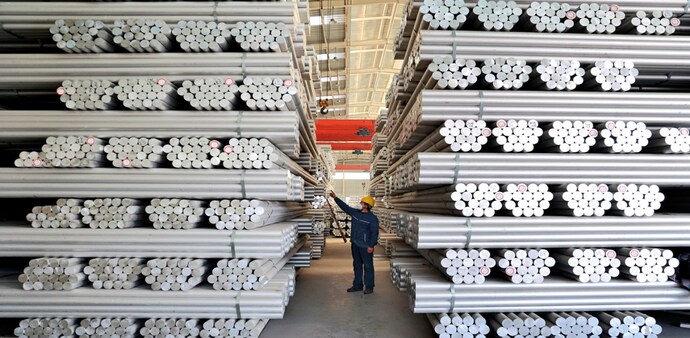
India produces a surplus of aluminium and exports it but gets undercut by cheap imports.
In 2024-25, India’s aluminium production stood at 6.4 million tonnes against domestic demand of 4.9 million tonnes, meaning India can comfortably meet its own requirements and export the surplus.
Currently, India is already the world's second-largest producer of aluminium. Despite this surplus, India imported around 3 million tonnes of aluminium in 2025, largely from China and West Asia.
Where they come from
The geography of India’s metal imports adds another layer of concern. China is, by a wide margin, the largest source of India's base metal imports, supplying $9.7 billion worth, nearly double the next largest supplier, Japan, at $5 billion. Strikingly, six of India's top ten suppliers are in Asia, a reflection of just how dominant the region and China have become in global metal processing and export capacity.
For India, this means that any disruption to Chinese supply chains, whether from trade friction, export restrictions, or broader geopolitical tension, would not be a minor inconvenience. It would hit India’s metal-dependent industries hard, and it would hit them fast, given how embedded Chinese-sourced metals have become in everything from EV components to renewable energy infrastructure to steel production inputs.
Base metals, and copper in particular, sit at the intersection of nearly every priority sector in India’s growth strategy. This creates a fundamental tension for a country that aspires to be the factory of the world.
The story of India’s base metals trade is not one of scarcity. India has the reserves. It has the demand driven by electrification and infrastructure growth, and until India closes that gap, the country that used to mine these metals will keep having to buy them back.
@nindakbaba
Every electric vehicle rolling out in India, every new transmission line strung across to carry solar power to homes, every artillery shell forged for the armed forces —all of it depends on a handful of base metals. For decades, India prided itself on producing these at home. Copper for motors and grids, aluminium for aircraft frames to power cables. However, on each of these fronts, India’s dependence on imported metals is rising.
Advertisement
As recently as 2021-22, India ran a healthy surplus of over $12 billion in base metal trade. The country exported more aluminium, copper, zinc, and iron ore than it imported. This position fit comfortably with India’s self-image as a resource-rich nation with a maturing industrial base. By 2022-23, that picture changed. The surplus didn’t shrink gradually; it flipped into a deficit. Today, India imports nearly $52 billion worth of base metals annually, a figure now almost 43% higher than what it exports.
For an economy that has staked its future on manufacturing-led growth through Make in India, production-linked incentive (PLI) schemes, and an ambitious defence indigenisation drive, it means that even as India builds more electric vehicles (EVs), lays more grid infrastructure, and manufactures more defence equipment, the metallic backbone of all that activity is increasingly arriving by ship rather than coming out of an Indian mine or smelter.
Advertisement
Metal by metal
When the entire import bill is broken down, a clear pattern emerges. Iron and steel lead the list at $15.8 billion, followed closely by copper and aluminium. Together, these three metals account for over 85% of all of India’s base metal imports. The trade problem is heavily concentrated in three metals, each with its own underlying story: copper’s supply shock, iron ore’s quality mismatch, and aluminium’s own cost and capacity pressures, with domestic smelting capacity struggling to keep pace with demand from packaging, construction, and EVs and electronics, where lightweighting is a priority.
Advertisement
Copper
Until just a few years ago, India was a net exporter of refined copper. The country had the smelting capacity, the processing infrastructure, and the export volumes to be a net positive contributor to global copper trade. Today, that position has completely reversed. India’s copper import bill has crossed $12.8 billion, or over Rs 1 trillion during 2025-26 alone, making it the second-largest base metal imported after iron and steel.
What changed? Two forces—the demand side and the supply side collided. On the demand side, India's economy is undergoing an electrification wave that is fundamentally copper-intensive. EVs use three to four times more copper than conventional vehicles, owing to their electric motors, battery systems, and wiring.
As EV adoption accelerates, driven by policy incentives, falling battery costs, and growing consumer acceptance, the copper requirement per vehicle sold has effectively multiplied.
It isn’t just EVs. Even with India’s renewable energy push, from solar parks to wind farms to battery storage systems, copper demand is increasing. Solar panels need copper for their internal wiring and junction boxes. Wind turbines use copper in their generators and transformers. Battery storage systems are also copper-heavy by design.
On the supply side, Vedanta’s Sterlite copper smelter in Thoothukudi, Tamil Nadu, was once India’s largest copper smelting facility. It accounted for roughly 40% of the country's domestic refining capacity. However, it has been shut since 2018, following protests and a local environmental dispute that escalated into a permanent closure.
Advertisement
The shutdown of a single facility removing 40% of national refining capacity has coincided with the steepest ramp-up in copper demand in the country. This has resulted in imports filling a domestic processing gap.
The Ministry of Mine’s Vision Document on Copper Sector, 2025 states that India has heavy reliance on imported copper concentrate, with about 66% sourced from just three countries.
“Enhancing exploration activities will be crucial in expanding geological resources, allowing India to tap into its domestic potential more effectively. Additionally, adopting emerging technologies can boost mine productivity in existing operations. Alongside this, acquiring or investing in foreign assets is essential to secure a long-term copper supply, helping India mitigate its heavy reliance on imports of primary raw material,” report says.
The report also highlighted that, “India lacks specific guidelines for copper scrap quality to improve dependency on scrap, unlike China's stringent policies. Heavily dependent on imports of copper concentrate due to weak domestic resource base, recycling is going to play a major role in meeting the demand.”
Iron ore
If copper’s story is about a sudden supply shock meeting surging demand, iron ore’s story is more structural because it cannot be fixed by simply reopening a shuttered plant.
Advertisement
India is the world’s fifth-largest holder of iron ore reserves and the second-largest steel producer. By any conventional measure, this is a country that should be entirely self-sufficient in iron ore. Yet India continues to import iron ore and metallurgical inputs.
India’s steel demand is rising fast, but high-grade ore is limited. So, imports from Brazil and Oman are increasing, while lower-grade ore continues flowing out.
Much of India’s iron ore is high in impurities such as alumina, silica, and phosphorus, making it difficult to use directly in the production of the high-grade steel that modern industries demand. Automobile manufacturing, defence production, precision engineering, and large infrastructure projects all require steel grades that domestic ore, in its current form, struggles to deliver without significant beneficiation.
This is where the 2030 target sharpens an already uncomfortable problem. India’s steel industry has set its sights on nearly doubling capacity to 300 million tonnes per annum by 2030, an ambition that would cement India’s position as a global steel powerhouse. But achieving that target requires a step-change not just in volume of raw material, but in the quality of raw material supply.
Aluminium
Advertisement
India produces a surplus of aluminium and exports it but gets undercut by cheap imports.
In 2024-25, India’s aluminium production stood at 6.4 million tonnes against domestic demand of 4.9 million tonnes, meaning India can comfortably meet its own requirements and export the surplus.
Currently, India is already the world's second-largest producer of aluminium. Despite this surplus, India imported around 3 million tonnes of aluminium in 2025, largely from China and West Asia.
Where they come from
The geography of India’s metal imports adds another layer of concern. China is, by a wide margin, the largest source of India's base metal imports, supplying $9.7 billion worth, nearly double the next largest supplier, Japan, at $5 billion. Strikingly, six of India's top ten suppliers are in Asia, a reflection of just how dominant the region and China have become in global metal processing and export capacity.
For India, this means that any disruption to Chinese supply chains, whether from trade friction, export restrictions, or broader geopolitical tension, would not be a minor inconvenience. It would hit India’s metal-dependent industries hard, and it would hit them fast, given how embedded Chinese-sourced metals have become in everything from EV components to renewable energy infrastructure to steel production inputs.
Base metals, and copper in particular, sit at the intersection of nearly every priority sector in India’s growth strategy. This creates a fundamental tension for a country that aspires to be the factory of the world.
The story of India’s base metals trade is not one of scarcity. India has the reserves. It has the demand driven by electrification and infrastructure growth, and until India closes that gap, the country that used to mine these metals will keep having to buy them back.
@nindakbaba
Read more!