
Berger Paints’ focus on new areas to strengthen its core business and stave off competition from newer players
Berger Paints’ focus on new areas to strengthen its core business and stave off competition from newer players
Berger Paints is focusing on new areas such as water-proofing and construction chemicals to strengthen its core business and stave off competition from newer players.
Krishna Gopalan
- May 13, 2025,
- Updated May 13, 2025 2:20 PM IST
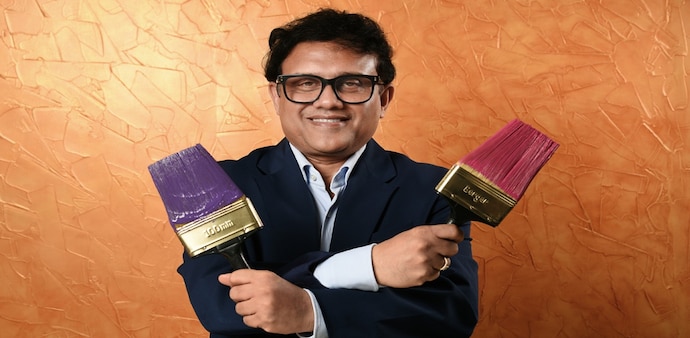
Two years ago, in peak summer, Abhijit Roy was on a routine visit to Nagpur. It was an oppressively hot afternoon, and the MD & CEO of Berger Paints was in deep conversation with dealers and a bunch of contractors. Such interactions often lead to a path-breaking idea. That day was no exception. “The water from the tap is unbearably hot. We have to wait for it to cool down,” said a contractor, imploring Roy for a solution. The MD & CEO smelled an opportunity and, once back at the company’s Kolkata headquarters, called in the top team. The task: create a product to cool down water in plastic as well as concrete tanks. “We needed something that could sit on any surface,” says Roy. A combination of a grip primer, a heat reflecting coating with an anti-dust layer to maintain the efficacy of the coating led to the breakthrough—the just-launched Berger Paints’ Tank Kool. Given that large parts of the country are hot for long periods, the product can sell across markets.
Hey!
Already a subscriber? Sign In
THIS IS A PREMIUM STORY FROM BUSINESS TODAY.
Subscribe to Business Today Digital and continue enjoying India's premier business offering uninterrupted
only FOR
₹999 / Year
Unlimited Digital Access + Ad Lite Experience
Cancel Anytime
-
 Unlimited access to Business Today website
 -
 Exclusive insights on Corporate India's working, every quarter
 -
 Access to our special editions, features, and priceless archives
 -
 Get front-seat access to events such as BT Best Banks, Best CEOs and Mindrush
Two years ago, in peak summer, Abhijit Roy was on a routine visit to Nagpur. It was an oppressively hot afternoon, and the MD & CEO of Berger Paints was in deep conversation with dealers and a bunch of contractors. Such interactions often lead to a path-breaking idea. That day was no exception. “The water from the tap is unbearably hot. We have to wait for it to cool down,” said a contractor, imploring Roy for a solution. The MD & CEO smelled an opportunity and, once back at the company’s Kolkata headquarters, called in the top team. The task: create a product to cool down water in plastic as well as concrete tanks. “We needed something that could sit on any surface,” says Roy. A combination of a grip primer, a heat reflecting coating with an anti-dust layer to maintain the efficacy of the coating led to the breakthrough—the just-launched Berger Paints’ Tank Kool. Given that large parts of the country are hot for long periods, the product can sell across markets.
Advertisement
Roy, sitting in his new office in Kolkata’s New Town, is visibly kicked. The eight-storey building has been built to commemorate the company’s 100th anniversary. In fact, a museum on the ground floor encapsulates the journey of a company that set up shop in India in 1923, changed hands several times before it came to the UB Group, then owned by Vijay Mallya. In 1991, the businessman, known for his repertoire of liquor brands, sold Berger to Kuldip Singh Dhingra and Gurbachan Singh Dhingra, brothers from Amritsar, when its revenue was Rs 100 crore. Today, it is a Rs 11,300 crore company with a 21% market share, the second-largest after Asian Paints. Over the last few years, it has positioned itself as a solutions company (one big moment that led to this was the launch of the Express Painting service in 2014). “We solve your problems, and we also paint,” says Roy. It has also moved into construction chemicals and water proofing.
Advertisement
The $9 billion Indian paints market is at an inflection point where decades of dominance by the two biggest players—Asian Paints and Berger together hold 75% market share in the organised segment—is being challenged by some of the country’s biggest conglomerates. The most prominent is the Aditya Birla Group’s brand Birla Opus. JSW Paints also has big plans to challenge the status quo. So has Pidilite, the owner of the Fevicol brand. Can Berger then maintain its hold in the face of the challenges by the corporate biggies?
Painting The Picture
The paints industry is split 70:30 between the decorative and industrial segments.
Last February, Grasim Industries, part of the Aditya Birla Group, made its debut in decorative paints with Birla Opus. Analysts are calling the launch of the brand, with a wide range of products and a sizeable capex outlay of Rs 10,000 crore, as disruptive for the sector. Berger will have to up its game as the threat of losing market share looms, they say.
Advertisement
An unfazed Roy goes back about two decades when the sector was in the throes of an MNC invasion with biggies such as SKK, Jotun, Sherwin-Williams, KCC, Nippon, Hempel and RPM investing in manufacturing plants and hiring talent. “Even then, there was a lot of talk about technology and deep pockets. Berger has only grown since then,” he says, adding that his company bought the US-based Sherwin-Williams’ decorative paints business in 2013. This was seven years after the multinational had acquired Mumbai-based Nitco Paints. “The difference this time is that a host of Indian players are jumping in. We are seeing companies in cement and steel enter the paints segment,” says Roy.
Anand Kumar Jaiswal, Professor of Marketing at IIM-Ahmedabad, points at the entry of Birla Opus and says the dominant position of the parent in cement through UltraTech gives it a relationship with builders. “It complements the existing portfolio. For Pidilite, a presence in adhesives and a bond with the furniture industry make paints a logical extension,” he says. He says the company has a strong distribution network in B2B and B2C (through Fevicol). “For JSW Paints, it is a question of synergy with cement at the point of purchase,” he says.
Advertisement
Berger is gauging the situation without compromising on the long-term view of the business. “Our teams have become more efficient. The growth rates will remain intact. In fact, this phase gives us a chance to tighten the screws and become more efficient,” says Roy. Another significant development is the potential exit of AkzoNobel, the owner of the Dulux brand, from India at a price tag of around $2 billion. Berger was in the race for the company. Roy says it dropped out because of the high valuation. “It must make sense to us. There is no hurry or worry from our end,” he says. A recent Nirmal Bang report says the challenger Opus “is largely targeting markets where Asian Paints is the leader.” These include Maharashtra, Gujarat and Tamil Nadu. North and East are Berger’s key markets, while Asian Paints dominates in South and West of India. But there are interesting differences. Roy says Berger has a strong presence in Kerala, Vijayawada and Guntur in Andhra Pradesh, and Jalgaon in Maharashtra. “Again, within West Bengal, which is a stronghold, we are weak in Siliguri,” he says. The company is now focusing on the South and West. Roy talks about the need to work closely with dealers, builders and architects. “There is a need to get the distribution right. We have interesting plans for South and West,” he adds.
Advertisement
Abhijeet Kundu, Senior Vice-President of Research at Antique Stock Broking, likes the strength of the Berger brand. “They have demonstrated consistent and steady growth for a long time. The potential for growth is far greater in their North and East strongholds than in the South and West,” he says. There is a marked difference in customer preferences between the regions. “The customers in South and West prefer more premium products while the North and East are more bargain-conscious,” says Ambi Parameswaran, Founder, brand-building.com.
Berger has in the recent past been associated with high-profile projects like the new Pamban bridge and the Chenab rail bridge. Pointing to his landline and the writing table, Roy says everything around us needs a coat of paint. “In developed markets in Europe, industrial paints account for around 50% share. There are enough opportunities in India.”
New Frontiers
In October 2019, Berger acquired a 95.53% stake in STPL, a Kolkata-based unlisted company, for Rs 167.5 crore. STPL is into construction chemicals, concrete admixtures (a blend of chemical compounds added to concrete mix to improve performance), waterproofing chemicals, flooring compounds, bitumen and coal-based tar products. It was a small deal, but the strategic intent was clear. “In China, waterproofing and chemicals is larger than paints (in India, the size of the former is estimated to be around Rs 20,000 crore). It was obvious that India would move in that direction, and we needed to be there with a good range of products,” says Roy. STPL had been around for almost 100 years and had a modest 7% EBITDA (earnings before interest, taxes, depreciation and amortisation) margin. “In the last three-four years, we have doubled revenues. Margins are 11%,” he says. Nirmal Bang’s report on Berger outlines the increased focus on construction chemicals. “While the average selling price in the segment is low, the margins are higher,” it says.
Advertisement
The foray was the outcome of long deliberations starting 2016 on the company’s next big move. This was a couple of years after the launch of Express Painting, which gave the company a premium tag and an entry into services. “Someone spoke of damp patches as an opportunity. It seemed strange since damp-proofing was the answer,” recalls Roy. A closer look at the category threw up potential in adjacent areas. Pidilite’s Dr Fixit was already there but the waterproofing and chemicals segment seemed large.
Jaiswal says it is necessary for paint companies to step outside their traditional areas. “The modern customer is looking for a solution. The focus has shifted to offering a comprehensive range of products and services. That can be a very big differentiator in the mind of the customer.” He says buying paints is easy but servicing is tough. “Product innovation in decorative means identifying unmet needs. It could be stains on the walls or weather coating, which are huge markets, as external walls in India need more care due to the tropical weather.”
In Roy’s own mind, Berger had “a right to win” with its distribution and manufacturing strengths. In 2017, it launched the HomeShield waterproofing range (this included HomeShield PU RoofKoat and waterproof putty). The market was there but the approach had to be different. Berger put in place a “Moisture Meter” to determine the water content in the walls. The meter suggests solutions based on the reading. “It was about making scientific waterproofing the USP,” says Roy. Jaiswal agrees that rooftop and construction chemicals are small markets. “But it is a common problem. The market can take off,” he says.
That said, Roy maintains that the process of building a brand is a challenge but can be hugely rewarding. Capitalising on its brand equity in paints is one way of doing it. Kundu concurs and says the existing distribution infrastructure is a plus. “This is an underpenetrated market, making it attractive.”
The segment grew for Berger initially but addressed only 30% of the business, since 70% came from new construction. “It was clear to us that we needed to be in the larger segment where the product is used right at the beginning and not at the stage of repair,” he says. The company now has a meaningful play in construction and waterproofing with the purchase of STP and launch of more products. “We are the third-largest after Asian Paints and Pidilite,” says Roy. In the recent past, it has launched Berger Dampstop and Berger Roof Kool & Seal; the latter can handle heat and monsoon.
Kundu says paint companies are increasingly looking for a bigger play in the value-added segment for product differentiation. “This leads to higher margins,” he says. He says 30-35% of the industry is still unorganised, offering significant headroom for growth.
Looking Ahead
Berger’s journey over the last 30-odd years since the Dhingras bought it has been dotted with apparently small but meaningful decisions. One taken early was to retain the office in Kolkata (the owners worked from Delhi) and bring in professionals, an unusual decision at the time.
Roy, who joined the company in 1996 as a product manager, before assuming the top job in mid-2012, says for a long time the strategy was to “copy Asian Paints” and sell the product at a lower price. “It meant lower EBITDA margins without any scale. It was necessary to do that to penetrate the market.” It was time to change a lot of things.
The launch of Easy Clean (stain-free paint) in 2010-11 and its success convinced the company about its ability to innovate. One of the most important decisions, on the advice of management guru Gurcharan Das, was having brand names connoting the product benefit. “We now have simple names for our products. For example, Bison (an emulsion brand) conveys toughness,” says Roy. In the past, brand names were exotic, such as Berger Vinyl or Berger Luxol. The suggestion was simple—if it was about durability, just call it long life. The process of naming is a lot more straightforward now. That was in 2009-10. “Today, our advertising money is spent more effectively. At 2-3% of sales (in fast moving consumer goods, it is around 8%), it gives us more bang for the buck,” he says.
Obviously, a sharper focus on the brand name has worked in tandem with other things such as innovation and staff training. The journey since 1991 can be broken into two parts—carving out a clear identity in paints and then venturing into adjacencies.
According to Roy, the waterproofing and chemicals arms work with the existing paints team. “In that sense, there is no big investment, and it has worked out well,” he says. Around 10% of Berger’s revenue comes from this (from low single digits five years ago). The Nirmal Bang report says it “can be around 20% in a few years” and talks about how the space has been seeing serious innovations. “The company is not looking at entering the repair side of construction chemicals,” it adds. Parameswaran of brand-building.com says a paint company entering related building materials can tap its existing distribution and user base. “Technology in these businesses is not complicated and is often available off the shelf,” he says.
In paints, companies have stronghold regions or cities. “Luckily, for construction and waterproofing, a significant portion goes through projects. That means we can go into the West or South, where we are not big in paints,” says Roy. This also gives the company a good reason to work on its distribution in weak areas. “There is a separate team for urban markets where we are not big.” The objective is to increase the stickiness for the Berger brand.
The next obvious step would be premiumisation. Roy says Indians are painting their houses more often. “The quality of the paints has improved. They also last longer. Premiumisation alone is not enough. There should be a perceptible consumer benefit, which has not been addressed,” he says. Parameswaran says painting is one part of the overall costs; in fact, labour and other associated costs could be higher. The emergence of a more aware consumer with high disposable income could change a lot of industry dynamics. There is a compelling reason to do simple things complemented by high-quality execution. Berger Paints wants to do just that over the next hundred years.
@krishnagopalan
Read more!