
BRIC By BRIC: The Bloc’s Attempt to Make Its Presence Felt Post US Tariffs
BRIC By BRIC: The Bloc’s Attempt to Make Its Presence Felt Post US Tariffs
With the US going all out to impose punitive tariffs on BRICS nations, the grouping has got another chance to make its presence felt at the global high table.
Archna Shukla
- Aug 27, 2025,
- Updated Aug 27, 2025 9:57 PM IST
Brics was described as a failed project by JP Morgan economist Jim O’Niel two decades after he coined the acronym BRIC for Brazil, Russia, India and China. These economies, he said in 2001, were poised to shift the global economic structure led by the G7. The four nations held their first formal summit in 2009. BRIC became BRICS after South Africa joined a year later. In subsequent years, the bloc set up a financial framework to have greater autonomy in global trade and governance, but nothing concrete came out of the proposal.
Hey!
Already a subscriber? Sign In
THIS IS A PREMIUM STORY FROM BUSINESS TODAY.
Subscribe to Business Today Digital and continue enjoying India's premier business offering uninterrupted.
only FOR
₹999 / Year
Unlimited Digital Access + Ad Lite Experience
Cancel Anytime
-
 Unlimited access to Business Today website
 - Exclusive insights on Corporate India's working, every quarter
- Access to our special editions, features, and priceless archives
- Get front-seat access to events such as BT Best Banks, Best CEOs and Mindrush
Brics was described as a failed project by JP Morgan economist Jim O’Niel two decades after he coined the acronym BRIC for Brazil, Russia, India and China. These economies, he said in 2001, were poised to shift the global economic structure led by the G7. The four nations held their first formal summit in 2009. BRIC became BRICS after South Africa joined a year later. In subsequent years, the bloc set up a financial framework to have greater autonomy in global trade and governance, but nothing concrete came out of the proposal.
Advertisement
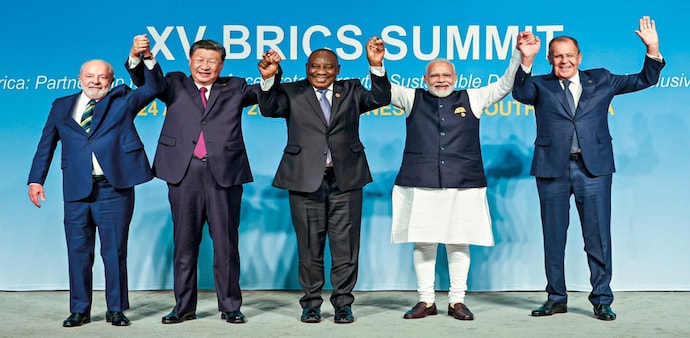
BRICS, however, is in the limelight again, thanks to US President Donald Trump, who has called BRICS “anti-America” and “anti-dollar” and threatened an additional 10% levy, in addition to bilateral tariffs, on countries aligning with the bloc. “BRICS was a side-show on the global arena of multinational economic and geopolitical groups. President Trump has put it on the centre stage,” says Arpita Mukherjee, Professor at ICRIER, and a policy expert.
Trump alone, however, is not to be credited for the attention on BRICS. More than 30 developing economies are currently knocking on its doors seeking admission. “BRICS is one of the most appealing groupings in the world today,” says Yaroslav Lissovolik, a Russian economist and a member of the Russian International Affairs Council. “The bloc (has) expanded its core membership two-fold, from 5 to 10, and introduced a partnership belt that takes the overall number of BRICS+ economies to 20,” he adds.
Advertisement
Observers say the expansion of BRICS has happened largely in the wake of G7 aggression and economic sanctions slapped on the countries it sees as errant. In the recent past, countries such as Iran (2012), North Korea (2017), and Russia (2022) have been expelled from SWIFT and barred from transacting in dollar, thus crippling their access to financial resources, investments and trade with other countries.
“Economic sanctions don’t simply penalise the countries in question. They inconvenience their partners, too,” says Mukherjee. A case in point is the Russian oil that India had to pay for in dirhams and yuan in the past after Russia ran up a massive pile of rupees it had no use for. The rupee-ruble payment mechanism the duo devised subsequently to circumvent the sanctions has the US up in arms again. Trump has threatened a 50% tariff on India because of its oil and defence imports from Russia. On August 14, US Treasury Secretary Scott Bessent further warned that if Trump’s proposed meeting with Russian President Vladimir Putin in Alaska didn’t go well, even higher secondary tariffs could be imposed on India.
Advertisement
Arguing that BRICS is yet to find a cohesive identity of its own, trade expert and former professor of economics at Jawaharlal Nehru University Biswajit Dhar, says that Trump, with his unilateral actions, has underscored the “relevance of a grouping of the south.”
Its muddled character notwithstanding, BRICS is a resourceful bloc. Not only does it represent over 40% of the world’s population spread across four continents, it also has substantial economic clout. According to the International Monetary Fund (IMF), BRICS’ collective GDP growth is expected to be 3.4% against the global average of 2.8% in 2025. IMF expects the bloc to account for 41% of the global economy while the European Union and the US’ share is expected to be around 28%. According to accounting firm EY, BRICS accounted for 27.3% global merchandise exports in 2024.
“BRICS today has a more pragmatic economic agenda that includes developing a system for financial settlements, reforming the contingent reserve agreement (CRA) mechanism, and developing a system of guarantees for investments into BRICS markets,” says Lissovolik, adding that this raises the prospects of the bloc delivering “a palpable impact on the global economic architecture in the coming years.” CRA is a financial agreement among BRICS nations to provide mutual support and short-term liquidity through currency swaps in times of crisis.
Advertisement
In practical terms, this translates into BRICS’ ability to use its clout in global trade and finance to its members’ advantage and reduce their dependence on dollar and other G7 currencies, which threatens the West’s stranglehold on global economy and geopolitics.
This explains Trump’s rage.
Multipolar Challenges
In the 10 years that he’s been in office, Prime Minister Narendra Modi undertook his longest diplomatic tour in July when he visited five countries—Ghana, Argentina, Brazil, Trinidad and Tobago, and Namibia—over eight days. A month before this, India and Uganda resolved to strengthen their bilateral trade and economic ties after a hiatus of 23 years. A year ago, Modi’s concerted efforts led to African Union’s inclusion in G20. Incidentally, China already has strong economic and trade ties with most of these countries. At around $19 trillion, China is not only the world’s second-largest economy but also the largest trading partner of many countries across the world, including those in the global south. The country—which accounts for almost 18% of global exports and 13% imports— has supplemented its increasing trade with a push to bilateral transactions in yuan. According to a paper published by global financial services firm StoneX, more than 25 countries are already part of an international payment mechanism put in place by China called ‘cross-border interbank payment system’ that allows financial settlement using yuan. China has pitched the arrangement as an alternative in situations arising out of economic sanctions or diplomatic friction with any G7 member, the article says.
Advertisement
Not coincidentally, BRICS’ expansion, too, is primarily led by China. Many see it as an attempt on China’s part to bring countries disgruntled with the US, besides its trading partners in the global south under one umbrella and drive the agenda at BRICS. “China is trying to pose a direct counter to the US, for instance, as a strong votary of globalisation,” says Dhar.
Modi reaching out to the aforementioned countries is to be seen in this context. Even as BRICS’ stated goal is to be the voice of the global south, the possibility of it becoming a group led by China, as against G-7 led by the US, is not far-fetched.
Given that India and China are not best of friends, this poses a new challenge for India even as it pushes for a multi-polar world order.
“India is being proactive in securing its interest and influence in the world at large,” says Rajiv Kumar, former vice chairman of NITI Aayog. “It’s a good strategy to offer a mutually beneficial development model to the world at a time when tariffs and sanctions are being thrown around,” he adds.
The tension between China and India notwithstanding, experts say that India’s interests are better served with a grouping of global south than the club of rich countries that resort to arm-twisting when their interests are not served. Trump’s actions lend credence to this.
Read more!