
Can India become the next airport hub like Doha, Dubai, and Singapore?
Can India become the next airport hub like Doha, Dubai, and Singapore?
India is in the midst of a massive aviation upgrade. Can it become the next airport hub like Doha, Dubai, and Singapore?
Richa Sharma
- Nov 17, 2025,
- Updated Nov 17, 2025 6:30 PM IST
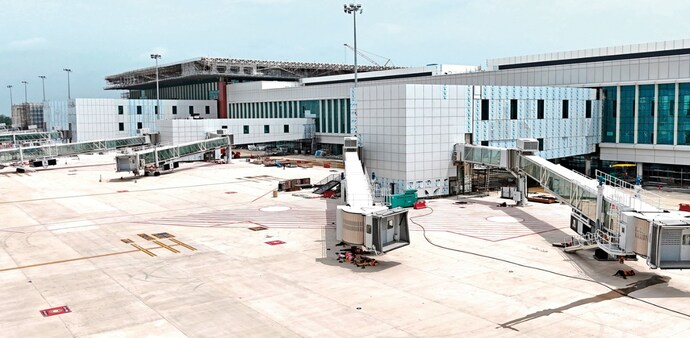
The opening of the two greenfield airports this December—the Navi Mumbai International Airport (NMIA) and the Noida International Airport (NIA)—could be a watershed moment in Indian aviation. They are poised to grant Mumbai and Delhi a transformative twin-airport model, akin to Dubai’s DXB–DWC, London’s Heathrow–Gatwick, and New York’s JFK–Newark, positioning them as a dual-hub ecosystem on the global aviation map.
Hey!
Already a subscriber? Sign In
THIS IS A PREMIUM STORY FROM BUSINESS TODAY.
Subscribe to Business Today Digital and continue enjoying India's premier business offering uninterrupted
only FOR
₹999 / Year
Unlimited Digital Access + Ad Lite Experience
Cancel Anytime
-
 Unlimited access to Business Today website
 -
 Exclusive insights on Corporate India's working, every quarter
 -
 Access to our special editions, features, and priceless archives
 -
 Get front-seat access to events such as BT Best Banks, Best CEOs and Mindrush
The opening of the two greenfield airports this December—the Navi Mumbai International Airport (NMIA) and the Noida International Airport (NIA)—could be a watershed moment in Indian aviation. They are poised to grant Mumbai and Delhi a transformative twin-airport model, akin to Dubai’s DXB–DWC, London’s Heathrow–Gatwick, and New York’s JFK–Newark, positioning them as a dual-hub ecosystem on the global aviation map.
Advertisement
Also, it’s the first time since 2008 that two greenfield airports will be operationalised in the same year. The last time was Bengaluru and Hyderabad; the former is also getting ready to welcome a second airport to cater to the growing passenger numbers.
The new airports in the Mumbai Metropolitan Region (MMR) and the National Capital Region (NCR) will also enhance regional connectivity and complement the massive expansion plans of domestic airlines.
“With just 160 airports, India is already the third-largest aviation market. Imagine what will happen if the same growth continues. Aviation is booming in India and will continue to do so for the next two decades at least,” Sanjay Lazar, CEO, Avialaz Consultants, tells Business Today.
Advertisement
Big dreams
A recent report by Knight Frank said that India’s air passenger traffic is projected to increase nearly 50%, from 412 million in the last financial year (FY25) to 600 million by FY30. The government plans to add another 50 airports by the end of this decade. The airlines, on their part, have an order book of around 1,500 aircraft, a source of ready demand for the new airport infrastructure. These airports are projected to attract an investment of Rs 1 lakh crore by 2030.
The aim of having a world-class airport infrastructure is to position India as a global aviation hub on the lines of Dubai, Singapore and Doha. However, experts point out that despite the operationalisation of NMIA and NIA, there is a list of operational infrastructure, along with policy and regulatory levers, that requires attention if India is to become a global aviation hub.
Advertisement
Union Civil Aviation Minister K. Rammohan Naidu recently said the government is in the process of achieving smooth passenger transfers between domestic and international flights, which is a key step towards making India a global aviation hub. “On the ground, the real challenge is to ensure smooth transfers across all combinations: domestic to domestic, international to domestic, domestic to international, and international to international. Once we address these challenges, our airports will be on a par with the best in the world,” he said.
The ministry is devising a system where passengers travelling abroad from Delhi or Mumbai can complete immigration checks at selected origin airports.
The real challenge is to ensure smooth transfers across all combinations. Once we address these challenges, our airports will be on a par with the best in the world.
-K RAMMOHAN NAIDU,CIVIL AVIATION MINISTER
NIA, likely to be operational by December, will have a capacity of 12 million passengers per annum (mmpa) in the first phase, going up to 70 mmpa in the fourth phase. NMIA will have a capacity of 20 mmpa; it will reach 90 mmpa in the final phase.
However, the passenger capacity of both the new airports is less than that of large global airports such as Atlanta, Dubai, Dallas and Heathrow, which handle more than 80 million passengers per annum, says Suprio Banerjee, Vice President and Co-Group Head, Corporate Ratings, ICRA Ltd. The existing IGI airport in Delhi had got 79.3 million passengers in the year ended March 31, 2025, while Chhatrapati Shivaji Maharaj International Airport (CSMIA) in Mumbai handled 55.2 million passengers.
Advertisement
“The current operational scale of Navi Mumbai and Noida airports would be lower than these airports, but given their ultimate expansion plans, the new airports are likely to catch up in scale over the next 5-10 years,” Banerjee tells BT.
The NMIA, along with CSMIA, will form a unique dual-airport system within MMR. Both these airports are operated by Gautam Adani-owned Adani Group, which is the largest operator of airports under the public-private partnership (PPP) model in India. It operates Lucknow, Thiruvananthapuram, Jaipur and Lucknow, among others. GMR runs Delhi, Hyderabad and Goa, while state and private players run Cochin, Bengaluru and Kannur airports.
NMIA is among the first airports in India that will offer passengers and stakeholders an end-to-end digital experience from the first day of commercial operations. Travellers will experience a seamless, technology-led journey designed to deliver speed, comfort, and efficiency, says the company.
Adani Airport Holdings Ltd (AAHL) has partnered with enterprise artificial intelligence (AI) major AIONOS to deploy a multi-lingual, omni-channel agentic AI solution. “At AAHL, we are redefining the airport experience through intelligent, digital-first innovations that turn travel anxiety into excitement. Our partnership with AIONOS is a pivotal step in delivering seamless, personalised journeys. Combined with in-house solutions like Aviio, Adani OneApp, and Airport in a Box, we are creating a connected ecosystem that drives efficiency, inclusivity, and sets new benchmarks for smart, sustainable, future-ready airports in India,” says AAHL CEO Arun Bansal.
Advertisement
The company’s integrated digital platform Aviio provides real-time updates, paperless processes, and personalised digital services. The app can be used for a tech-enabled food and beverage and retail experience, including pre-ordering of duty-free goods and food delivery at the gate. AI-enabled systems and smart lanes with automated tray returns promise to change the checkpoint experience. With machine learning scanning for threats, passengers would glide through without the usual stress or long waits.
In the north, the NIA at Jewar in UP is expected to cater to passengers living in NCR and cities in Uttar Pradesh. It is being developed by the UP government and the Swiss giant Zurich AG.
NIA is also planning technology upgrades such as smart counters to recognise passengers instantly through DigiYatra-compatible biometric systems, while AI-powered kiosks are expected to handle baggage drops and print tags in seconds. The systems will track real-time passenger flow to dynamically adjust lighting, air conditioning, and manpower at service counters.
Internationally, the biggest airports are upgrading technology to enhance customer experience. Dubai, one of the busiest in the world, is testing new scanners and AI technologies that eliminate the need for passengers to remove items such as laptops, perfumes, creams, and liquids over 100ml during security checks, which is expected to reduce the time taken by security checks. The Hamad International Airport, Doha, has introduced a digital twin through a simple 3D interface that controls aircraft stand conflicts, facilitates quick reactions to notifications, and keeps an eye on the condition of vital airport infrastructure.
Advertisement
Apart from this, the authorities plan to connect NIA and NMIA with modern urban transport systems, good quality road infrastructure, hotels and other facilities. “The announcement of this upcoming airport has already triggered a substantial rise in property values across key areas in the vicinity. This greenfield airport will further accelerate the growth, driving sustained demand and significant price appreciation, presenting lucrative long-term investment opportunities,” says Vimal Nadar, National Director & Head of Research, Colliers India.
Airports have always been big drivers of urban development. Both these airports mark a pivotal transformation in the real estate landscape of the regions. The development of NIA has already triggered a real estate boom in Yamuna Expressway, Noida Extension, Greater Noida and Jewar.
Several major airports—including in Chennai, Hyderabad, Bengaluru, and Delhi—are planning capacity upgrades alongside the greenfield facilities. The government is also getting ready to offer 11 more airports under the PPP model with a new provision limiting each operator to two airports.
A global hub
The ongoing expansion of aviation infrastructure is driven by India’s larger ambition to become a global aviation hub in the coming years. Domestic airlines are planning to add around 1,500 new aircraft and are aggressively reworking their route networks and targeting passengers who use foreign airports as transit points. If India’s airports can offer more slots, efficient transit scheduling, competitive pricing for airlines, and stronger connectivity, its key airports could evolve into regional transit hubs.
Experts say at full capacity, NMIA and NIA are expected to emerge as regional hubs for transit passengers, like Dubai, Singapore, and Doha, where travellers from multiple cities land before heading to their destinations. “NMIA’s integrated terminal layout allows for smooth international and domestic transfers, complemented by advanced baggage handling and dedicated transfer corridors. The combination of infrastructure and regulatory alignment will help NMIA strengthen India’s position as a preferred global aviation gateway,” says a spokesperson for NMIA.
India is now one of the world’s largest and fastest-growing aviation markets, which makes a strong domestic origin and destination (OD) base available to feed a hub. “IATA and industry data show India’s market has been growing strongly and is among the top three by originating OD traffic. That makes a hub strategy commercially plausible provided transfer traffic economics and policies are aligned,” says Mayur Patel, head of Asia with data specialist OAG Aviation.
Patel says once fully developed, both the airports are designed to match the capacity of major global hubs such as Dubai and Doha. However, this goal will be realised over multiple phases spanning decades, he adds.
“Unlike single-city hubs (Dubai International Airport, Hamad International Airport) that serve very large transfer populations across Africa/Asia/Europe, Navi Mumbai and Noida compete with established home hubs (Mumbai/Delhi) and must win transfer traffic by offering better connectivity, shorter transfer times, or airline commercial incentives. Local catchment (Mumbai and Delhi NCR combined) gives them large origin/destination demand, a key ingredient many hub airports rely on,” he adds.
However, some aviation experts say it is too ambitious to assume that NMIA and NAI will whisk away traffic from global airports in just a few years. A lot will depend on how domestic airlines can attract passengers, now served by foreign airlines, with smart routing and incentives. They say the present capacities of these airports are less than New Delhi’s IGI which, with three terminals and four runways, is expecting 140 mmpa passengers in another decade. Its present capacity is 100 mmpa. “I think NMIA will need more capacity. I don’t see these airports making a significant dent in Dubai or Doha until these cities and aero cities can offer facilities that are half as good as those offered by Dubai or Doha. At best, I see a 10% dent with greater connectivity and slots opening,” says Lazar.
There is another hurdle. India has put a freeze on opening bilaterals, which means restricting frequency/capacity (seats) as demanded by airlines so that they can increase their flight frequencies. IATA work shows liberal ASA (air service agreement) frameworks help cities emerge as aviation hubs.
“The connectivity needs to be improved. Bilaterals of most nations have been exhausted, hence that will certainly be a dampener for growth, unless India opens those,” says Lazar.
Gulf carriers have been pushing for expanded bilateral flying rights with India to meet rising passenger demand. However, the Indian government has kept these demands on hold to protect domestic airlines, many of which are yet to fully utilise their existing bilateral entitlements. While the European Union follows an open-skies policy with minimal restrictions, countries like the United States, China, and Australia limit foreign airlines from carrying passengers between two points within their borders.
India is among the top three by origin and destination traffic. That makes a hub strategy commercially plausible.
-MAYUR PATEL,HEAD OF ASIA, OAG AVIATION
The Roadmap
Aviation experts list out a set of reforms to get Indian airports ready for competition with global giants. The primary among them would be to expedite transfers with a single transfer security/checkpoint, through-checked baggage across carriers, and simplified customs corridors for transfers. Gulf hubs have a sub-two-hour transfer window.
Intermodal access to a reliable high-speed rail/metro/expressway with last-mile connectivity to keep transfer times to city/regional nodes predictable is necessary. So are high-quality transfer amenities with well-designed transfer lounges, clear wayfinding, transit visas or visa-on-arrival for short transits, and efficient retail/food options to monetise non-aero revenue.
Airports in India have been focusing on non-aero revenue, which includes duty-free shopping and retail, cargo, food & beverage, car parking, and more. But they need to do a lot more. Patel says India’s average non-aero revenue per passenger is $3.75–4.30 (PPP airports, FY2024), while for key global hubs, it is $7.2–15.9 per passenger (2023). It is projected to reach $7 per passenger by 2030. Primarily, Indian duty-free spending is focused on liquor and chocolates. Assessments show Indians don’t spend much on big foreign brands at airports.
“Based on the above, there is a clear opportunity for revenue/passenger growth across airports in India. Indian airports lag global peers in non-aeronautical revenues per passenger. Lower international/transit traffic contributes to lower non-aero yields in India,” says Lazar.
In the next four to five years, non-aero yield at Mumbai and Delhi is projected to grow, driven by growth in the duty-free segment, premium retail expansions and better yields from advertising, car parking, and rentals, say experts.
At the policy level, there has been a demand for liberal traffic rights and ASAs to allow international carriers route traffic via Indian hubs or encourage Indian carriers to develop global feed.
“One needs to provide volume-based rebates, attractive refuelling terms, priority slots to airlines, dedicated transfer zones, transit visa relaxations and technology for boarding and baggage transfer for transit passengers. Competitive and varied MRO service offerings are also key for an airport to develop as a transit hub over the long term,” says ICRA’s Banerjee.
Another key focus area is air cargo. Experts say there is a need to streamline belly cargo transfer as air-freight connectivity is a major revenue for hub airports like Dubai. India also needs to create bonded logistics parks and fast-track customs clearance.
Lazar says the government must classify airports as MMTH (Multi-Modal Transport Hubs) and plan mini-cities around them with vast municipal and tax benefits. “India needs to augment airport capacity; increase slots; ensure last-mile connectivity & inter-airport connectivity; and build retail, leisure, business centres like Aerocity at each airport to enhance convention and business travel and ensure on-time departures/arrivals. Also, to invite more foreign capital, it must offer tax holidays,” he says.
Navi Mumbai and Noida airports are expected to set a new benchmark in Indian aviation in the coming years. But India as a whole needs more such efforts, and maybe on a larger scale.
@richajourno
Read more!