
Cricket’s New Global Order: How IPL franchises are spreading across borders
Cricket’s New Global Order: How IPL franchises are spreading across borders
Once the playground of Bollywood celebrities and vanity buyers, IPL franchises have graduated into blue-chip assets, attracting sovereign wealth funds, commanding record valuations, and anchoring a cross-continent, year-round cricket economy.
Jyotindra Dubey
- May 16, 2026,
- Updated May 21, 2026 5:31 PM IST
April 18, 2008. M. Chinnaswamy Stadium, Bengaluru. Lazer show. Floodlights. Noise. It felt less like the birth of a sports league and more like a music concert. The stands were also filled with faces more familiar with film sets and boardrooms than cricket. Cricketers, many still adjusting to the shortest format of the game, found the high-stakes auctions surreal, still overwhelmed by how their names sparked bidding wars.
Advertisement
In the Kolkata Knight Riders (KKR) dugout sat Sourav Ganguly, India’s former captain, beside men he had sledged while representing India. Tonight, they wore the same jersey, sharing the same dressing room.
The crowd didn’t care. They were already in love as Brendon McCullum walked out to bat alongside Ganguly, swinging from the very first ball. A Kiwi, batting in Bengaluru, under an Indian captain, for an Indian-owned franchise, scoring 158 not out off 73 balls. The IPL had made a promise on opening night. McCullum kept it.
Off the field, millions tuned in that evening, and every evening after. The timing couldn’t be better. India had just won the inaugural ICC World T20, and an entire nation was hungry for more. The IPL was ready to feed that appetite.
Advertisement
But not everyone was convinced. Critics dismissed the league as a vanity project, a flashy playground for the rich, driven more by branding than business logic. The excitement, they argued, would be short-lived.
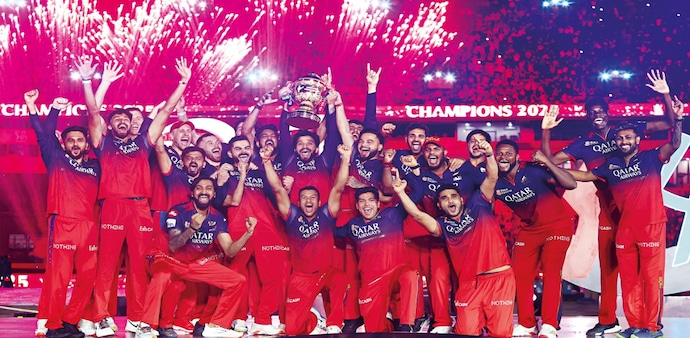
What began as a spectacle 18 years ago has now become one of the most valuable sports businesses in the world and, increasingly, an asset class. The recent ownership churn at Royal Challengers Bengaluru (RCB) and Rajasthan Royals (RR), both changing hands at valuations around `16,000 crore, makes this clear. Even accounting for differences in deal structure, these transactions provide the first credible market benchmarks for IPL franchise valuations.
The IPL is now a sporting ecosystem that generated a revenue of over $1.5 billion, which translates into 8% of India’s sports industry, estimated around $19 billion, in FY25, according to the KPMG report.
Advertisement
THE ECONOMICS
The original revenue model was straightforward: centrally shared broadcasting revenue by the Board of Control for Cricket in India (BCCI), match-day ticket sales, jersey sponsorships, and merchandise. There were no global franchise extensions, no branded cafés, no 360-degree content monetisation. Owners came on board more for visibility than returns, which were hard to find.
“It was a vanity buy initially. The leadership team from the BCCI and everybody else involved with the league were going to their personal contacts, and it was hard to convince them to invest,” says Dhiraj Malhotra, founding member of the IPL leadership team, currently CEO, Washington Freedom & Welsh Fire, and former CEO of Delhi Capitals (IPL).
The initial franchise owners were on board for branding and had less knowledge of cricket. However, that changed over the years, and owners now come with knowledge of the game. “They are following the future tour programmes of the teams, following domestic cricket. There is genuine interest. They understand how a team is to be built, how you build it not just around superstars but as per player utility,” he adds.
Over 70% of franchise revenues are derived from centrally shared media rights and sponsorship pools, with only limited dependence on on-field performance. Revenues flow in whether your team wins or loses, every season. While central revenues create a stable base, valuations diverge due to differences in cost structures and long-term earning potential. Older franchises, having completed their bid payments, enjoy higher profitability, while newer teams like Gujarat Titans (GT) and Lucknow Super Giants (LSG) still carry instalment obligations. At the same time, legacy teams benefit from stronger brand recall and larger fan bases, which translate into higher sponsorship potential and premium valuations.
Advertisement
The BCCI owns the central rights and administers the league. The central commercial pool is split roughly as follows: around 50% retained by the BCCI, 45% shared equally among franchises, and 5% allocated as prize money.
The title sponsorship history tells the story of commercial acceleration better than any chart. DLF, the first title sponsor, paid `40 crore per season for the first four editions from 2008 to 2012. By 2024, Tata had to pay `500 crore per season, a more than 12-fold increase.
Media rights followed the same trajectory. The 2023–27 broadcast cycle was sold for `48,390 crore, nearly six times the `8,200 crore fetched in the first cycle.
The reason is simple: Reach. The 2025 edition of IPL reached approximately 1.1 billion unique viewers and delivered over 840 billion minutes of watch time. To put that in perspective: more than a billion people watched some portions of the cricket tournament.
As per the KPMG report, in 2024, overall sports sponsorships in India were valued at `7,421 crore, with the IPL alone commanding roughly half of all sponsorship spend.
Advertisement
Sponsorships matured over time, too. The sponsors once bought a logo space on a jersey and called it a campaign. They now demand 360-degree integration, digital activation, co-branded content, and grassroots programmes. The shift reflects the rise of the fan economy, where brands expect measurable returns, not just visibility. For instance, Swiggy, the food-delivery app, has tied up with Jio Hotstar to integrate its food ordering while watching the match live.
At the franchise level, each IPL team now manages approximately 25 brand partnerships annually, spanning fintech, FMCG, edtech, and more. Ticketing, merchandising, and licensing remain secondary but growing streams.
THE GLOBAL PLAY
The headline story of IPL’s growth may be the surge in broadcast and title sponsorship revenues. Yet, the game changer for franchises has been more strategic: going global and turning themselves into multi-league operators.
In 2015, Knight Riders—the parent company of KKR—bought a majority stake in the Trinidad and Tobago team of the newly launched Caribbean Premier League (CPL). It was a quiet move, barely noticed outside cricket’s business circles. The following season, they renamed the team Trinbago Knight Riders, extending the Knight Riders brand overseas. The team won the CPL title that very first year.
Advertisement
For several years, this remained a lone experiment. The CPL had launched in 2013, the Big Bash in Australia relaunched its city-franchise format around the same time, all liberally replicating the IPL's playbook of city identity, player auctions, and broadcast-first packaging. Yet, IPL ownership money largely stayed home.
The inflexion point came in 2021-22. RR’s parent acquired a major stake in the Barbados team of the CPL, the second such move by an IPL team owner. Then, in 2022, two new leagues were launched, SA20 in South Africa and ILT20 in the UAE. Now, all six teams in SA20 are owned by IPL franchise owners. While in ILT20, Reliance Industries, GMR Group and Knight Riders own a team each. Additionally, Adani Sportsline, not an IPL franchise owner but owner of Gujarat Giants in Women’s Premier League (WPL), also owns a team in ILT20.
Major League Cricket (MLC) in the United States was launched in 2023 on the same template. Four out of the six teams in the MLC are owned by IPL franchise owners. The most recent chapter is England. For years, The Hundred remained closed to private investors, but in 2025, that changed, and IPL money moved in quickly.
RPSG Group, owners of LSG, bought a 70% stake in Manchester Originals for around £81 million. Reliance Industries acquired a 49% stake in Oval Invincibles for £60 million, and Sun Group, owners of Sunrisers Hyderabad, acquired 100% of Northern Superchargers for £100 million.
The Big Bash in Australia remains closed for investments but is in the process of potential privatisation. Cricket Australia is pushing to sell up to 49% stakes in most teams and 100% of two teams to secure private funding.
But IPL is different not just for its scale, but for how its economics are wired. Most other cricket leagues follow slightly different scripts. In SA20 and ILT20, central revenues are largely controlled by their respective boards, with franchises operating under tighter financial structures and less assured payouts.
CPL and The Hundred offer a pooled model just like IPL, but on a much smaller revenue base, limiting franchise upside. In The Hundred, the central pool is shared with the franchise and respective counties.
While MLC in the US is a privately-owned league, the franchise owners are betting on the league’s future as much as their teams. Investors who own franchises have invested in this central entity, American Cricket Enterprises, which operates MLC.
“Multi-league ownership expands the revenue base across geographies, diversifies audience touchpoints, and creates year-round brand recall rather than a two-month seasonal spike cycle,” says Mahek Vikamsey, Partner, KPMG in India. According to him, this enables higher sponsorship value through bundled domestic and international exposure, continuous fan engagement, and better content and intellectual property monetisation. At the same time, shared scouting and operations improve team performance while boosting overall franchise valuation.
IPL's NEW PRICE TAG
The recent stake sales in RR and RCB do more than add eye-catching numbers to two of the league’s most visible franchises. They mark a turning point in how IPL teams are valued. Ownership of two of the IPL’s oldest franchises changed hands recently. Consortium led by steel tycoon Lakshmi N. Mittal and Aditya Mittal (75%) along with Adar Poonawala (18%) has acquired 93% ownership of RR, valuing the franchise at approximately `15,660 crores. RCB was sold to a consortium of Aditya Birla Group, Times of India Group, Bolt Ventures, and Blackstone for roughly `16,660 crore.
For the longest time, IPL franchise valuations existed in a grey zone. Everyone knew these were valuable assets, but there was no consistent benchmark. One earlier reference point came in March last year when the Torrent Group acquired a 67% stake in GT from CVC Capital, valuing the relatively new franchise around `7,500 crore.
Chennai Super Kings (CSK) has traditionally served as the reference point, with no ownership changes, no stock exchange listing, but quite active in the unlisted share market. With 379.4 million equity shares outstanding as of March 31, 2025, and unlisted trades hovering around `300 per share, CSK’s implied valuation stands at roughly ` 11,500 crore.
The two recent deals, however, finally put a clear price on what IPL franchises are worth, confirming that they are neither vanity buys nor mere branding proxies, but a genuine asset class. “What makes this (RCB deal) particularly interesting is the nature of the buyer consortiums: Blackstone, Aditya Birla Group, and NFL franchise owners are not speculative buyers. These are institutional, longer-duration capital allocators making a conscious bet,” says Vikamsey.
IPL franchises are now appreciating assets driven by massive fan demand. Taken together, these transactions signal a structural shift in how professional cricket teams are valued, owned, and monetised.
PRIVATE EQUITY PLAY
Unlike the initial auctions of IPL teams, which were dominated by Bollywood celebrities and Indian conglomerates, these teams have now got institutional buyers interested as well, including RedBird Capital Partners, CVC Capital Partners and now Blackstone.
RedBird Capital acquired a 15% stake in RR for roughly $37.5 million in 2021 and exited in the recent acquisition of the team at a huge upside. Similarly, CVC Capital Partners bought the GT franchise in 2022. The PE firm sold a majority stake to the Torrent Group last year, retaining a 33% stake.
“The institutional investors don’t buy into narrative; they buy into cash flows. They model central revenue pools, stress-test cost structures, and look for visibility on returns over a defined horizon. Thus, their willingness to pay premium valuations to invest in IPL teams is not without business logic,” an industry insider told Business Today.
The valuations of IPL franchises sit on three powerful levers. The first is global expansion. Teams are no longer confined to a two-month window in India; they are building multi-league portfolios across geographies, extending both brand and revenue cycles through the year.
“PE participation can accelerate professional governance, unlock under-monetised revenue streams, enable multi-team global platforms, and institutionalise capital structures, shaping the IPL’s shift from promoter-led teams to scalable sports businesses,” says Vikamsey.
The second is the strength of the underlying revenue-sharing model—central media rights and sponsorship pools that ensure steady, almost annuity-like, cash flows, insulating franchises from the volatility of on-field performance. And the third is simple economics: scarcity. There are only so many IPL teams, and even fewer opportunities to acquire meaningful stakes in them. While T20 leagues are expanding globally, IPL franchise slots remain tightly capped, preserving their scarcity.
GLOBAL COMPARISON
IPL is an undisputed beast, not only when it comes to cricket but also compared to other global sports leagues. At roughly $1.2 billion annually, its broadcasting deal is smaller compared to other global leagues. However, the comparison changes when adjusted to scale.
With just 74 matches in a two-month season, IPL generates $16.8 million per match, among the highest globally. Leagues like National Football League (NFL), National Basketball Association (NBA), and English Premier League (EPL) have decades-old histories, six-month-long seasons, and anywhere between 300 to 2,000+ matches per season. IPL’s per-match revenue is second to that of the NFL’s $36.8 million, as per a Jefferies report.
“Because there are fewer matches (in IPL), each one commands a premium. Advertisers pay more per second of airtime. Sponsors pay more per logo placement. The economics of scarcity, usually a disadvantage for shorter leagues, have become IPL’s greatest commercial weapon,” says the industry insider quoted earlier.
Malhotra believes the kind of generational loyalty that defines fan culture in established sports leagues is quietly taking root in India too. “When I go to England and ask somebody, ‘why do you follow Arsenal or Manchester United?,’ the answer is mostly because their grandfather followed them, then their father followed them. It has become a family tradition. That’s slowly building in India too.”
BCCI's GOLDEN GOOSE
The BCCI is the richest and most powerful cricket board among all cricket-playing nations. It currently accounts for approximately 85% of ICC’s global television revenues. In FY25, it earned a total income of `11,055 crore, with IPL surplus contributing `5,071 crore, nearly half.
That financial weight translates into global influence. The BCCI earns approximately $230 million per year from ICC, around 38.5% of ICC’s annual distribution pool, more than five times what the England and Wales Cricket Board ($41.33 million) and Cricket Australia ($37.53 million) receive in total.THE MULTIPLIER EFFECT
The significance of IPL also creates economic spillovers. Take tourism. According to the Kotak Mutual Fund report, IPL’s 2019 edition alone drew nearly 4,00,000 tourist arrivals and $68 million in hospitality revenue. By 2024, that figure had scaled to an estimated $450 million, a 6x jump in five years with travel demand surging 60–70% during peak months, the report says. Till 2021, there were eight IPL teams. This increased to 10 in 2021. With it, the number of venues also increased.
Advertisements tell a similar story. IPL has become one of the most premium media platforms in the world, with ad rates scaling sharply alongside viewership, and sponsorship revenue placing it among the top leagues globally in brand equity.
The employment footprint is harder to quantify but no less real. IPL creates several temporary jobs during the tournament period. The sports merchandise market draws around 40% of its demand from IPL-related purchases. E-commerce sales also witness a significant rise, roughly 25%, during the season. Food delivery platforms report 40–50% spikes on match nights, with each match generating around $100,000 in stadium food and beverage revenue alone, according to the Kotak report. Match days, despite accounting for less than 10% of franchise income, trigger a 30–70% surge in travel demand, pushing room rates up by 20–30%, and lifting spending across airlines, restaurants, and retail at the host city.
Over time, IPL has quietly turned its host cities into recurring economic hubs. It was a driving force behind the transformation of stadiums in Guwahati and Raipur, additional home venues for RR and RCB. Hosting IPL matches has elevated these stadiums into world-class venues capable of hosting international cricket. “Looking ahead, the real upside lies in formalising and scaling the surrounding ecosystem: purpose-built stadiums, sports tourism, and allied media and entertainment assets that generate sustained, year-round value rather than being limited to the tournament window,” says Vikamsey. The league culture pioneered by IPL has also spread well beyond cricket. Pro Kabaddi League has consistently crossed 200 million viewers, making it India’s second-biggest sponsorship property after cricket.
The model is being replicated across the Indian Super League, Premier Volleyball League, and a growing number of emerging properties—each one borrowing from a template that began on that April night in Bengaluru in 2008.
@nindakbaba
April 18, 2008. M. Chinnaswamy Stadium, Bengaluru. Lazer show. Floodlights. Noise. It felt less like the birth of a sports league and more like a music concert. The stands were also filled with faces more familiar with film sets and boardrooms than cricket. Cricketers, many still adjusting to the shortest format of the game, found the high-stakes auctions surreal, still overwhelmed by how their names sparked bidding wars.
Advertisement
In the Kolkata Knight Riders (KKR) dugout sat Sourav Ganguly, India’s former captain, beside men he had sledged while representing India. Tonight, they wore the same jersey, sharing the same dressing room.
The crowd didn’t care. They were already in love as Brendon McCullum walked out to bat alongside Ganguly, swinging from the very first ball. A Kiwi, batting in Bengaluru, under an Indian captain, for an Indian-owned franchise, scoring 158 not out off 73 balls. The IPL had made a promise on opening night. McCullum kept it.
Off the field, millions tuned in that evening, and every evening after. The timing couldn’t be better. India had just won the inaugural ICC World T20, and an entire nation was hungry for more. The IPL was ready to feed that appetite.
Advertisement
But not everyone was convinced. Critics dismissed the league as a vanity project, a flashy playground for the rich, driven more by branding than business logic. The excitement, they argued, would be short-lived.
What began as a spectacle 18 years ago has now become one of the most valuable sports businesses in the world and, increasingly, an asset class. The recent ownership churn at Royal Challengers Bengaluru (RCB) and Rajasthan Royals (RR), both changing hands at valuations around `16,000 crore, makes this clear. Even accounting for differences in deal structure, these transactions provide the first credible market benchmarks for IPL franchise valuations.
The IPL is now a sporting ecosystem that generated a revenue of over $1.5 billion, which translates into 8% of India’s sports industry, estimated around $19 billion, in FY25, according to the KPMG report.
Advertisement
THE ECONOMICS
The original revenue model was straightforward: centrally shared broadcasting revenue by the Board of Control for Cricket in India (BCCI), match-day ticket sales, jersey sponsorships, and merchandise. There were no global franchise extensions, no branded cafés, no 360-degree content monetisation. Owners came on board more for visibility than returns, which were hard to find.
“It was a vanity buy initially. The leadership team from the BCCI and everybody else involved with the league were going to their personal contacts, and it was hard to convince them to invest,” says Dhiraj Malhotra, founding member of the IPL leadership team, currently CEO, Washington Freedom & Welsh Fire, and former CEO of Delhi Capitals (IPL).
The initial franchise owners were on board for branding and had less knowledge of cricket. However, that changed over the years, and owners now come with knowledge of the game. “They are following the future tour programmes of the teams, following domestic cricket. There is genuine interest. They understand how a team is to be built, how you build it not just around superstars but as per player utility,” he adds.
Over 70% of franchise revenues are derived from centrally shared media rights and sponsorship pools, with only limited dependence on on-field performance. Revenues flow in whether your team wins or loses, every season. While central revenues create a stable base, valuations diverge due to differences in cost structures and long-term earning potential. Older franchises, having completed their bid payments, enjoy higher profitability, while newer teams like Gujarat Titans (GT) and Lucknow Super Giants (LSG) still carry instalment obligations. At the same time, legacy teams benefit from stronger brand recall and larger fan bases, which translate into higher sponsorship potential and premium valuations.
Advertisement
The BCCI owns the central rights and administers the league. The central commercial pool is split roughly as follows: around 50% retained by the BCCI, 45% shared equally among franchises, and 5% allocated as prize money.
The title sponsorship history tells the story of commercial acceleration better than any chart. DLF, the first title sponsor, paid `40 crore per season for the first four editions from 2008 to 2012. By 2024, Tata had to pay `500 crore per season, a more than 12-fold increase.
Media rights followed the same trajectory. The 2023–27 broadcast cycle was sold for `48,390 crore, nearly six times the `8,200 crore fetched in the first cycle.
The reason is simple: Reach. The 2025 edition of IPL reached approximately 1.1 billion unique viewers and delivered over 840 billion minutes of watch time. To put that in perspective: more than a billion people watched some portions of the cricket tournament.
As per the KPMG report, in 2024, overall sports sponsorships in India were valued at `7,421 crore, with the IPL alone commanding roughly half of all sponsorship spend.
Advertisement
Sponsorships matured over time, too. The sponsors once bought a logo space on a jersey and called it a campaign. They now demand 360-degree integration, digital activation, co-branded content, and grassroots programmes. The shift reflects the rise of the fan economy, where brands expect measurable returns, not just visibility. For instance, Swiggy, the food-delivery app, has tied up with Jio Hotstar to integrate its food ordering while watching the match live.
At the franchise level, each IPL team now manages approximately 25 brand partnerships annually, spanning fintech, FMCG, edtech, and more. Ticketing, merchandising, and licensing remain secondary but growing streams.
THE GLOBAL PLAY
The headline story of IPL’s growth may be the surge in broadcast and title sponsorship revenues. Yet, the game changer for franchises has been more strategic: going global and turning themselves into multi-league operators.
In 2015, Knight Riders—the parent company of KKR—bought a majority stake in the Trinidad and Tobago team of the newly launched Caribbean Premier League (CPL). It was a quiet move, barely noticed outside cricket’s business circles. The following season, they renamed the team Trinbago Knight Riders, extending the Knight Riders brand overseas. The team won the CPL title that very first year.
Advertisement
For several years, this remained a lone experiment. The CPL had launched in 2013, the Big Bash in Australia relaunched its city-franchise format around the same time, all liberally replicating the IPL's playbook of city identity, player auctions, and broadcast-first packaging. Yet, IPL ownership money largely stayed home.
The inflexion point came in 2021-22. RR’s parent acquired a major stake in the Barbados team of the CPL, the second such move by an IPL team owner. Then, in 2022, two new leagues were launched, SA20 in South Africa and ILT20 in the UAE. Now, all six teams in SA20 are owned by IPL franchise owners. While in ILT20, Reliance Industries, GMR Group and Knight Riders own a team each. Additionally, Adani Sportsline, not an IPL franchise owner but owner of Gujarat Giants in Women’s Premier League (WPL), also owns a team in ILT20.
Major League Cricket (MLC) in the United States was launched in 2023 on the same template. Four out of the six teams in the MLC are owned by IPL franchise owners. The most recent chapter is England. For years, The Hundred remained closed to private investors, but in 2025, that changed, and IPL money moved in quickly.
RPSG Group, owners of LSG, bought a 70% stake in Manchester Originals for around £81 million. Reliance Industries acquired a 49% stake in Oval Invincibles for £60 million, and Sun Group, owners of Sunrisers Hyderabad, acquired 100% of Northern Superchargers for £100 million.
The Big Bash in Australia remains closed for investments but is in the process of potential privatisation. Cricket Australia is pushing to sell up to 49% stakes in most teams and 100% of two teams to secure private funding.
But IPL is different not just for its scale, but for how its economics are wired. Most other cricket leagues follow slightly different scripts. In SA20 and ILT20, central revenues are largely controlled by their respective boards, with franchises operating under tighter financial structures and less assured payouts.
CPL and The Hundred offer a pooled model just like IPL, but on a much smaller revenue base, limiting franchise upside. In The Hundred, the central pool is shared with the franchise and respective counties.
While MLC in the US is a privately-owned league, the franchise owners are betting on the league’s future as much as their teams. Investors who own franchises have invested in this central entity, American Cricket Enterprises, which operates MLC.
“Multi-league ownership expands the revenue base across geographies, diversifies audience touchpoints, and creates year-round brand recall rather than a two-month seasonal spike cycle,” says Mahek Vikamsey, Partner, KPMG in India. According to him, this enables higher sponsorship value through bundled domestic and international exposure, continuous fan engagement, and better content and intellectual property monetisation. At the same time, shared scouting and operations improve team performance while boosting overall franchise valuation.
IPL's NEW PRICE TAG
The recent stake sales in RR and RCB do more than add eye-catching numbers to two of the league’s most visible franchises. They mark a turning point in how IPL teams are valued. Ownership of two of the IPL’s oldest franchises changed hands recently. Consortium led by steel tycoon Lakshmi N. Mittal and Aditya Mittal (75%) along with Adar Poonawala (18%) has acquired 93% ownership of RR, valuing the franchise at approximately `15,660 crores. RCB was sold to a consortium of Aditya Birla Group, Times of India Group, Bolt Ventures, and Blackstone for roughly `16,660 crore.
For the longest time, IPL franchise valuations existed in a grey zone. Everyone knew these were valuable assets, but there was no consistent benchmark. One earlier reference point came in March last year when the Torrent Group acquired a 67% stake in GT from CVC Capital, valuing the relatively new franchise around `7,500 crore.
Chennai Super Kings (CSK) has traditionally served as the reference point, with no ownership changes, no stock exchange listing, but quite active in the unlisted share market. With 379.4 million equity shares outstanding as of March 31, 2025, and unlisted trades hovering around `300 per share, CSK’s implied valuation stands at roughly ` 11,500 crore.
The two recent deals, however, finally put a clear price on what IPL franchises are worth, confirming that they are neither vanity buys nor mere branding proxies, but a genuine asset class. “What makes this (RCB deal) particularly interesting is the nature of the buyer consortiums: Blackstone, Aditya Birla Group, and NFL franchise owners are not speculative buyers. These are institutional, longer-duration capital allocators making a conscious bet,” says Vikamsey.
IPL franchises are now appreciating assets driven by massive fan demand. Taken together, these transactions signal a structural shift in how professional cricket teams are valued, owned, and monetised.
PRIVATE EQUITY PLAY
Unlike the initial auctions of IPL teams, which were dominated by Bollywood celebrities and Indian conglomerates, these teams have now got institutional buyers interested as well, including RedBird Capital Partners, CVC Capital Partners and now Blackstone.
RedBird Capital acquired a 15% stake in RR for roughly $37.5 million in 2021 and exited in the recent acquisition of the team at a huge upside. Similarly, CVC Capital Partners bought the GT franchise in 2022. The PE firm sold a majority stake to the Torrent Group last year, retaining a 33% stake.
“The institutional investors don’t buy into narrative; they buy into cash flows. They model central revenue pools, stress-test cost structures, and look for visibility on returns over a defined horizon. Thus, their willingness to pay premium valuations to invest in IPL teams is not without business logic,” an industry insider told Business Today.
The valuations of IPL franchises sit on three powerful levers. The first is global expansion. Teams are no longer confined to a two-month window in India; they are building multi-league portfolios across geographies, extending both brand and revenue cycles through the year.
“PE participation can accelerate professional governance, unlock under-monetised revenue streams, enable multi-team global platforms, and institutionalise capital structures, shaping the IPL’s shift from promoter-led teams to scalable sports businesses,” says Vikamsey.
The second is the strength of the underlying revenue-sharing model—central media rights and sponsorship pools that ensure steady, almost annuity-like, cash flows, insulating franchises from the volatility of on-field performance. And the third is simple economics: scarcity. There are only so many IPL teams, and even fewer opportunities to acquire meaningful stakes in them. While T20 leagues are expanding globally, IPL franchise slots remain tightly capped, preserving their scarcity.
GLOBAL COMPARISON
IPL is an undisputed beast, not only when it comes to cricket but also compared to other global sports leagues. At roughly $1.2 billion annually, its broadcasting deal is smaller compared to other global leagues. However, the comparison changes when adjusted to scale.
With just 74 matches in a two-month season, IPL generates $16.8 million per match, among the highest globally. Leagues like National Football League (NFL), National Basketball Association (NBA), and English Premier League (EPL) have decades-old histories, six-month-long seasons, and anywhere between 300 to 2,000+ matches per season. IPL’s per-match revenue is second to that of the NFL’s $36.8 million, as per a Jefferies report.
“Because there are fewer matches (in IPL), each one commands a premium. Advertisers pay more per second of airtime. Sponsors pay more per logo placement. The economics of scarcity, usually a disadvantage for shorter leagues, have become IPL’s greatest commercial weapon,” says the industry insider quoted earlier.
Malhotra believes the kind of generational loyalty that defines fan culture in established sports leagues is quietly taking root in India too. “When I go to England and ask somebody, ‘why do you follow Arsenal or Manchester United?,’ the answer is mostly because their grandfather followed them, then their father followed them. It has become a family tradition. That’s slowly building in India too.”
BCCI's GOLDEN GOOSE
The BCCI is the richest and most powerful cricket board among all cricket-playing nations. It currently accounts for approximately 85% of ICC’s global television revenues. In FY25, it earned a total income of `11,055 crore, with IPL surplus contributing `5,071 crore, nearly half.
That financial weight translates into global influence. The BCCI earns approximately $230 million per year from ICC, around 38.5% of ICC’s annual distribution pool, more than five times what the England and Wales Cricket Board ($41.33 million) and Cricket Australia ($37.53 million) receive in total.THE MULTIPLIER EFFECT
The significance of IPL also creates economic spillovers. Take tourism. According to the Kotak Mutual Fund report, IPL’s 2019 edition alone drew nearly 4,00,000 tourist arrivals and $68 million in hospitality revenue. By 2024, that figure had scaled to an estimated $450 million, a 6x jump in five years with travel demand surging 60–70% during peak months, the report says. Till 2021, there were eight IPL teams. This increased to 10 in 2021. With it, the number of venues also increased.
Advertisements tell a similar story. IPL has become one of the most premium media platforms in the world, with ad rates scaling sharply alongside viewership, and sponsorship revenue placing it among the top leagues globally in brand equity.
The employment footprint is harder to quantify but no less real. IPL creates several temporary jobs during the tournament period. The sports merchandise market draws around 40% of its demand from IPL-related purchases. E-commerce sales also witness a significant rise, roughly 25%, during the season. Food delivery platforms report 40–50% spikes on match nights, with each match generating around $100,000 in stadium food and beverage revenue alone, according to the Kotak report. Match days, despite accounting for less than 10% of franchise income, trigger a 30–70% surge in travel demand, pushing room rates up by 20–30%, and lifting spending across airlines, restaurants, and retail at the host city.
Over time, IPL has quietly turned its host cities into recurring economic hubs. It was a driving force behind the transformation of stadiums in Guwahati and Raipur, additional home venues for RR and RCB. Hosting IPL matches has elevated these stadiums into world-class venues capable of hosting international cricket. “Looking ahead, the real upside lies in formalising and scaling the surrounding ecosystem: purpose-built stadiums, sports tourism, and allied media and entertainment assets that generate sustained, year-round value rather than being limited to the tournament window,” says Vikamsey. The league culture pioneered by IPL has also spread well beyond cricket. Pro Kabaddi League has consistently crossed 200 million viewers, making it India’s second-biggest sponsorship property after cricket.
The model is being replicated across the Indian Super League, Premier Volleyball League, and a growing number of emerging properties—each one borrowing from a template that began on that April night in Bengaluru in 2008.
@nindakbaba
Read more!