
How India's start-ups can outlast the funding slowdown
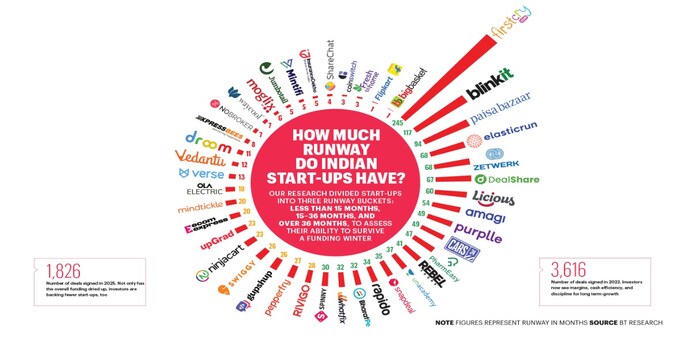
To assess how prepared start-ups are for a funding winter, BT analyzed India's 100 most-funded start-ups to estimate their cash runway.
Jyotindra Dubey
- Apr 15, 2026,
- Updated Apr 15, 2026 3:11 PM IST
For nearly a decade, the Indian start-up narrative was defined by valuations. Founders raced to join the Unicorn club, following a simple rule: scale first, outspend the competition, and figure out the bills later.
That party seems to be over and that reckoning has now arrived.
Late-stage funding is slowing sharply, and investor scrutiny has intensified, making survival—not just growth—the central question for start-ups. Cash runway, once a footnote in pitch decks, has emerged as the most critical measure of resilience in a funding-constrained environment.
Advertisement
As Gopal Jain, Managing Director and CEO of Gaja Capital, puts it, “India’s start-up ecosystem has grown up. The metrics that once drove valuations, such as GMV, user counts, headline funding rounds, have given way to the ones that matter—margins, cash efficiency, and discipline to build for the long term.” According to him, founders today have to treat the runway as a strategic asset. A business with 18-24 months of runway commands negotiating leverage—with investors, customers, and even talent.
The shift is visible in funding trends. Overall, start-up funding dropped 9.4% to $11.4 billion in 2025, but the pullback has been uneven. Early-stage funding rose 20% to $4.3 billion, while late-stage funding, critical for scaling, declined sharply by 24% to $5.4 billion, according to Tracxn data.
Advertisement
Funding hasn’t just declined in value terms. Investors signed fewer cheques as well. The total number of deals fell to 1,826 in 2025, nearly half the 3,616 deals at the peak in 2022. Not only has the overall funding dried up, investors are backing fewer start-ups, too. And more than 35,000 start-ups have shut down over the past three years, including over 11,267 in 2025 alone, implying that these companies can become unsustainable when funding dries.
GoMechanic, once celebrated for rapid expansion, collapsed after admitting to financial misreporting and was forced into a distress sale. BYJU’S, whose valuation peaked at $22 billion in 2022, has faced mounting pressure over governance, debt, and cash flow.
Advertisement
Together, these cases highlight a broader pattern: abundant capital masked weak financial discipline, allowing valuations to outpace underlying business fundamentals.
CALCULATING RUNWAY
To assess how prepared start-ups are for this funding winter, we analysed India’s 100 most-funded start-ups to estimate their cash runway.
The analysis is based on data from Tracxn, with financials sourced from CMIE Prowess using the latest available filings. Companies that are cash-generating, as well as those in the banking, financial services, and insurance space or without FY25 filings, were excluded to ensure comparability.
Cash burn is measured using net cash flow from operating activities, with monthly burn derived by annualising this figure. Runway is calculated by dividing the available cash and liquid balances by the monthly burn.
While this approach provides a view of the liquidity risk, it does not account for future fund-raising, cost rationalisation, or one-off cash movements.
THE DIVIDE
The analysis of the cash runway available to India’s most well-funded start-ups reveals a sharply divided list: a small number of start-ups with substantial cash buffers, a sizable middle tier with some cushion but still awaiting further funding, and a group with very little runway remaining.
Advertisement
To put that into context, we have divided the start-ups into three runway buckets: less-than-15-month, 15–36-months, and over-36-months, to assess their ability to survive a funding winter.
The less-than-15-month start-ups are the most vulnerable, while those with 36-plus months have the cushion to adapt. Most importantly, it reveals dependence on external funding. The shorter the runway, the higher the dependency on fresh funds over internal cash generation.
At the most stressed end, the sub-15-month runway category, some high-profile names stand out. Flipkart and BigBasket each have roughly a month’s runway based on FY25 data. Although both have strong parent support—Walmart for Flipkart and Tata Digital for BigBasket—their inclusion in this category highlights tightening liquidity even among large platforms.
Supermarket Grocery Supplies Private Ltd, the flagship entity behind BigBasket, reported a consolidated total income of Rs 9,915 crore in FY25 but a net cash outflow of Rs 1,360 crore from operating activities against cash reserves of merely Rs 78 crore. Flipkart reported an operating cash outflow of Rs 4,386 crore, with Rs 146 crore in cash balances, according to company financials sourced from CMIE Prowess data.
Advertisement
One month's runway doesn’t mean an immediate shutdown, especially for large start-ups like Flipkart and BigBasket, which have a strong parent backing. However, it does highlight extreme dependence on fresh funding, as current cash flows are insufficient to sustain operations without capital infusion at regular intervals.
Other start-ups in this high-risk category include CoinSwitch, ShareChat, and InsuranceDekho, with a runway of less than six months, all of which may need to either raise capital or significantly cut costs. Edtech player Vedantu and digital media firm VerSe Innovation also appear here with a runway of around 12 months.
The next cluster comprises start-ups with 15-36 months of runway. This group includes Ola Electric Mobility, Pepperfry, Spinny, and BharatPe. Ola Electric Mobility has an 18-month runway based on FY25 data, as it reported a net cash outflow of Rs 200 crore per month while its cash reserves stood at Rs 3,518 crore as of March 2025, as per CMIE data.
Ola Electric is now a publicly listed company. This gives the company better access to public market capital. However, given the company’s scale of operation and the competition in the sector, a runway of 18 months is generally considered risky and borderline.
Advertisement
Swiggy, the food delivery app, has a net cash outflow of Rs 2,170 crore from operating activities, while the company reported Rs 4,623 crore in cash and liquid investments as of March 2025, giving it a runway of about 26 months at the current cash burn rate.
Rapido, the bike-taxi company, recorded a cash burn of Rs 255 crore in FY25. But with Rs 731 crore in cash, they have around three years of runway without needing more funding, even if they keep burning cash at the same rate.
At the upper end, start-ups such as Unacademy, Rebel Foods, PharmEasy, Cars24, and Amagi have over three years of runway, giving them strategic flexibility.
Some companies stand out for exceptionally long runways. First Cry, for instance, has over 20 years of runway at its current burn rate. Amagi, a Bengaluru-based SaaS start-up, has enough money to last over four years. Edtech major Unacademy had Rs 1,168 crore in cash as of March 2025, as per CMIE data, which translates into a 37-month runway, at the current burn rate.
Blinkit has almost ten years of runway left. It spent Rs 165 crore more than it earned but had Rs 1,036 crore in cash and an additional Rs 576 crore in current investments as of March 2025. Zomato acquired Blinkit in 2022. With Zomato’s support, and as its losses narrow, Blinkit should be able to become profitable soon, as Zomato did.
BURN QUALITY
Not all cash burns are the same. Some start-ups burn cash in capital expenditure to fuel growth and build future value, while others do it to keep the business running. Two start-ups can have the same runway, but very different outcomes, depending on whether their burn is driving growth or covering inefficiencies.
Take Spinny. The used-car marketplace acquired vehicle servicing start-up GoMechanic in November last year for Rs 450 crore, according to Tracxn data.
In FY25, Spinny reported operating revenue of Rs 4,746 crore, as per CMIE data, up 25% from the previous fiscal. Its net loss also narrowed, showing improved operating performance and better unit economics.
Based on FY25 numbers, Spinny has an estimated runway of about 30 months. While the company continues to improve its unit economics, a portion of its existing cash burn is tied to acquisitions that could later translate into higher revenues.
A similar strategy can be seen at VerSe Innovation Pvt. Ltd., the Bengaluru-based unicorn that runs Dailyhunt, a news aggregator, and Josh, a short-video platform.
The company made two acquisitions last fiscal year, Valueleaf and Magzter. Valueleaf is a digital marketing firm that is being integrated with VerSe’s NexVerse.ai ad-tech platform, while Magzter is a global digital newsstand, which was acquired to start a subscription model and reduce dependence on advertising revenue.
In contrast, Mohalla Tech Private Ltd—the Bengaluru-based parent company of social media platform ShareChat and short-video app Moj—is burning cash largely due to financial obligations rather than growth investments. Mohalla reported an annual cash burn of Rs 432 crore in FY25, with a total income of Rs 757 crore, against expenses of Rs 1,865 crore. About 36% of its total expenses went towards debt servicing, including interest payments. As of March 2025, the company’s books carry long-term debt in the form of debentures and bonds worth Rs 5,061 crore. This gives Mohalla Tech a runway of just about four months, with a large part of the burn tied to debt servicing and not capex.
THE CASH GENERATORS
Amid the funding slowdown, a small set of start-ups stands out for a different reason. They are not burning cash. Instead, their core operations are generating cash, placing them in a far stronger position than many of their peers. In simple terms, their day-to-day business can sustain itself.
In an environment where investors have turned cautious and deals are taking longer to close, it provides a much-needed critical cushion. Avaada Energy, the Indian clean energy start-up, generated positive cash flow from operations of Rs 1,661 crore—the highest among the country’s most-funded start-ups. It is followed by Lenskart, which made its secondary market debut in November last year, and Walmart-backed PhonePe, India’s leading digital payments platform offering UPI transactions and a range of financial services.
The list of cash generators also includes logistics provider Delhivery, global hospitality platform OYO, food delivery giant Zomato, and the recently listed edtech platform PhysicsWallah.
Together, these companies highlight a different playbook where growth is balanced with operational discipline and cash generation.
CONCLUSION
The runway calculations reveal an uncomfortable truth: scale does not automatically translate into financial resilience. Several well-known start-ups, despite strong revenues and market presence, are still operating with relatively thin cash buffers. As funding slows, the reality is forcing a reset—companies with shorter runways will have to cut costs, fix unit economics, or seek strategic capital to stay afloat.
“We are noticing that start-up founders in India themselves are being careful about valuations, given how they are seeing others struggling to live up to expectations of investors. So the shift towards more sustainable, long term approach is also coming from the founders themselves, and not driven by investors alone,” Dinesh Pai, Head of Investments, Rainmatter, a VC firm by Zerodha.
Investors feel the shift is less about a lack of money and more about how it is being deployed. As Anirudh Garg, Partner at Venture Capital firm BEENEXT points out, there is still substantial dry powder in the system, but the bar for investment has risen sharply, especially for large growth rounds. This recalibration is evident across the funding landscape. According to Jain, growth-stage capital continues to flow, but increasingly towards companies that can demonstrate improving margins, disciplined capital use, and earnings that compound over time. In other words, the next decade’s winners are likely to be built on financial rigour, not just ambition.
That shift is also redefining what kinds of risk investors are willing to underwrite. Garg notes that high-burn strategies are still viable—but only for clear category leaders with a credible, time-bound path to profitability. “There is still some leeway in sectors with massive outcome potential (AI infrastructure, deep tech, fintech, etc.), but even there, profitability cannot be theoretical — it must be visible,” he said.
India’s private capital machine is working. But the bar has been raised.
@nindakbaba
For nearly a decade, the Indian start-up narrative was defined by valuations. Founders raced to join the Unicorn club, following a simple rule: scale first, outspend the competition, and figure out the bills later.
That party seems to be over and that reckoning has now arrived.
Late-stage funding is slowing sharply, and investor scrutiny has intensified, making survival—not just growth—the central question for start-ups. Cash runway, once a footnote in pitch decks, has emerged as the most critical measure of resilience in a funding-constrained environment.
Advertisement
As Gopal Jain, Managing Director and CEO of Gaja Capital, puts it, “India’s start-up ecosystem has grown up. The metrics that once drove valuations, such as GMV, user counts, headline funding rounds, have given way to the ones that matter—margins, cash efficiency, and discipline to build for the long term.” According to him, founders today have to treat the runway as a strategic asset. A business with 18-24 months of runway commands negotiating leverage—with investors, customers, and even talent.
The shift is visible in funding trends. Overall, start-up funding dropped 9.4% to $11.4 billion in 2025, but the pullback has been uneven. Early-stage funding rose 20% to $4.3 billion, while late-stage funding, critical for scaling, declined sharply by 24% to $5.4 billion, according to Tracxn data.
Advertisement
Funding hasn’t just declined in value terms. Investors signed fewer cheques as well. The total number of deals fell to 1,826 in 2025, nearly half the 3,616 deals at the peak in 2022. Not only has the overall funding dried up, investors are backing fewer start-ups, too. And more than 35,000 start-ups have shut down over the past three years, including over 11,267 in 2025 alone, implying that these companies can become unsustainable when funding dries.
GoMechanic, once celebrated for rapid expansion, collapsed after admitting to financial misreporting and was forced into a distress sale. BYJU’S, whose valuation peaked at $22 billion in 2022, has faced mounting pressure over governance, debt, and cash flow.
Advertisement
Together, these cases highlight a broader pattern: abundant capital masked weak financial discipline, allowing valuations to outpace underlying business fundamentals.
CALCULATING RUNWAY
To assess how prepared start-ups are for this funding winter, we analysed India’s 100 most-funded start-ups to estimate their cash runway.
The analysis is based on data from Tracxn, with financials sourced from CMIE Prowess using the latest available filings. Companies that are cash-generating, as well as those in the banking, financial services, and insurance space or without FY25 filings, were excluded to ensure comparability.
Cash burn is measured using net cash flow from operating activities, with monthly burn derived by annualising this figure. Runway is calculated by dividing the available cash and liquid balances by the monthly burn.
While this approach provides a view of the liquidity risk, it does not account for future fund-raising, cost rationalisation, or one-off cash movements.
THE DIVIDE
The analysis of the cash runway available to India’s most well-funded start-ups reveals a sharply divided list: a small number of start-ups with substantial cash buffers, a sizable middle tier with some cushion but still awaiting further funding, and a group with very little runway remaining.
Advertisement
To put that into context, we have divided the start-ups into three runway buckets: less-than-15-month, 15–36-months, and over-36-months, to assess their ability to survive a funding winter.
The less-than-15-month start-ups are the most vulnerable, while those with 36-plus months have the cushion to adapt. Most importantly, it reveals dependence on external funding. The shorter the runway, the higher the dependency on fresh funds over internal cash generation.
At the most stressed end, the sub-15-month runway category, some high-profile names stand out. Flipkart and BigBasket each have roughly a month’s runway based on FY25 data. Although both have strong parent support—Walmart for Flipkart and Tata Digital for BigBasket—their inclusion in this category highlights tightening liquidity even among large platforms.
Supermarket Grocery Supplies Private Ltd, the flagship entity behind BigBasket, reported a consolidated total income of Rs 9,915 crore in FY25 but a net cash outflow of Rs 1,360 crore from operating activities against cash reserves of merely Rs 78 crore. Flipkart reported an operating cash outflow of Rs 4,386 crore, with Rs 146 crore in cash balances, according to company financials sourced from CMIE Prowess data.
Advertisement
One month's runway doesn’t mean an immediate shutdown, especially for large start-ups like Flipkart and BigBasket, which have a strong parent backing. However, it does highlight extreme dependence on fresh funding, as current cash flows are insufficient to sustain operations without capital infusion at regular intervals.
Other start-ups in this high-risk category include CoinSwitch, ShareChat, and InsuranceDekho, with a runway of less than six months, all of which may need to either raise capital or significantly cut costs. Edtech player Vedantu and digital media firm VerSe Innovation also appear here with a runway of around 12 months.
The next cluster comprises start-ups with 15-36 months of runway. This group includes Ola Electric Mobility, Pepperfry, Spinny, and BharatPe. Ola Electric Mobility has an 18-month runway based on FY25 data, as it reported a net cash outflow of Rs 200 crore per month while its cash reserves stood at Rs 3,518 crore as of March 2025, as per CMIE data.
Ola Electric is now a publicly listed company. This gives the company better access to public market capital. However, given the company’s scale of operation and the competition in the sector, a runway of 18 months is generally considered risky and borderline.
Advertisement
Swiggy, the food delivery app, has a net cash outflow of Rs 2,170 crore from operating activities, while the company reported Rs 4,623 crore in cash and liquid investments as of March 2025, giving it a runway of about 26 months at the current cash burn rate.
Rapido, the bike-taxi company, recorded a cash burn of Rs 255 crore in FY25. But with Rs 731 crore in cash, they have around three years of runway without needing more funding, even if they keep burning cash at the same rate.
At the upper end, start-ups such as Unacademy, Rebel Foods, PharmEasy, Cars24, and Amagi have over three years of runway, giving them strategic flexibility.
Some companies stand out for exceptionally long runways. First Cry, for instance, has over 20 years of runway at its current burn rate. Amagi, a Bengaluru-based SaaS start-up, has enough money to last over four years. Edtech major Unacademy had Rs 1,168 crore in cash as of March 2025, as per CMIE data, which translates into a 37-month runway, at the current burn rate.
Blinkit has almost ten years of runway left. It spent Rs 165 crore more than it earned but had Rs 1,036 crore in cash and an additional Rs 576 crore in current investments as of March 2025. Zomato acquired Blinkit in 2022. With Zomato’s support, and as its losses narrow, Blinkit should be able to become profitable soon, as Zomato did.
BURN QUALITY
Not all cash burns are the same. Some start-ups burn cash in capital expenditure to fuel growth and build future value, while others do it to keep the business running. Two start-ups can have the same runway, but very different outcomes, depending on whether their burn is driving growth or covering inefficiencies.
Take Spinny. The used-car marketplace acquired vehicle servicing start-up GoMechanic in November last year for Rs 450 crore, according to Tracxn data.
In FY25, Spinny reported operating revenue of Rs 4,746 crore, as per CMIE data, up 25% from the previous fiscal. Its net loss also narrowed, showing improved operating performance and better unit economics.
Based on FY25 numbers, Spinny has an estimated runway of about 30 months. While the company continues to improve its unit economics, a portion of its existing cash burn is tied to acquisitions that could later translate into higher revenues.
A similar strategy can be seen at VerSe Innovation Pvt. Ltd., the Bengaluru-based unicorn that runs Dailyhunt, a news aggregator, and Josh, a short-video platform.
The company made two acquisitions last fiscal year, Valueleaf and Magzter. Valueleaf is a digital marketing firm that is being integrated with VerSe’s NexVerse.ai ad-tech platform, while Magzter is a global digital newsstand, which was acquired to start a subscription model and reduce dependence on advertising revenue.
In contrast, Mohalla Tech Private Ltd—the Bengaluru-based parent company of social media platform ShareChat and short-video app Moj—is burning cash largely due to financial obligations rather than growth investments. Mohalla reported an annual cash burn of Rs 432 crore in FY25, with a total income of Rs 757 crore, against expenses of Rs 1,865 crore. About 36% of its total expenses went towards debt servicing, including interest payments. As of March 2025, the company’s books carry long-term debt in the form of debentures and bonds worth Rs 5,061 crore. This gives Mohalla Tech a runway of just about four months, with a large part of the burn tied to debt servicing and not capex.
THE CASH GENERATORS
Amid the funding slowdown, a small set of start-ups stands out for a different reason. They are not burning cash. Instead, their core operations are generating cash, placing them in a far stronger position than many of their peers. In simple terms, their day-to-day business can sustain itself.
In an environment where investors have turned cautious and deals are taking longer to close, it provides a much-needed critical cushion. Avaada Energy, the Indian clean energy start-up, generated positive cash flow from operations of Rs 1,661 crore—the highest among the country’s most-funded start-ups. It is followed by Lenskart, which made its secondary market debut in November last year, and Walmart-backed PhonePe, India’s leading digital payments platform offering UPI transactions and a range of financial services.
The list of cash generators also includes logistics provider Delhivery, global hospitality platform OYO, food delivery giant Zomato, and the recently listed edtech platform PhysicsWallah.
Together, these companies highlight a different playbook where growth is balanced with operational discipline and cash generation.
CONCLUSION
The runway calculations reveal an uncomfortable truth: scale does not automatically translate into financial resilience. Several well-known start-ups, despite strong revenues and market presence, are still operating with relatively thin cash buffers. As funding slows, the reality is forcing a reset—companies with shorter runways will have to cut costs, fix unit economics, or seek strategic capital to stay afloat.
“We are noticing that start-up founders in India themselves are being careful about valuations, given how they are seeing others struggling to live up to expectations of investors. So the shift towards more sustainable, long term approach is also coming from the founders themselves, and not driven by investors alone,” Dinesh Pai, Head of Investments, Rainmatter, a VC firm by Zerodha.
Investors feel the shift is less about a lack of money and more about how it is being deployed. As Anirudh Garg, Partner at Venture Capital firm BEENEXT points out, there is still substantial dry powder in the system, but the bar for investment has risen sharply, especially for large growth rounds. This recalibration is evident across the funding landscape. According to Jain, growth-stage capital continues to flow, but increasingly towards companies that can demonstrate improving margins, disciplined capital use, and earnings that compound over time. In other words, the next decade’s winners are likely to be built on financial rigour, not just ambition.
That shift is also redefining what kinds of risk investors are willing to underwrite. Garg notes that high-burn strategies are still viable—but only for clear category leaders with a credible, time-bound path to profitability. “There is still some leeway in sectors with massive outcome potential (AI infrastructure, deep tech, fintech, etc.), but even there, profitability cannot be theoretical — it must be visible,” he said.
India’s private capital machine is working. But the bar has been raised.
@nindakbaba
Read more!