
How Jaipur is reclaiming its place as India’s premier luxury hub
With a wave of new luxury hotels, and its ascent as a destination for art, fashion, culture, and design, is the Pink City reclaiming its place as Indi's premier luxury hub?
Smita Tripathi
- Oct 7, 2025,
- Updated Oct 13, 2025 10:16 PM IST
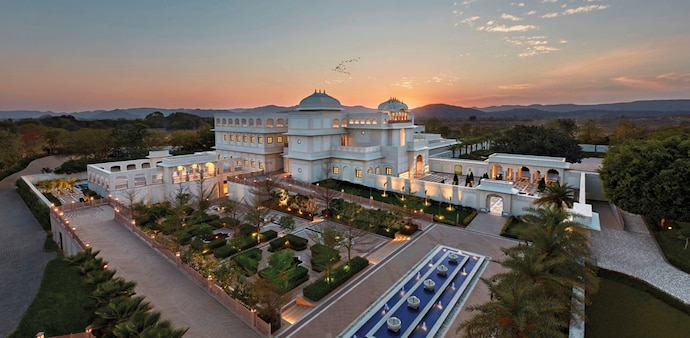
Rich with a sprinkling of fair musk-rose blooms: And such too is the grandeur of the dooms”. British Romantic poet John Keats immortalised these lines in Endymion. The said ‘grandeur’ is eponymic to Jaipur, a royal city which has been a byword for opulence. Maharajas held court in sprawling palaces, artisans perfected the delicate art of meenakari, and the city drew nobles, traders, and travellers in search of jewels and spectacle. Over time, its splendour was preserved in sandstone façades and storied hotels, but its reputation as a living luxury capital faded, eclipsed by newer destinations. Now, the Pink City is staging a striking return. Consider this: In the last 12 months alone, marquee hotels such as Raffles Jaipur, Mementos by ITC Hotels, and Anantara Jewel Bagh have opened in the city. And if that wasn’t enough, Jaipur has a formidable pipeline that includes Ritz-Carlton, Sofitel Legend Sukh Bagh Jaipur, Waldorf Astoria, Conrad, and Signia by Hilton—all slated to open before the decade’s end. These new entrants will sit alongside Jaipur’s existing grande dames, such as Rambagh Palace (managed by IHCL), The Leela Palace Jaipur, The Oberoi Rajvilas, etc.
Hey!
Already a subscriber? Sign In
THIS IS A PREMIUM STORY FROM BUSINESS TODAY.
Subscribe to Business Today Digital and continue enjoying India's premier business offering uninterrupted
only FOR
₹999 / Year
Unlimited Digital Access + Ad Lite Experience
Cancel Anytime
-
 Unlimited access to Business Today website
 -
 Exclusive insights on Corporate India's working, every quarter
 -
 Access to our special editions, features, and priceless archives
 -
 Get front-seat access to events such as BT Best Banks, Best CEOs and Mindrush
Rich with a sprinkling of fair musk-rose blooms: And such too is the grandeur of the dooms”. British Romantic poet John Keats immortalised these lines in Endymion. The said ‘grandeur’ is eponymic to Jaipur, a royal city which has been a byword for opulence. Maharajas held court in sprawling palaces, artisans perfected the delicate art of meenakari, and the city drew nobles, traders, and travellers in search of jewels and spectacle. Over time, its splendour was preserved in sandstone façades and storied hotels, but its reputation as a living luxury capital faded, eclipsed by newer destinations. Now, the Pink City is staging a striking return. Consider this: In the last 12 months alone, marquee hotels such as Raffles Jaipur, Mementos by ITC Hotels, and Anantara Jewel Bagh have opened in the city. And if that wasn’t enough, Jaipur has a formidable pipeline that includes Ritz-Carlton, Sofitel Legend Sukh Bagh Jaipur, Waldorf Astoria, Conrad, and Signia by Hilton—all slated to open before the decade’s end. These new entrants will sit alongside Jaipur’s existing grande dames, such as Rambagh Palace (managed by IHCL), The Leela Palace Jaipur, The Oberoi Rajvilas, etc.
Advertisement
According to hospitality consulting firm HVS ANAROCK, Jaipur has about 7,800 branded hotel keys. Nearly a quarter (or 1,900 keys) fall in the luxury segment and over 1,800 luxury keys will be added in the next five years—nearly 37% of the total pipeline of over 4,900 rooms across 30-plus hotel projects.
“This is in stark contrast to the national trend, where only 15% of the proposed supply falls within the luxury segment, and the bulk is dominated by midscale, upper midscale and upscale developments,” as per Hotelivate, a hospitality consulting firm.
Advertisement
“The city already has a strong base,” says Akash Datta, managing director for South Asia at HVS ANAROCK. “What’s striking is that despite this depth, the pipeline remains robust.”
Zubin Saxena, Senior Vice President & Regional Head, South Asia, Hilton, agrees. “Rajasthan, particularly Jaipur, has long lured travellers for its rich history, vibrant culture, stunning architecture, and culinary experiences. Its domestic and global appeal makes it a natural fit for our brands like Waldorf Astoria, Signia by Hilton, and Conrad Hotels & Resorts.”
Advertisement
One prerequisite for luxury development is suitable infrastructure. With burgeoning footfalls—Rajasthan reported 230 million domestic visits and 20,000,000 international arrivals in 2024—it’s important that infrastructure is conducive. Jaipur International Airport is undergoing a massive Rs 600-crore upgrade, adding a new terminal and several more check-in counters. Road links from Delhi are improving, with the Delhi–Mumbai Expressway and the improved Delhi-Jaipur highway cutting travel time further.
Such connectivity smoothens the seasonality of Jaipur’s tourism. Corporate travel from Delhi-NCR, MICE (meetings, incentives, conferences, and exhibitions) events, and exhibitions now plug demand gaps between wedding and holiday seasons. Post-pandemic, the city’s hotel market rebounded faster than most others with revenue per available room (RevPar) tripling between 2020-21 and 2022-23, according to Hotelivate.
Thai chain Anantara Hotels & Resorts, with more than 50 properties worldwide, chose Jaipur—not Goa, not Kerala—for its Indian debut, primarily because of its wedding potential. “Weddings have truly become a highlight of our journey since opening. Not a single saaya (auspicious date) in either the previous year or the current year has passed without weddings at the hotel,” says Dillip Rajakarier, Group CEO of Minor International, which owns Anantara Hotels & Resorts.
Advertisement
However, the creation of a true luxury hub goes beyond just building hotels. As Jaipur reinvents itself, it is emerging as one of India’s most competitive luxury clusters—and there is no shortage of examples to prove it.
Take Punit Balana. The Jaipur-based designer celebrated 10 years of his label with the opening of his flagship store in the city—his third after Delhi and Mumbai. The celebrations included a fashion show, set against the backdrop of the iconic Rambagh Palace, and had Bollywood actor Ananya Pandey as the showstopper. “Jaipur has truly established itself as a hub for craftsmanship and textiles. Its rich cultural heritage, combined with excellent connectivity, makes it easily accessible to a global audience. What makes it truly special is its unique pace, neither too fast nor too slow, which gives the city its own beauty,” says Balana, who has seen a 50% growth in sales post the pandemic.
In July, at a glittering ceremony in Jaipur, Titan unveiled Jalsa, a limited-edition tourbillon watch, from Nebula by Titan with dials hand-painted by Padma Shri awardee Shakir Ali to depict royal processions across the Hawa Mahal. Only 10 pieces exist, each priced at Rs 40.5 lakh. Titan will take Jalsa to the Grand Prix d’Horlogerie de Genève, placing Jaipur on the global watch map.
Advertisement
Last winter, art curator Noelle Kadar, working with Sawai Padmanabh Singh of the Jaipur royal family, opened the Jaipur Centre for Arts (JCA) inside the City Palace. “Our tourism numbers are the same as Florence or Paris,” says Kadar. “Visitors expect contemporary art as well as monuments when they visit those cities. We felt we now had a similar audience in Jaipur.”
JCA showcases museum quality art, and its debut show featured renowned artists such as Dayanita Singh, Anish Kapoor, and Manjunath Kamath. But it also gives a voice to younger artists. “If the story is interesting for Jaipur, we want to show it,” she says, adding that their next show will be about contemporary miniature paintings.
Jewellery designer Sunita Shekhawat launched the Museum of Meenakari Heritage in March last year, charting centuries of enamel work. Her daughter Niharika Shekhawat says locals, many of whom studied abroad, returned to Jaipur out of pride. The collection showcases remarkable reproductions of historic artefacts, from pieces reflecting Mughal-Rajput artistry to those crafted using rare techniques such as Ronde-bosse and plique-à-jour enamelling. These include decorative boxes, vanity mirrors, a hair pin, pair of prancing horse earrings and a meenakari pill box. The price range is Rs 1.25 lakh to Rs 18.5 lakh. Niharika says the idea came to them when during the Anant Ambani wedding, Nita Ambani asked them to make an enamel box for her.
Advertisement
In November 2023, couturier Anita Dongre staged Rewild, her sustainability-themed show, in the courtyards of the City Palace. “Jaipur felt like the only city that made sense… Doing it at the City Palace wasn’t just a dream, it was a way to honour the city’s legacy.”
Each of these ventures reinforces the others. Museums gain visibility from affluent travellers and hotels benefit from fashion shows. As demand strengthens, supply thickens. “Luxury hotels play a significant role in shaping Jaipur’s tourism and luxury industry. They are open to collaborations, and our recent partnership with Rambagh Palace for our 10-year celebration was a wonderful example of that,” says Balana.
“Over the last few years, it’s been a nightmare to find a hotel room in Jaipur during season,” says Kadar. The influx of Hilton, Marriott, and Accor brands is designed to solve exactly that shortage.
By 2030, Jaipur could host more than 10,000 branded rooms, with luxury comprising nearly a third. Jaipur has long been synonymous with luxury, heritage and world-class hospitality. Now it is entering a new chapter.
For visitors arriving at dawn, when the sun hits the Hawa Mahal in blush and gold, the city’s transformation is almost literal. Jaipur may remain the Pink City in name. But in spirit, it is turning deep gold.
@smitabw
Read more!