
How new-age traders see AI as an indispensable tool but others warn of its negative consequences
How new-age traders see AI as an indispensable tool but others warn of its negative consequences
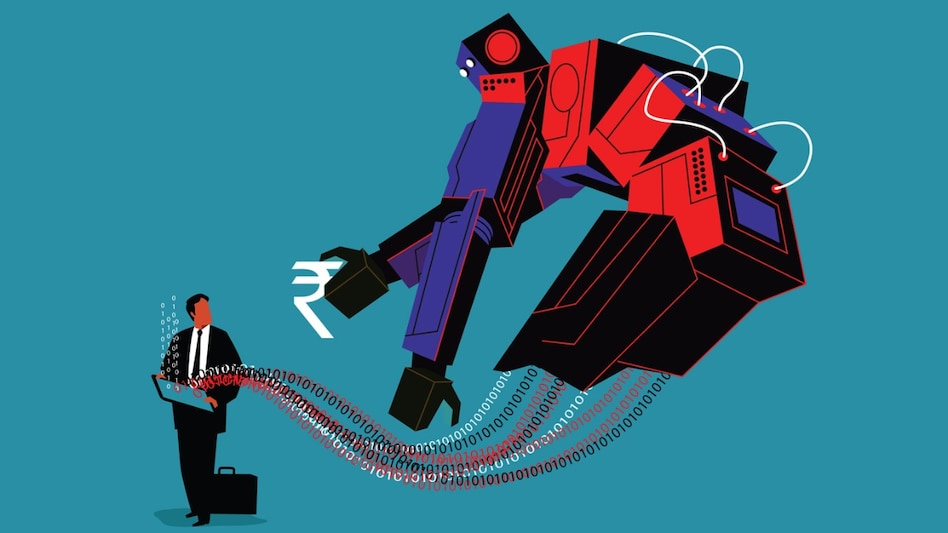
New-age traders see AI as an indispensable tool, one that can process vast datasets on a scale no human can match. But some market veterans warn that it has the potential to amplify herd behaviour and trigger flash crashes.
Prashun Talukdar
- Jan 8, 2026,
- Updated Jan 8, 2026 5:38 PM IST
Depending on who you are listening to, artificial intelligence (AI) is either the holy grail of investing or a phenomenon that can undermine stock market probity and integrity. Both sides argue their case with reason, conviction and passion.
Hey!
Already a subscriber? Sign In
THIS IS A PREMIUM STORY FROM BUSINESS TODAY.
Subscribe to Business Today Digital and continue enjoying India's premier business offering uninterrupted
only FOR
₹999 / Year
Unlimited Digital Access + Ad Lite Experience
Cancel Anytime
-
 Unlimited access to Business Today website
 -
 Exclusive insights on Corporate India's working, every quarter
 -
 Access to our special editions, features, and priceless archives
 -
 Get front-seat access to events such as BT Best Banks, Best CEOs and Mindrush
Depending on who you are listening to, artificial intelligence (AI) is either the holy grail of investing or a phenomenon that can undermine stock market probity and integrity. Both sides argue their case with reason, conviction and passion.
AI is transforming the way markets are analysed, trades executed and risks managed. Yet, the growing reliance on machine-driven market strategies carries risks.
Advertisement
AI may speed up data processing and enhance real-time analysis; but on the flip side, it has the potential to amplify herd behaviour and trigger flash crashes, say experts. AI’s expanding footprint in the markets has become a hot issue as the technology that enables computer systems to mimic human cognitive abilities makes rapid inroads.
Market veteran Arun Kejriwal provides a cautionary counterbalance to the optimism surrounding algorithmic investing. Having observed the markets for decades, he argues that AI is in its infancy and still struggling to adapt to the complexities of a live trading environment.
Some traders see AI as an indispensable support system—one that can process vast datasets and accelerate decision-making on a scale “no human can match”.
Advertisement
AI-Driven Analysis
Fintech platforms emphasise the significant advantages AI brings to modern investing, particularly in processing large and complex market datasets.
For Yashas Khoday, chief product officer and co-founder of trading platform FYERS, AI is a game-changing analytical engine.
“AI is fundamentally changing how investors make sense of complex market data. First, it can process huge volumes of information, from price charts and earnings to news and sentiment, all at once,” he says.
This helps uncover patterns and signals that a human analyst might miss. Second, it removes bias. “While people often overvalue their opinions or recent trends, AI looks at the data objectively and consistently. This helps investors make smarter, more evidence-based decisions.”
Advertisement
Siddharth Sureka, Chief AI Officer at brokerage Motilal Oswal Financial Services Ltd, explains how new models are unlocking insights from both structured and unstructured sources.
“AI/ML (machine learning) models unlock the ability to uncover signals from huge volumes of structured and unstructured data, such as historical prices, tick data, order books, corporate filings, news, economic indicators, etc., that otherwise could have been missed by traditional approaches,” says Sureka.
"While people often overvalue their opinions or recent trends, Al looks at the data objectively and consistently. This helps investors make smarter, more evidence-based decisions," says Yashas Khoday, Co-Founder & Chief Product Officer, FYERS.
-Yashas Khoday,Co-Founder & Chief Product Officer, FYERS
Protective Shield?
Kejriwal argues that AI is helpful in scanning news and quickly identifying companies that may potentially feel the harmful impact of a market-related development but insists that decisions cannot be outsourced entirely to machines.
“While it gives you a list, you use your mind to confirm whether it is talking in the right direction or not. But can I follow that list blindly? The possibility that you may get cleaned out is more than your chances of making money.”
The concerns extend to market manipulation. Kejriwal cites an example where technical triggers are deliberately exploited. If a stock at Rs 120 needs to cross Rs 128.50 to register a breakout, a manipulator could push it to that level to attract buyers.
Advertisement
“Now, tomorrow it will generate a buy signal. Tomorrow, there will be buyers galore in that stock. And I am the one who is supplying the stock tomorrow. So, I have rigged the system,” he says, pointing out that systems are only as good as their creators and markets have people capable of exploiting both human and machine behaviour.
Kejriwal firmly rejects the notion that AI can act as a protective shield for retail investors. “How do you see AI as a protection for retailers? No, it can’t be,” he says. “If you want protection from all these sorts of activities, you will have to teach the machine what to do, what not to do, etc.”
He draws an analogy with industrial robots, which work flawlessly only after extensive programming. “Once you programme the robot to do multiple activities, it will do so without complaining. But you have spent money, time, effort in programming, in teaching, in making the robot learn. Similarly, if you want a machine to help you make money in the stock market, you have to learn how to programme it,” he says.
Kejriwal’s position is clear: AI can replicate and duplicate patterns, but originality, interpretation and forward thinking are uniquely human strengths that cannot be recreated in a machine.
Advertisement
AI is excellent for getting information instantly, for collating standby type of information. But using it to predict price movement is not so easy.
-ARUN KEJRIWAL,KEJRIWAL RESEARCH & INVESTMENT SERVICES Pvt Ltd
Real-Time Edge
One of AI’s biggest advantages is its ability to operate continuously and process market information as it unfolds. Khoday explains this contrast with manual analysis.
“Machine learning models can process millions of data points in real time, which is something no human can match. They can detect hidden trends and patterns which manual analysis often misses,” he says. He clarifies that humans remain essential evaluators. “The goal is not to follow machines blindly. It’s about using machines to expand our field of view, not replace human thinking.”
For Sureka, real-time processing has dramatically changed corporate analysis. He points to the leap from pre-GPT to post-GPT workflows.
“In the pre-GPT era, an analyst was required to hear the quarterly calls, make notes and extract key themes for analysis. It was a laborious and gruelling process. In the post-GPT era, AI-based tools have accelerated the process as they can transcribe, summarise and extract key pieces of information in minutes,” he says.
Managing Risk
Advertisement
Khoday says AI-powered risk tools help on two fronts. “First, they use pattern recognition to detect anomalies and forecast volatility.” By scanning vast amounts of market data, they can spot early signals like sudden price shifts, news triggers, liquidity shortages or unusual trading activity. “Second, they are much better at handling preset risk rules. This makes risk execution more disciplined and consistent.”
Sureka notes that AI’s strength comes from understanding non-linear relationships across variables.
“These non-linear relationships help identify and flag unusual patterns or deviations from expected behaviour. These early warning tools and systems can help better manage risks; however, they cannot be completely eliminated, and black swan events will continue happening,” he says.
Herd Behaviour
Khoday warns against uncritical dependence on machine signals. “When too many systems react to the same signals, it can create chain reactions, especially in volatile markets. It’s like a car crash on a highway where one collision leads to many more,” he says.
Automated systems have already demonstrated their capacity to accelerate flash crashes. Human filters and contextual awareness are essential, he insists.
Sureka echoes this concern with an example. “Herd behaviour may arise if multiple investors leverage similar algorithmic systems and is highly automated. One example is the 2010 US flash crash, where the Dow dropped more than 1,000 points in 10 minutes. The index lost close to 9% of its value and over $1 trillion in equity; 70% was regained the same day,” he says.
Even the most advanced models are dependent on the quality of data they are trained on. Khoday points out that as datasets increasingly converge, human interpretation becomes the real differentiator. “The role of the trader is evolving. Just like it has through every market cycle, human judgment will always be the edge.”
"If the data curated for training contains biases, the model will reflect that," highlights Siddharth Sureka, Chief AI Officer, Motilal Oswal Financial Services Ltd.
-Siddharth Sureka,Chief AI Officer, Motilal Oswal Financial Services Ltd
Sureka highlights the probabilistic behaviour of AI systems. “If the data curated for training contains biases, the model will reflect that.”
So, how should one respond when AI models flag risks? Khoday describes a balanced response framework: Evaluate the signal. “If it holds weight, then gauge the impact. It could mean reducing position size, tightening stop-loss levels, or in some cases, exiting altogether,” he says. The key, he emphasises, is preparedness.
Veteran trader Kejriwal and a couple of AI leaders are united in their view that AI is neither a plug-and-play solution nor an instant path to profit. It is powerful, fast, and increasingly indispensable, but requires careful understanding, reliable data, strong governance and human interpretation.
New-age traders agree. Nevertheless, AI’s ability to transform workflows, process large datasets and generate real-time insights is reshaping how investors operate, they say.
@prashuntalukdar
Read more!