
India’s Best Banks and NBFCs: How we picked the winners
The rationale behind the BT-KPMG India's Best Banks and NBFCs Survey 2024-25
BT Team
- Mar 10, 2026,
- Updated Mar 10, 2026 4:07 PM IST
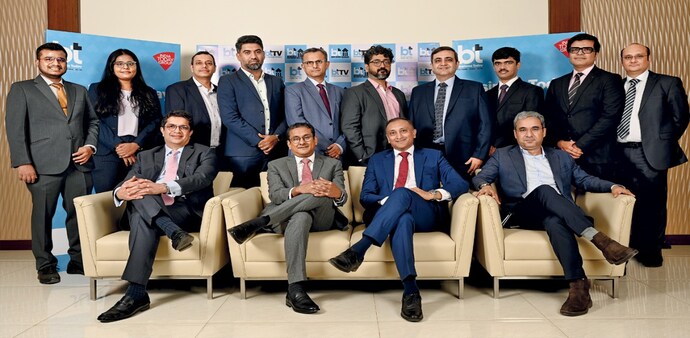
After a rigorous process of engaging with banks, NBFCs, fintechs, and analysing large volumes of data to shortlist the top three nominees in as many as eleven categories, it was time to choose the best of the best for the 30th edition of the BT-KPMG Best Banks & NBFCs Survey. The jury met at Mumbai’s NSE boardroom on a toasty January morning to decide the winners.
Hey!
Already a subscriber? Sign In
THIS IS A PREMIUM STORY FROM BUSINESS TODAY.
Subscribe to Business Today Digital and continue enjoying India's premier business offering uninterrupted
only FOR
₹999 / Year
Unlimited Digital Access + Ad Lite Experience
Cancel Anytime
-
 Unlimited access to Business Today website
 -
 Exclusive insights on Corporate India's working, every quarter
 -
 Access to our special editions, features, and priceless archives
 -
 Get front-seat access to events such as BT Best Banks, Best CEOs and Mindrush
After a rigorous process of engaging with banks, NBFCs, fintechs, and analysing large volumes of data to shortlist the top three nominees in as many as eleven categories, it was time to choose the best of the best for the 30th edition of the BT-KPMG Best Banks & NBFCs Survey. The jury met at Mumbai’s NSE boardroom on a toasty January morning to decide the winners.
Advertisement
In a first in nine years, BT constituted a larger seven-member jury—led by Dinesh Khara, former Chairman, State Bank of India—to decide 13 jury awards. The other jury members were Ashima Goyal, Professor Emeritus, IGIDR; Zarin Daruwala, Group Chief Executive at PL Capital, and former CEO, Standard Chartered Bank; G. N. Bajpai, Founder & Chairman, GovEva and former Chairman of SEBI and LIC; Gunit Chadha, Founder, APAC Financial Services and former CEO, Deutsche Bank; Ashish Chauhan, MD & CEO, NSE India; and Surojit Shome, former MD & CEO, DBS Bank India.
Customer experience, impact of innovation, succession planning, and scalability of initiatives were the points of focus during the discussion. The jury also discussed the challenges faced by public-sector banks, especially in talent management, given the relatively low compensation and absence of hire-and-fire flexibility as available to private and foreign banks.
Advertisement
At the end of the deliberations, the jury finalised 12 awards out of 13 categories. The category Best in Innovation (Private Banks) was dropped due to the absence of strong entries.
ICICI Bank, L&T Finance, and HSBC India emerged as standout performers, winning two awards each. The selection of ICICI Bank as Bank of the Year was unanimous despite the bank having won the honour for five consecutive years. There was also unanimity in conferring the Lifetime Achievement Award on Shaktikanta Das, former Governor of the Reserve Bank of India.
Together with the seven quantitative (non-jury) awards, the study features a total of 19 awards this year. HDFC Bank was excluded from the quantitative study due to the merger of HDFC Ltd into the bank during the past three-year period.
Advertisement
Our knowledge partner KPMG ran the process of selecting the best three nominees in each category and conducted the quantitative ranking.
QUANTITATIVE AWARDS
For rankings based on pure financial performance, data was taken from published annual reports of banks for FY22 to FY25, except for the data on the number of branches of a few foreign banks, which was sourced from their official websites.
The survey covered 53 scheduled commercial banks that had published annual reports in the public domain or had provided their annual reports prior to October 31, 2025.
Foreign banks with a balance sheet size of less than `25,000 crore as on March 31, 2025 were not considered for the survey. Also not covered were scheduled commercial banks whose financial statements were not available, or which had not completed three years of operations in India as on March 31, 2025, or were involved in mergers in the last three years, or were under liquidation.
The Ranking Process
The banks were divided between ‘Indian Banks’ (consisting of public- and private-sector banks), ‘Foreign banks’ (branches of foreign banks operating in India), and Indian small finance banks. Indian Banks were further classified based on balance sheet size as on March 31, 2025.
Advertisement
Group I: Indian banks with a balance sheet size of more than or equal to `5 lakh crore
Group II: Indian banks with a balance sheet size of more than `2 lakh crore and less than `5 lakh crore
Group III: Indian banks with a balance sheet size of less than or equal to `2 lakh crore
Group IV: Foreign banks with a balance sheet size of more than or equal to `25,000 crore
Group V: Indian Small finance banks
Ranking Parameters
The banks were judged on three parameters—growth, size, and strength—divided into 36 sub parameters (39 sub-parameters for foreign banks):
Growth: There were 12 sub-parameters (14 for foreign banks), which included YoY growth in total deposits, alongside three-year* CAGR of total deposits; YoY growth in CASA deposits, alongside three-year* CAGR of CASA deposits; YoY growth in loans and advances, alongside three-year* CAGR in loans and advances; YoY growth in fee income (commission, exchange and brokerage income plus miscellaneous income), alongside three-year* CAGR in fee income; YoY growth in operating profit, alongside three-year* CAGR in operating profit; and absolute increase in market share of deposits and of CASA balances. The two additional parameters for foreign banks were YoY growth in saving account (SA) deposits and alongside three-year CAGR of SA deposits.
Advertisement
*Two years for Shivalik Small Finance Bank Limited and Unity Small Finance Bank Limited
Size: There were 3 sub-parameters: size of total deposits, size of operating profits, and size of balance sheet as on March 31, 2025.
Strength: There were 4 overarching sub-parameters:
Quality of assets: Increase inGNPAs in %: Additions to GNPAs during the year as a percentage of average net loans and advances (i.e. average of closing balance of FY24 and FY25); NPA coverage: provisioning as on March 31, 2025 for NPAs as percentage of GNPA closing balance; net NPAs as a ratio of net advances: GNPAs closing balance net of provisioning as at March 31, 2025 expressed as percentage of net advances; GNPAs as a ratio of gross advances: GNPAs closing balance as on March 31, 2025 expressed as percentage of gross advances; secured net advances (net of provisions) to total net advances (net of provisions): Secured net advances to total net advances as at March 31, 2025; deposits of 20 largest depositors as a percentage of total deposits, advances to the 20 largest borrowers as a percentage of total advances, exposure to 20 largest borrowers/customers as a percentage of total exposure.
For determining rankings based on the provision coverage ratio, banks having zero NPAs and banks having a provision coverage ratio of 100% were assigned the highest rank in that parameter.
Advertisement
Productivity and efficiency: Cost-to-income ratio: Operating expenditure as a percentage of operating income; cost-to-average asset ratio: operating expenditure as a percentage of average total assets (i.e. average of closing balance of FY24 and FY25); absolute increase in return on assets: basis points increase in return on assets (net profit over total assets) from FY24 to FY25; percentage increase in ratio of operating profit to total income from FY24 to FY25; profit per employee; number of branches in India as on March 31, 2025 for foreign banks.
Quality of earnings: Return on Assets (RoA): Ratio of net profit to average total assets (i.e. average of closing balance of FY24 and FY25); fee income as a percentage of total income; return on equity: reported net profit divided by average net worth (i.e. average of closing balance of FY24 and FY25); NIM: total interest income minus total interest expenses as a percentage of average interest earning assets; penalties imposed by the RBI during the year.
Capital adequacy and liquidity coverage: Capital adequacy ratio: Capital-to-risk weighted assets ratio for FY25; Tier-I capital: total of equity capital and disclosed reserves; liquidity coverage ratio: ratio of high-quality liquid assets (HQLA) to total net cash outflows over the following 30 calendar days.
Final Scoring and Rating
A score was assigned for each bank on each of the 36 sub-parameters (39 for foreign banks), based on their ranks. The score under each parameter was then multiplied by the parameter’s weight to arrive at the final score. The results were aggregated to arrive at the final rankings based on the total score.
In total, 35 banks were not considered for the survey in FY25 due to mergers, liquidation, non-availability of annual reports in public domain for FY25 and foreign banks with balance sheet size of less than `25,000 crore.
QUANTITATIVE AWARDS
For rankings based on pure financial performance, data was taken from published annual reports of NBFCs for FY22 to FY25. The survey included 26 non-banking finance companies (NBFCs) including housing finance companies (HFCs), which were further divided into two sub-groups:
Group I: Upper layer NBFCs—11 NBFCs out of 15 classified in the upper layer (NBFC-UL) by the RBI. One classified as a core investment company and three involved in mergers in the last three years were not considered.
Group II: HFCs with a balance sheet size of `10,000 crore or more as on March 31, 2025 (including 3 HFCs in the upper layer).
The Ranking Process
NBFCs were judged on three parameters—growth, size and strength—divided into 29 sub-parameters for upper layer NBFCs and 28 sub-parameters for HFCs:
Growth: There were six sub-parameters in this category, which included YoY growth in loans, alongside three-year* compounded annual growth rate (CAGR) in loans; YoY growth in borrowings, alongside three-year* CAGR in borrowings and YoY growth in operating profit, alongside three-year* CAGR in operating profit.
*Two years for Shriram Finance Limited and Piramal Finance Limited
Size: There were two sub-parameters, which included size of operating profits and size of the balance sheet as on March 31, 2025.
Strength: There were five overarching sub-parameters, each with further sub-divisions as set out below:
Quality of assets: Increase in gross Stage-3 loans ratio: Additions to gross Stage-3 loans during the year as percentage of the average gross loans (i.e. average of closing balance of FY24 and FY25); PCR: provisioning as on March 31, 2025 for Stage-3 loans as a percentage of gross Stage-3 loans as on March 31, 2025; net Stage-3 loans as a ratio of net loans: gross Stage-3 loans closing balance net of provisioning expressed as a percentage of net loans as on March 31, 2025; gross Stage-3 loan ratio: gross Stage-3 loan balance as a percentage of gross loan balance as on March 31, 2025; impairment on loans to gross loans ratio: impairment on loans debited to the statement of profit and loss including loans written off as bad debts (net of recoveries) during the year ended March 31, 2025 as percentage of gross loan balance as at March 31, 2025; gross Stage-2 loan ratio: gross Stage-2 loan balance as a percentage of gross loan balance as at March 31, 2025; Secured loans to total loans: Secured gross loans to total gross loans as on March 31, 2025 (only for upper layer NBFCs).
Productivity and efficiency: Cost-to-income ratio: Operating expenditure as a percentage of operating income; cost-to-average asset ratio: operating expenditure as a percentage of average total assets (i.e. average of closing balance of FY24 and FY25); absolute increase in ROA: YoY basis points increase in ROA; and YoY percentage increase in ratio of operating profit to total income.
Quality of earnings: ROA: Ratio of net profit to average total assets; ROCE: reported net profit divided by average net worth; NIM: total interest income minus total interest expenses as a percentage of average interest earning assets; penalties imposed by RBI and other regulatory authorities during the year; amount involved in frauds reported during the year as required to be disclosed by the Master Direction - Monitoring of Frauds in NBFCs (Reserve Bank) Directions, 2016 issued by RBI*.
Liability management: Diversified funding mix; Debt-equity ratio: total of debt securities, deposits, borrowings and subordinated liabilities as a percentage of total equity share capital and other equity as on March 31, 2025.
Capital adequacy and liquidity coverage: Capital adequacy ratio: Capital-to-risk weighted assets ratio for FY25; Tier I capital: total of equity capital and disclosed reserves; liquidity coverage ratio: ratio of HQLA to total net cash outflows over the following 30 calendar days.
Final Scoring and Rating
A score was assigned for each of the 29 sub-parameters for upper layer NBFCs and 28 sub-parameters for HFCs, based on rank, which were multiplied by the parameter’s weight, and then aggregated.
QUALITATIVE BANK INSTITUTIONAL AWARDS
Four qualitative awards recognised the strategies undertaken in areas of innovation, human capital excellence, emerging tech & AI, and social impact.
Best Bank in Innovation: Banks had to describe their innovation initiatives across five critical focus areas of customer experience, product innovation, business model, service delivery, and digital adoption. Every initiative was evaluated and ranked based on four key parameters including areas of impact, uniqueness of solution, adoption of solution, and impact created by the initiative.
Best Bank in Human Capital Excellence: Banks were evaluated on interventions across four critical focus areas under: Technology as an enabler to drive employee experience throughout the employee lifecycle; Innovation in talent acquisition; Innovation in talent management; Initiatives around diversity, equity, inclusion and governance. Each of these areas were further evaluated based on uniqueness of idea, breadth of the initiative, implementation evidence, and impact achieved.
Best Bank in Emerging Tech and AI: We evaluated the banks on the maturity of their AI and emerging tech capability on six dimensions. These were strategy and vision, technology and innovation, impact, partnerships, adoption and scale, and governance. Each dimension had clearly defined criteria and weights that reflected their relative importance.
The assessment granularity looked at clarity of strategic intent, depth and scalability of technology deployment, execution capability, demonstrable and measurable impact, strength of partnerships and external recognition, breadth of enterprise-wide adoption, and robustness of governance and responsible AI practices.
Best Bank in Social Impact: Banks were evaluated and ranked on a composite scoring framework across three core social impact pillars of financial inclusion, community focus, and livelihood enablement. Category-wise and parameter-level weightages were assigned.
Key indicators assessed include access to formal banking, priority sector lending performance, credit deployment to underserved segments (women entrepreneurs, self-help groups, marginal farmers and vulnerable communities), scale and reach of CSR beneficiaries, convergence of government schemes, rural and last-mile coverage, and initiatives across healthcare, education, livelihoods, and environmental sustainability. Banks were assessed based on quantitative metrics, qualitative disclosures, their responses to questions, and independent research-based parameters to capture both the scale and depth of social impact.
Business Transformation Leader of the Year: In addition to the institutional awards, the Survey also recognises CEOs who have undertaken bank-wide transformation and brought about significant growth to a bank. The process involved assessment of the transformation journey of CEOs across multiple parameters such as leadership; vision, impact of the transformation and institutionalisation, scalability and sustainability of the transformation.
QUALITATIVE NBFC AWARDS
(Large NBFCs with assets greater than or equal to `10,000 crore)
Best Innovation: Promising initiatives across five focus areas—customer experience, product innovation, business model, service delivery and digital adoption—evaluated based on self-nomination responses to the survey floated by KPMG. Like the Best Bank innovation award, the entries received were evaluated and ranked based on four key parameters including area of impact, uniqueness of the solution, adoption of the solution and impact created by the initiative.
Human Capital Excellence: All participating NBFCs were evaluated on interventions across four focus areas: Technology as an enabler to drive employee experience; Innovation in talent acquisition; Innovation in talent management; Initiatives around diversity, equity, inclusion, and governance. These were further evaluated on uniqueness of idea, breadth of initiative, implementation evidence, and impact.
QUALITATIVE AWARDS
(Best in Fintech Value Added Service)The methodology applied a structured, weighted scoring framework to assess organisational maturity of the firms and their sustainability and impact. This was executed by using four assessment lenses; company health, differentiation, scalability, and regulatory compliance.
Read more!