
India’s ethanol policy dilemma: To tweak or not to tweak
India achieved a 20% ethanol blending in petrol this year, five years ahead of schedule. While it is an important step towards reducing crude oil imports, auto owners are complaining about reduced mileage and damaged engines. Does India’s ethanol policy need a tweak?
Richa Sharma
- Sep 24, 2025,
- Updated Sep 25, 2025 11:39 AM IST
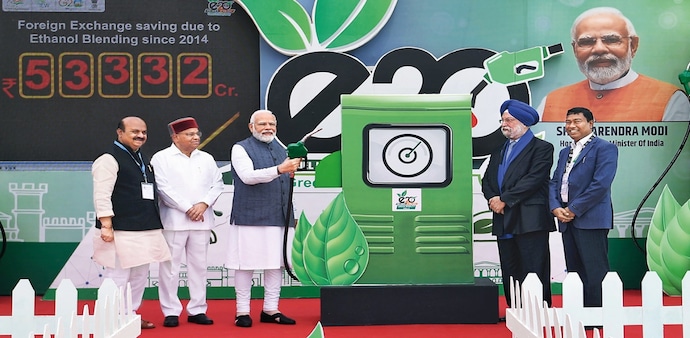
The government saved over Rs 1.4 lakh crore in foreign exchange on account of the Ethanol Blended Petrol (EBP) Programme, Union Petroleum and Natural Gas Minister Hardeep Singh Puri said in the Lok Sabha recently. However, behind the national success story lies a more complicated reality for consumers as they complain about reduced mileage and claim rejection by insurance companies.
Hey!
Already a subscriber? Sign In
THIS IS A PREMIUM STORY FROM BUSINESS TODAY.
Subscribe to Business Today Digital and continue enjoying India's premier business offering uninterrupted
only FOR
₹999 / Year
Unlimited Digital Access + Ad Lite Experience
Cancel Anytime
-
 Unlimited access to Business Today website
 -
 Exclusive insights on Corporate India's working, every quarter
 -
 Access to our special editions, features, and priceless archives
 -
 Get front-seat access to events such as BT Best Banks, Best CEOs and Mindrush
The government saved over Rs 1.4 lakh crore in foreign exchange on account of the Ethanol Blended Petrol (EBP) Programme, Union Petroleum and Natural Gas Minister Hardeep Singh Puri said in the Lok Sabha recently. However, behind the national success story lies a more complicated reality for consumers as they complain about reduced mileage and claim rejection by insurance companies.
Advertisement
According to the government, the EBP Programme has also played a key role in improving farmer incomes by enabling better crop prices and more timely payments, particularly in sugarcane, where payment delays by mills have been endemic. Puri said that from ethanol supply year (ESY) 2014–15 up to June 2025, the programme has facilitated payment of over Rs 1.21 lakh crore to farmers and replaced more than 238 lakh metric tonnes of crude oil.
As the government races ahead with its ethanol blending roadmap—reaching the E20 milestone in 2025, five years ahead of schedule—the ripple effects are being felt in every corner of the country. Social media is flooded with complaints of 10-15% fuel efficiency loss, far beyond the government’s estimate of 2-4%. Meanwhile, oil marketing companies (OMCs) are absorbing a Rs 1.7 per litre loss on E20, citing high feedstock costs. While automakers insist that no engine damage has been reported, some insurers have warned that using ethanol-blended fuel in non-compatible vehicles may void engine-related claims.
Advertisement
This brings us to the larger question of whether India’s ethanol policy, as it stands now, requires a re-examination.
Global Lessons
Petrol with 20% ethanol is called E20. In Brazil, which pioneered E27 decades ago, ethanol-blended fuel is cheaper than petrol. The price of ethanol-blended E27 petrol in Brazil is $1.15 per litre while E100 costs $0.77 per litre. In India, most fuel sold is E20, and its retail price is around Rs 100 per litre. As blending increases, prices decrease, but in India, E20 is priced the same as E10. The main reason: Fuel prices in India are centrally controlled, and while rising feedstock prices impact ethanol economics, the benefits of blending are yet to be passed on to consumers.
Advertisement
The countries that have got the ethanol economics right have taken different approaches. Brazil has encouraged the use of sugarcane-based ethanol through tax policies, government pricing mechanisms, and widespread availability of flex-fuel vehicles, which let drivers switch between ethanol and gasoline based on price. By keeping ethanol taxes low and supporting local production, it has made ethanol a consistently cheaper alternative at the pump.
The US relies on corn-based ethanol and supports its production through initiatives such as the Renewable Fuel Standard, subsidies for corn farmers, and funding for ethanol infrastructure. These measures have cut production costs and ensured steady supply. Both countries have managed to pass on the benefits to consumers. They have another advantage—their crop yield is higher compared to India. “In case of damaged and surplus food grain, the yield (ethanol) per tonne of grain is 450 litres, and for maize, it is 380. However, for GMO corn in the US, it is 420-430 litres. There (US and Brazil), yields per acre are much higher compared to India,” says C.K. Jain, President, Grain Ethanol Manufacturers Association. Agriculture scientists in India are working on improving the seed variety for maize with higher starch content and optimal moisture content. Experts say grain-based ethanol holds immense potential to drive rural development, enhance farmers’ incomes and ensure year-round ethanol production. “It must be actively promoted through supportive policies, assured feedstock supply and fair pricing mechanism,” says Sanjay Ganjoo, Director General, the Indian Federation of Green Energy.
Advertisement
Fixing Demand
In India, stakeholders have called for calibrated approaches that provide economic incentives to build consumer confidence and encourage the shift to ethanol- blended fuel. Despite consumer concerns about potential vehicle damage, the Automotive Research Association of India, citing 2016 and 2021 studies, has said that the use of E20 showed no sign of adverse impact on vehicles. Union Minister for Road Transport and Highways Nitin Gadkari accused the petroleum sector of lobbying against the government’s push for ethanol-blended fuel. “Everywhere there are lobbies, there are interests… petrol lobby is very rich,” Gadkari said
Automakers, while acknowledging a marginal drop in mileage, have reported no complaints of engine damage so far. Experts point out that a 4-6% reduction in fuel efficiency means that consumers will require more fuel to cover the same distance, resulting in increased out-of-pocket spending.
“India had targeted 20% blend for 2030, and we achieved that in 2025. It is a good thing, but the challenge is for the older vehicles. In south Gujarat, the petroleum association requested a reduction in the blend below 15% as they received complaints from consumers,” Vivek Sharma, principal analyst-powertrain at S&P Global Mobility, tells Business Today.
Advertisement
The Centre’s policy think-tank, NITI Aayog, had proposed in 2021 that blended fuels should be priced lower than normal petrol “to compensate for the reduction in calorific value” and improve pan-India acceptance. E20 is expected to be replaced by E27 after October 2026, with trials for the higher blend already underway. .
Taking Stock
E27 will come with its own challenges such as availability of feedstock while the cultivable area remains the same. A shortage of feedstock means prices of ethanol-blended fuel will rise further, adding to OMCs’ costs.
In India, ethanol for blending with fuel mainly comes from a combination of sugarcane derivatives and cereal grains. Historically, molasses and sugarcane juice have been the primary raw materials, due to the country’s extensive sugarcane cultivation. Yet, figures from ESY 2023–24 show that cereal grains like maize and damaged food grains—including broken rice—now account for roughly 52.7% output, edging past sugarcane-based sources, which account for about 47.3%. Other feedstocks like damaged wheat, barley, millet, and agricultural waste have also been approved for ethanol production under the National Biofuel Policy, 2018.
Sugarcane is primarily grown in three states—Uttar Pradesh, Maharashtra, and Karnataka. The Centre reviews sugar availability for ethanol production after ensuring sufficient supply in the domestic market.
Advertisement
On September 1, the food ministry issued a notification announcing lifting of the four million tonne cap on sugar diversion for ethanol production that was in place for the 2024-25 ESY. This not only aims to increase ethanol output but also has significant economic implications for farmers. By allowing more sugarcane to be diverted to ethanol production, demand for sugarcane will rise, leading to better prices and more stable income for growers. Indian Sugar and Bio-Energy Manufacturers Association (ISMA) Director General Deepak Ballani said that, considering higher sugar production next year about 5 million tonnes of sugar can be diverted for ethanol in 2025-26.
According to Jain, the price of E20 cannot be lower than regular petrol, despite public perception that ethanol is cheaper. He explains that farmers receive Rs 21-24 per kilogramme for maize (based on the government’s Minimum Support Price). Millers and distillers generally pay Rs 2.5 more for transportation costs, supplier margins, and aggregator commissions.
“Distilleries work on processing maize for ethanol, and after margins, sell to OMCs at Rs 71-72. Then come VAT and petrol pump dealers’ margins. So, the price of E20 cannot be below the current levels,” Jain tells BT.
With the feedstock focus shifting toward grain-based ethanol—particularly from maize and rice—the rising demand for maize has led to a noticeable increase in its price and area under cultivation.
This year’s kharif season witnessed a nearly 15% increase in maize sowing, largely driven by the growing demand for ethanol. Around 90 new maize-based distilleries have come up across the country, and efforts are under way to develop high-starch maize varieties to improve ethanol yield. For years, maize prices hovered around Rs 15.9 per kg, but over the past three years, they have surged to Rs 24.6 per kg, a sharp 50% increase, reflecting the shift in demand dynamics.
Even with this expansion, current production is still short of projected needs. According to government data, India imported eight lakh tonnes maize in 2024-25, sharply up from 1.27 lakh tonnes the previous year, to meet ethanol demand. Demand is projected to reach 650-700 lakh tonnes per year to meet the E30 blending target by 2030.
Sops For Adoption
Despite the ambitions to reduce the fuel import bill and provide better returns to farmers, car owners have flagged a series of concerns that need to be addressed. At present, India does not have flex-fuel vehicles, though the government has issued a mandate to OEMs to ramp up production of vehicles that can run on any blend up to E100. “Almost 19 flex fuel cars were showcased at the Bharat Mobility Expo 2025 but the OEMs are waiting for a conducive policy by the government,” says Ballani.
However, a flex-fuel vehicle will cost more. “The shift to flex-fuel technology isn’t without cost implications. Upgrading the powertrain and related components adds around Rs 60,000 or more to the price of a model like Wagon R. The key question is: who bears this additional cost?” says S&P’s Sharma.
All stakeholders agree that the government needs to offer incentives for flex-fuel vehicles and treat them on a par with electric vehicles, which are taxed at 5% under the goods and services tax (GST). Sharma believes that unless targeted incentives are introduced—such as GST reduction, policy support around taxation, or adjustments to CAFE norms —consumers are unlikely to adopt this technology. “The complication, however, is that flex-fuel vehicles can still run entirely on gasoline, which makes designing such incentives far more complex,” he says. Car owners have also flagged concerns around insurance claims. Most standard motor insurance policies in India exclude coverage for damage resulting from the use of incorrect fuel. As a result, if a non-E20-compliant vehicle sustains engine damage due to the use of E20 fuel, the insurer may reject or reduce the claim. The Society of Indian Automobile Manufacturers, an auto industry body, has said that E20 fuel-related insurance and warranty claims will be honoured.
But insurance companies have a different take. “In case of am engine failure due to incorrect fuel usage, the claim would not be admissible. This falls under gross negligence as per the policy terms,” ACKO Insurance, a major general insurance company, has clarified on customers’ social media queries. "From an insurance standpoint, engine damage of any kind, not caused by an accident - whether due to fuel incompatibility, maintenance lapses or wear & tear - is not covered by a standard insurance policy. This exclusion is well-established and clearly stated in policy language. That said, we are actively evaluating the technical impact E20 fuel may have on engines and will consider relevant coverage enhancements if deemed necessary," said the ACKO insurance.
What Next?
The government has indicated that any shift toward E27 will be contingent upon detailed discussions with all stakeholders. While trials for higher blends are under way, scientists caution that moving beyond E20 will require significant adjustments—including retrofitting existing vehicles and promoting flex-fuel technology.
As E20 continues to be dispensed nationwide, the responsibility of addressing any vehicle-related implications rests with the consumer, at least until further safeguards or standards are introduced.
@richajourno
Read more!