
Is India close to using its vast thorium reserves to become self-reliant in nuclear power generation?
Is India close to using its vast thorium reserves to become self-reliant in nuclear power generation?
India's prototype fast breeder reactor has achieved criticality, advancing the three-stage nuclear strategy. Is the country close to using its vast thorium reserves to become atmanirbhar in nuclear power generation?
Richa Sharma
- May 20, 2026,
- Updated May 20, 2026 6:33 PM IST
In the 1950s, the father of the country’s nuclear programme, Dr. Homi Bhabha, conceived an ambitious three-stage nuclear programme. This happened long before India had mapped its uranium deposits and had no technology to utilise thorium. The plan: use natural uranium in pressurised heavy water reactors (PHWRs), then plutonium in fast breeder reactors (FBRs), and finally, thorium-based reactors to achieve a self-sustaining nuclear fuel cycle. The endgame was clear: each stage would feed the next, culminating in a self-sustaining thorium-uranium fuel cycle to power the country and cut down crude oil imports.
Advertisement
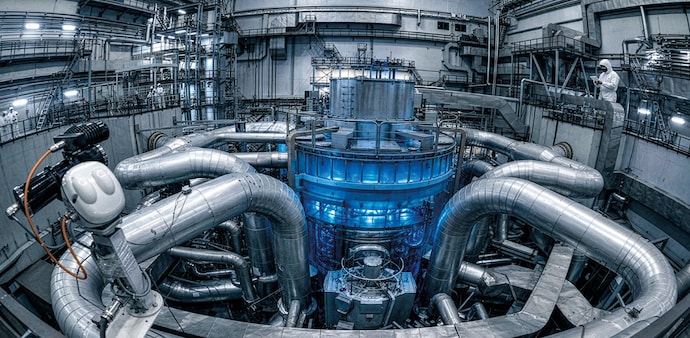
For decades, this vision remained a promise. But in April 2026, India crossed a crucial milestone. At Kalpakkam in Tamil Nadu, the prototype FBR achieved criticality, marking the country’s entry into the second stage of Bhabha’s blueprint. This is no small achievement for India, which is the second nation after Russia to accomplish this, albeit with delays. India’s present nuclear capacity of 8.8 GW is around 2% of its energy mix. The target is 22GW by 2032 and 100 GW by 2047.
With energy security under the spotlight due to the West Asia war and clean energy being the focal point of discussions about building a sustainable future, the penultimate stage of commercial deployment of thorium-based reactors is important (India has abundant thorium reserves).
Advertisement
However, owing to technological complexities, achieving that could take decades. Another hiccup is availability of uranium. Even though recent discoveries have increased supplies, they are not enough. India imports 70% of its annual 1,800-2,000-tonne requirement. Major suppliers are Kazakhstan (35-40%), Canada (30-35%), with a small share coming from Namibia, Australia, Uzbekistan, and Russia.
In such a scenario, does India need to fast-track the three-stage programme to reach the thorium stage? Or can it come up with new technologies that can reduce the time taken to become atmanirbhar in the nuclear fuel cycle? This includes introducing thorium in Stage 1 itself, rather than waiting for Stage 3 or fusion technology that does not require uranium or plutonium as fuel, thus completely skipping Stage 2.
Advertisement
New Vistas
Some experts, like the former chairman of the Atomic Energy Commission, Anil Kakodkar, say India cannot achieve the target of 100GW nuclear capacity by 2047 by following the three-stage nuclear programme. He believes the country must look for different nuclear technologies under various stages of development.
India must look for different nuclear technologies [other than the three-stage programme] to achieve the target of 100GW of nuclear capacity by 2047.
-Anil Kakodkar,Former Chairman of the Atomic Energy Commission,
“You don’t have to go through in that sequence… as stage one, stage two. It happened well and good, but if not [completed], I think nothing is lost. Now, we should move to thorium, accumulate that and accelerate stage three,” he tells Business Today. His idea is to take a slightly altered path to a three-stage programme which can advance the thorium usage for India.
The Kalpakkam FBR’s achievement has put the spotlight on utilising the vast thorium resources in India. Stage 3 reactors require an initial loading of Uranium 233, a material that does not occur in nature and must be bred from thorium by bombarding it with neutrons.
Advertisement
“Under the classical pathway, the only source of those neutrons at scale is the FBR fleet. But FBRs take decades to build, and their early fuel is precious Pu-239 from Stage 1—itself in limited supply. It is a slow compound interest problem, and India is impatient,” says Prabhat Ranjan, Vice Chancellor of D Y Patil International University, who has been doing research in nuclear power. He is also the co-founder of ASPL Fusion, a private Indian deep-tech start-up focused on nuclear fusion.
Fusion-fission hybrid technology offers a parallel route... potentially compressing the wait by 20–30 years.
-Prabhat Ranjan, Co-founder, ASPL Fusion
Role of start-ups
India has been working on technology for thorium-based reactors for decades. Now, a US-based private start-up, Clean Core Thorium Energy (CCTE), has created a new type of fuel that blends thorium with a more concentrated type of uranium called HALEU (high-assay low-enriched uranium).
This blended fuel can be used in India’s PHWRs, which make up the bulk of the country’s existing nuclear power capacity and many of the new units under development now. National Thermal Power Corporation (NTPC) has tied up with CCTE for indigenisation of fuel manufacturing.
Kakodkar says that CCTE’s technology can be used as an interim measure, where we generate power from thorium-uranium and generate fuel for stage 3, where we use thorium.
Advertisement
“Introduce the thorium-uranium-based fuel in stage one of the new capacity of the operational PHWRs. By irradiating thorium, you start building Uranium 233, not found naturally. It comes out as spent fuel inventory and is needed as fuel for Stage 3 of the nuclear programme. We can use this route also for energy independence as a bridge. So, this is a good method to lift to stage three, while stage two development can continue,” he says.
On why India could not test a thorium-uranium fuel in existing reactors, as done by CCTE, Kakodkar says there were some experiments, but they lacked the Advanced Heavy Water Reactors to increase the fuel burn-up.
“These are technology developments, and we should be strong in technology development for self-reliance. But if we cannot do that within the time frame, the best way is to collaborate. For Kudankulam, we are importing enriched uranium because we cannot make it today; maybe tomorrow we will be able to make it. The effort will be to continuously improve value addition in the country,” he says.
Advertisement
India is heavility dependent on imports for uranium, and the demand is expected to increase significantly, in line with nuclear capacity expansion, from 1,800–2,000 tonnes/year currently to over 5,000 tonnes/year by 2047.
“Growth will be driven by the target of 100 GW nuclear capacity, implying multi-fold increase in fuel requirements. Given the limited domestic production, incremental demand will be largely met through imports, increasing reliance on long-term international supply agreements,” says Vishal Periwal, Equity Analyst, Infrastructure and Utilities, Prabhudas Lildhar.
Innovations in the nuclear sector have caught the attention of private players. The introduction of the SHANTI Act has opened the doors of the sector to private players.
India’s nuclear programme+ has historically been entirely government funded. Marking a structural shift in India’s nuclear policy framework, the SHANTI Act, 2025 (Sustainable Harnessing and Advancement of Nuclear Energy for Transforming India, 2025) has opened a sector for regulated private sector participation in nuclear and fusion energy under Atomic Energy Regulatory Board (AERB) oversight. Big names such as Reliance and Adani have held discussions on investments in future technologies that require neither uranium nor plutonium as fuel nor create long-lived radioactive waste. The aim is to build a cleaner and safer alternative to nuclear fission reactors in India. Cumulative venture capital in fusion energy companies has reached about $11 billion, according to the International Energy Agency’s 2026 report.
Additionally, private players are already in talks with the Nuclear Power Corporation of India Ltd (NPPCIL) for investment in Bharat Modular Reactors and Bharat Small Modular Reactors, providing captive power to industries. Larson & Toubro has already tied up with the US-based Holtec International for deployment of its Small Modular Reactors (SMRs).
Fusion Push
Another solution is fusion-based reactor technology. It is gaining traction with a few Indian start-ups looking at power generation by 2035. Pranos, Anubal Fusion, Hylenr Technologies, and ASPL Fusion are among the key players looking to make India energy independent using this yet-to-be-proven commercial energy source. The good part, all of them are working on different technologies to make a breakthrough in the commercial deployment of fusion-based reactors. Pranos Fusion raised Rs 63 crore in March this year from VC funds, and is in talks for partnerships with private players.
India has fission-based reactors, which split a larger atom (Uranium) into several smaller atoms to release energy. Fusion is the opposite of fission; you combine two smaller atoms to form a larger atom, and in the process, release energy that is exponentially higher than what is given out in a fission reaction. The most common fusion reactions occur in stars and the sun.
Looking at tapping all possible sources of clean energy to meet India’s growing power demand, the Central Electricity Authority (CEA), in January this year, constituted a committee for preparing a road map for deployment of nuclear fusion-based power generation.
There has been a massive jump in start-ups working in fusion technology over the past few years. Globally, over 40 start-ups working on fusion technology have come up since 2024, according to the IAE.
“The reason being, in 2022, the National Ignition Facility at Lawrence Livermore National Laboratory in the US successfully demonstrated Fusion Ignition (generating more energy output than input) for the first time in history. Since then, the race to fusion has significantly heated up with over 40+ private companies,” says Nithish Kumar, Investment Analyst at Speciale Invest. The deep tech VC fund invested in Anubal Fusion in 2024.
“The bottleneck is Uranium 233, which must be bred from thorium and currently depends entirely on the slow FBR build-out. Fusion-fission hybrid technology offers a parallel route: fusion neutrons driving a subcritical thorium blanket, independently of the FBR fleet, potentially compressing the wait by 20–30 years,” says Ranjan, the co-founder of ASPL Fusion. Gandhinagar-based ASPL is one of the youngest start-ups working on this technology.
India is already contributing Rs 745 crore in 2026-27 for a global fusion project—the International Thermonuclear Experimental Reactor—a multi-country endeavour located in France. Prime Minister Narendra Modi had visited the site in Marseille, France, in February 2025.
Role Of Private capital
Achieving the 100 GW target is expected to require Rs 19,000 lakh crore investment, creating significant opportunities across the nuclear value chain, including EPC contractors, heavy engineering companies, component manufacturers, fuel cycle services, and plant O&M providers, according to research by Prabhudas Lilladher.
Alluding to the SHANTI Act, Ranjan says the entry of private capital does not compromise sovereignty. “It complements government investment by funding technology demonstration stages that would otherwise compete for space in an already stretched public R&D budget,” says Ranjan.
India’s nuclear value chain spans multiple segments, with power developers like NTPC, Adani, Tata Power, and JSW Energy participating at the ownership level. The equipment and component ecosystem is supported by players such as L&T, BHEL, MTAR, Walchandnagar, and ISGEC. In EPC and engineering, companies like Power Mech, HCC, and Engineers India play a key role.
The Union Budget 2025–26 allocated Rs 20,000 crore for the Nuclear Energy Mission. SMRs are envisioned for diverse uses, including replacing aging coal plants, supplying industrial captive power, supporting off-grid needs, and enabling hydrogen production.
The interest of India Inc is also evident. JSW Energy has already announced construction of a nuclear power plant in the next three-four years. Land acquisition at multiple locations is already being done for a 700 MW reactor. The company is looking at a mix of reactors to decarbonise its operations.
The Adani Group has entered the space through Adani Atomic Energy Ltd. Tata Power has begun site identification for 20-50 MW SMRs and formed a dedicated internal team to track regulatory developments and evaluate project opportunities. Reliance Industries is also exploring sites for a nuclear project.
The civil nuclear race is on among private players to commercialise the technology for power generation. But for now, the journey remains long and arduous.
@richajourno
In the 1950s, the father of the country’s nuclear programme, Dr. Homi Bhabha, conceived an ambitious three-stage nuclear programme. This happened long before India had mapped its uranium deposits and had no technology to utilise thorium. The plan: use natural uranium in pressurised heavy water reactors (PHWRs), then plutonium in fast breeder reactors (FBRs), and finally, thorium-based reactors to achieve a self-sustaining nuclear fuel cycle. The endgame was clear: each stage would feed the next, culminating in a self-sustaining thorium-uranium fuel cycle to power the country and cut down crude oil imports.
Advertisement
For decades, this vision remained a promise. But in April 2026, India crossed a crucial milestone. At Kalpakkam in Tamil Nadu, the prototype FBR achieved criticality, marking the country’s entry into the second stage of Bhabha’s blueprint. This is no small achievement for India, which is the second nation after Russia to accomplish this, albeit with delays. India’s present nuclear capacity of 8.8 GW is around 2% of its energy mix. The target is 22GW by 2032 and 100 GW by 2047.
With energy security under the spotlight due to the West Asia war and clean energy being the focal point of discussions about building a sustainable future, the penultimate stage of commercial deployment of thorium-based reactors is important (India has abundant thorium reserves).
Advertisement
However, owing to technological complexities, achieving that could take decades. Another hiccup is availability of uranium. Even though recent discoveries have increased supplies, they are not enough. India imports 70% of its annual 1,800-2,000-tonne requirement. Major suppliers are Kazakhstan (35-40%), Canada (30-35%), with a small share coming from Namibia, Australia, Uzbekistan, and Russia.
In such a scenario, does India need to fast-track the three-stage programme to reach the thorium stage? Or can it come up with new technologies that can reduce the time taken to become atmanirbhar in the nuclear fuel cycle? This includes introducing thorium in Stage 1 itself, rather than waiting for Stage 3 or fusion technology that does not require uranium or plutonium as fuel, thus completely skipping Stage 2.
Advertisement
New Vistas
Some experts, like the former chairman of the Atomic Energy Commission, Anil Kakodkar, say India cannot achieve the target of 100GW nuclear capacity by 2047 by following the three-stage nuclear programme. He believes the country must look for different nuclear technologies under various stages of development.
India must look for different nuclear technologies [other than the three-stage programme] to achieve the target of 100GW of nuclear capacity by 2047.
-Anil Kakodkar,Former Chairman of the Atomic Energy Commission,
“You don’t have to go through in that sequence… as stage one, stage two. It happened well and good, but if not [completed], I think nothing is lost. Now, we should move to thorium, accumulate that and accelerate stage three,” he tells Business Today. His idea is to take a slightly altered path to a three-stage programme which can advance the thorium usage for India.
The Kalpakkam FBR’s achievement has put the spotlight on utilising the vast thorium resources in India. Stage 3 reactors require an initial loading of Uranium 233, a material that does not occur in nature and must be bred from thorium by bombarding it with neutrons.
Advertisement
“Under the classical pathway, the only source of those neutrons at scale is the FBR fleet. But FBRs take decades to build, and their early fuel is precious Pu-239 from Stage 1—itself in limited supply. It is a slow compound interest problem, and India is impatient,” says Prabhat Ranjan, Vice Chancellor of D Y Patil International University, who has been doing research in nuclear power. He is also the co-founder of ASPL Fusion, a private Indian deep-tech start-up focused on nuclear fusion.
Fusion-fission hybrid technology offers a parallel route... potentially compressing the wait by 20–30 years.
-Prabhat Ranjan, Co-founder, ASPL Fusion
Role of start-ups
India has been working on technology for thorium-based reactors for decades. Now, a US-based private start-up, Clean Core Thorium Energy (CCTE), has created a new type of fuel that blends thorium with a more concentrated type of uranium called HALEU (high-assay low-enriched uranium).
This blended fuel can be used in India’s PHWRs, which make up the bulk of the country’s existing nuclear power capacity and many of the new units under development now. National Thermal Power Corporation (NTPC) has tied up with CCTE for indigenisation of fuel manufacturing.
Kakodkar says that CCTE’s technology can be used as an interim measure, where we generate power from thorium-uranium and generate fuel for stage 3, where we use thorium.
Advertisement
“Introduce the thorium-uranium-based fuel in stage one of the new capacity of the operational PHWRs. By irradiating thorium, you start building Uranium 233, not found naturally. It comes out as spent fuel inventory and is needed as fuel for Stage 3 of the nuclear programme. We can use this route also for energy independence as a bridge. So, this is a good method to lift to stage three, while stage two development can continue,” he says.
On why India could not test a thorium-uranium fuel in existing reactors, as done by CCTE, Kakodkar says there were some experiments, but they lacked the Advanced Heavy Water Reactors to increase the fuel burn-up.
“These are technology developments, and we should be strong in technology development for self-reliance. But if we cannot do that within the time frame, the best way is to collaborate. For Kudankulam, we are importing enriched uranium because we cannot make it today; maybe tomorrow we will be able to make it. The effort will be to continuously improve value addition in the country,” he says.
Advertisement
India is heavility dependent on imports for uranium, and the demand is expected to increase significantly, in line with nuclear capacity expansion, from 1,800–2,000 tonnes/year currently to over 5,000 tonnes/year by 2047.
“Growth will be driven by the target of 100 GW nuclear capacity, implying multi-fold increase in fuel requirements. Given the limited domestic production, incremental demand will be largely met through imports, increasing reliance on long-term international supply agreements,” says Vishal Periwal, Equity Analyst, Infrastructure and Utilities, Prabhudas Lildhar.
Innovations in the nuclear sector have caught the attention of private players. The introduction of the SHANTI Act has opened the doors of the sector to private players.
India’s nuclear programme+ has historically been entirely government funded. Marking a structural shift in India’s nuclear policy framework, the SHANTI Act, 2025 (Sustainable Harnessing and Advancement of Nuclear Energy for Transforming India, 2025) has opened a sector for regulated private sector participation in nuclear and fusion energy under Atomic Energy Regulatory Board (AERB) oversight. Big names such as Reliance and Adani have held discussions on investments in future technologies that require neither uranium nor plutonium as fuel nor create long-lived radioactive waste. The aim is to build a cleaner and safer alternative to nuclear fission reactors in India. Cumulative venture capital in fusion energy companies has reached about $11 billion, according to the International Energy Agency’s 2026 report.
Additionally, private players are already in talks with the Nuclear Power Corporation of India Ltd (NPPCIL) for investment in Bharat Modular Reactors and Bharat Small Modular Reactors, providing captive power to industries. Larson & Toubro has already tied up with the US-based Holtec International for deployment of its Small Modular Reactors (SMRs).
Fusion Push
Another solution is fusion-based reactor technology. It is gaining traction with a few Indian start-ups looking at power generation by 2035. Pranos, Anubal Fusion, Hylenr Technologies, and ASPL Fusion are among the key players looking to make India energy independent using this yet-to-be-proven commercial energy source. The good part, all of them are working on different technologies to make a breakthrough in the commercial deployment of fusion-based reactors. Pranos Fusion raised Rs 63 crore in March this year from VC funds, and is in talks for partnerships with private players.
India has fission-based reactors, which split a larger atom (Uranium) into several smaller atoms to release energy. Fusion is the opposite of fission; you combine two smaller atoms to form a larger atom, and in the process, release energy that is exponentially higher than what is given out in a fission reaction. The most common fusion reactions occur in stars and the sun.
Looking at tapping all possible sources of clean energy to meet India’s growing power demand, the Central Electricity Authority (CEA), in January this year, constituted a committee for preparing a road map for deployment of nuclear fusion-based power generation.
There has been a massive jump in start-ups working in fusion technology over the past few years. Globally, over 40 start-ups working on fusion technology have come up since 2024, according to the IAE.
“The reason being, in 2022, the National Ignition Facility at Lawrence Livermore National Laboratory in the US successfully demonstrated Fusion Ignition (generating more energy output than input) for the first time in history. Since then, the race to fusion has significantly heated up with over 40+ private companies,” says Nithish Kumar, Investment Analyst at Speciale Invest. The deep tech VC fund invested in Anubal Fusion in 2024.
“The bottleneck is Uranium 233, which must be bred from thorium and currently depends entirely on the slow FBR build-out. Fusion-fission hybrid technology offers a parallel route: fusion neutrons driving a subcritical thorium blanket, independently of the FBR fleet, potentially compressing the wait by 20–30 years,” says Ranjan, the co-founder of ASPL Fusion. Gandhinagar-based ASPL is one of the youngest start-ups working on this technology.
India is already contributing Rs 745 crore in 2026-27 for a global fusion project—the International Thermonuclear Experimental Reactor—a multi-country endeavour located in France. Prime Minister Narendra Modi had visited the site in Marseille, France, in February 2025.
Role Of Private capital
Achieving the 100 GW target is expected to require Rs 19,000 lakh crore investment, creating significant opportunities across the nuclear value chain, including EPC contractors, heavy engineering companies, component manufacturers, fuel cycle services, and plant O&M providers, according to research by Prabhudas Lilladher.
Alluding to the SHANTI Act, Ranjan says the entry of private capital does not compromise sovereignty. “It complements government investment by funding technology demonstration stages that would otherwise compete for space in an already stretched public R&D budget,” says Ranjan.
India’s nuclear value chain spans multiple segments, with power developers like NTPC, Adani, Tata Power, and JSW Energy participating at the ownership level. The equipment and component ecosystem is supported by players such as L&T, BHEL, MTAR, Walchandnagar, and ISGEC. In EPC and engineering, companies like Power Mech, HCC, and Engineers India play a key role.
The Union Budget 2025–26 allocated Rs 20,000 crore for the Nuclear Energy Mission. SMRs are envisioned for diverse uses, including replacing aging coal plants, supplying industrial captive power, supporting off-grid needs, and enabling hydrogen production.
The interest of India Inc is also evident. JSW Energy has already announced construction of a nuclear power plant in the next three-four years. Land acquisition at multiple locations is already being done for a 700 MW reactor. The company is looking at a mix of reactors to decarbonise its operations.
The Adani Group has entered the space through Adani Atomic Energy Ltd. Tata Power has begun site identification for 20-50 MW SMRs and formed a dedicated internal team to track regulatory developments and evaluate project opportunities. Reliance Industries is also exploring sites for a nuclear project.
The civil nuclear race is on among private players to commercialise the technology for power generation. But for now, the journey remains long and arduous.
@richajourno
Read more!