
Several students are pursuing management education overseas, only to return to India
Several students are pursuing management education overseas, only to return to India
Several students are pursuing management education overseas only to return and create an impact in India.
Krishna Gopalan
- Dec 8, 2025,
- Updated Dec 8, 2025 4:10 PM IST
After Naveen Tewari acquired a degree in mechanical engineering from Indian Institute of Technology (IIT), Kanpur, pursuing a master’s degree in the US was the next logical step. There was also a job offer from the global consulting firm McKinsey. One conversation with his father swung it for the young man.
Hey!
Already a subscriber? Sign In
THIS IS A PREMIUM STORY FROM BUSINESS TODAY.
Subscribe to Business Today Digital and continue enjoying India's premier business offering uninterrupted
only FOR
₹999 / Year
Unlimited Digital Access + Ad Lite Experience
Cancel Anytime
-
 Unlimited access to Business Today website
 -
 Exclusive insights on Corporate India's working, every quarter
 -
 Access to our special editions, features, and priceless archives
 -
 Get front-seat access to events such as BT Best Banks, Best CEOs and Mindrush
After Naveen Tewari acquired a degree in mechanical engineering from Indian Institute of Technology (IIT), Kanpur, pursuing a master’s degree in the US was the next logical step. There was also a job offer from the global consulting firm McKinsey. One conversation with his father swung it for the young man.
Advertisement
“You will be unhappy in research. You are someone who likes to make things happen,” said the father. Tewari did not question this and said yes to McKinsey. In many ways, it was a life-changing experience—out of the three years spent there, 18 months were dedicated to what was then the Reliance Infocomm project. Remember, one is speaking of the 2001-02 phase, in a very different India, where the digital economy was still at a nascent stage.
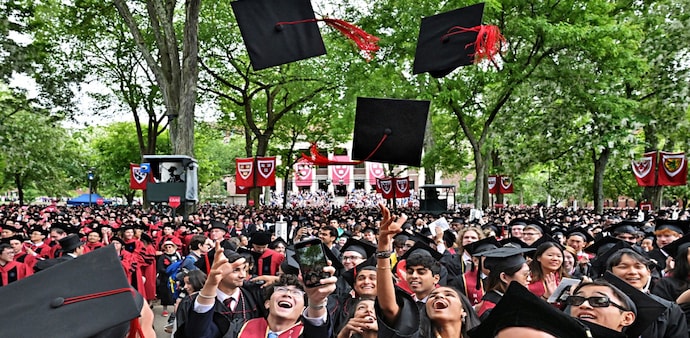
Armed with work experience, Tiwari—now Founder & CEO, InMobi Group—decided to go to the US for an MBA. The next stop was Harvard Business School. Part of a batch of 900 students, he saw a new world.
Like him, there are several Indians who choose to go overseas for studying management and come back with a different perspective. That said, studying in a top school abroad is expensive (upwards of $2,00,000 total course fee), but there is conviction on the payback in terms of learning, global exposure, and networking.
Advertisement
Eureka moments Conversations with those who have pursued a management degree outside India reveal a few interesting points. A diversified peer group across nationalities, a unique pedagogical experience and access to a large network stand out.
The diffident Indian with a bit of fear about failure often has a more focused and nuanced approach. Vartika Bansal, AI Ops Partner, Elevation Capital, who studied at Stanford Graduate School of Business, says risk-taking is a key facet. “The real risk is not in failing but in not trying. I realised chasing your wildest dreams and testing your potential is far more rewarding than playing safe and calculating career moves,” she says.
Advertisement
In the life of a student, that eureka moment changes everything. For Ahana Gautam, Founder and CEO of healthy snacking brand Open Secret, it was at Harvard when a case study on PepsiCo got a response from one of her classmates on the ethical responsibility of companies. “The time at Harvard was about moving from a pleasure-seeking mindset to creating a meaningful impact,” she says.
One thing led to another, and visiting chains like Whole Foods Market and Trader Joe’s strengthened that resolve. “It convinced me of the potential of my idea in India and a belief in the growing importance of health and fitness,” explains Gautam, who studied chemical engineering at IIT Bombay before heading westwards. In 2019, she set up Open Secret as an “unjunking food option.” The decision to return stemmed from a desire “to build something meaningful despite better opportunities in the US, says Gautam.
Not everyone opts for the traditional two-year degree. Take the case of Rajiv Mehta, General Partner, Athera Venture Partners, who chose to study at INSEAD, being convinced about a one-year programme. “There was the opportunity cost part to it, plus it came with a global and diverse student body,” he says. Before his current assignment, Mehta headed sports company PUMA, followed by stints at apparel and lifestyle companies such as Arvind Ltd and kitchen and home appliances company Stovekraft.
Advertisement
I was an expectant mother at the time of being accepted. Wharton’s supportive and flexible approach tilted the scale in its favour.
-PRIYANKA CHOPRA,CEO AND MANAGING PARTNER AT IIMA VENTURES
The undergraduate degree does make a difference. In INSEAD, most students, according to Mehta, are engineers. “However, they do not restrict the proportion since this does not create diversity. Being an engineer was a plus, but having peers from other streams helped in the overall learning,” he says. The one-year programme led to more intense networking, he says. “It is counterintuitive. In a short span, and in a high-stress environment, you end up making great friends.”
To Bansal, the fact that Stanford had one of the best engineering schools mattered. “As someone trained in that stream, I valued its analytical rigour, emphasis on problem-solving and culture of innovation. The school’s ability to blend technical excellence with business acumen aligned perfectly with the kind of growth I was seeking,” she says. Besides, the opportunities to take classes across the schools were a huge plus.
Tewari emphasises Harvard’s famed case study approach. “There’s no perfect answer, and it was remarkably different from my engineering upbringing, where it revolved around precision or a predictable outcome backed by a high level of logic. This now needed a very flipped intuition,” he says. Like Bansal, he says failure and its acceptance were key learnings.
Advertisement
THE TRANSFORMATION
The choice of a business school is driven by multiple factors. In case of Bansal, Stanford’s location was important, by way of what she terms “proximity to innovation”. Much of the world’s innovation over the last few decades, according to her, has originated in Silicon Valley. “The opportunity to live and learn at the very centre of that ecosystem, to absorb its entrepreneurial mindset and openness to experimentation, was incredibly compelling. It was a major reason to choose Stanford over Harvard, having acceptances from both schools.”
It is not uncommon for students to want to study at best business schools and hence apply to a small number of schools. In case of Priyanka Chopra, CEO & Managing Partner, IIMA Ventures and venture partner, Bharat Innovation Fund, her consideration set was limited to three: the school’s reputation, diversity and class size; quality of faculty, alumni network, industry connections, especially in technology and finally, the placement record. “I was also an expectant mother at the time of being accepted. Wharton’s (The Wharton School, University of Pennsylvania) supportive and flexible approach tilted the scale in its favour,” she says.
Advertisement
Most students at INSEAD were engineers. Being an engineer was a plus, but having peers from other streams helped in overall learning.
-RAJIV MEHTA,GENERAL PARTNER, ATHERA VENTURE PARTNERS
One incident during that phase is etched in her mind. There was a challenge to balance motherhood and the demands of a rigorous academic programme. Chopra recalls “a remarkable woman” who was a grandmother and CEO, sharing a piece of advice. ‘Think of your career as a dimmer switch and not an on/off button. Never switch it off and dim it when your family needs you and turn it up when you are ready to go full throttle,’” she says. For her, the learning was that one does not have to choose between ambition and balance.
Inevitably, the transformation during the MBA for many people took off when a preconceived notion was shattered. For Bansal, an expectation of rigour eventually led to something “much deeper and more personal.” She calls the two years “profoundly transformative” and how they humbled her. The world experience included a summer in Bhutan, working with the king on development initiatives and later with Mumbai High Court’s Chief Justice, which exposed her to public policy and governance.
Not surprisingly, for anyone from a middle-class family in India, it was critical to adapt. Tewari values Harvard for changing him from “that Kanpur boy” to thinking of the world differently. “The environment at Harvard was people thinking and talking about changing the world,” he says.
The global order may be shifting, but it will be worth watching whether the overseas MBA retains its shine. Chances are, that isn’t going to change anytime soon.
@krishnagopalan
Read more!