
Straddling Europe and Asia, Istanbul blends imperial grandeur and vibrant street life
Straddling Europe and Asia, Istanbul blends imperial grandeur and vibrant street life
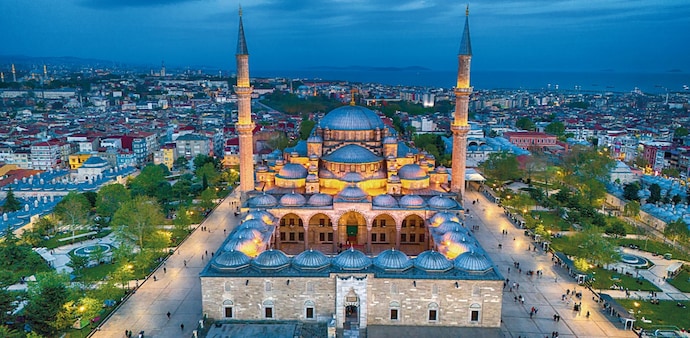
Straddling Europe and Asia, Istanbul blends imperial grandeur, vibrant street life, unforgettable cuisine, and centuries of history into one endlessly fascinating city.
Smita Tripathi
- Jul 16, 2026,
- Updated Jul 16, 2026 4:16 PM IST
As I step into Istanbul’s Basilica Cistern, the first thing that comes to mind is Dan Brown’s Inferno. Walking through the dimly lit underground chamber surrounded with rows of ancient columns, soft lights reflecting off the water and Medusa’s famous stone heads lurking beneath the columns, I can’t help but recall the novel’s climactic scenes, half-expecting Robert Langdon to emerge around a corner. Later, standing beneath the vast dome of Hagia Sophia, I find myself again thinking of Brown’s descriptions and the sense of history layered upon history that defines Istanbul. Yet no novel, however vivid, can fully capture the experience of being there in person.
Advertisement
Istanbul is not merely a city. It is a crossroads of civilisations and few places on earth can claim a history as rich or as consequential. Founded as Byzantium, transformed into Constantinople by the Roman Emperor Constantine, and later becoming the capital of the Ottoman Empire, Istanbul has served as the centre of power for centuries. Little wonder, this is a city where history never feels distant. Today, home to more than 16 million people, it rises across the seven hills overlooking the Bosphorus Strait—the narrow waterway that separates Europe from Asia. Being the only city in the world that spans two continents, its unique geography has shaped its identity for centuries. The city feels simultaneously European and Asian, Christian and Islamic, ancient and modern—truly a bridge between the East and the West.
Advertisement
The heart of this history lies in the Fatih district, where many of Istanbul’s most famous landmarks stand within walking distance of one another. The Hagia Sophia is perhaps the most impressive. Built in the sixth century as a cathedral before being transformed into a mosque after the Ottoman conquest of Constantinople, it embodies the city’s layered history. Christian mosaics coexist alongside Islamic calligraphy. Mustafa Kemal Atatürk, the first president of Türkiye, converted it into a museum in 1934 to project the secular ideals of the newly formed Turkish Republic. However, since 2020, it has reverted to being a functional mosque. It is currently under restoration and visitors are allowed only in the upper galleries. To understand more about the Hagia Sophia, visit the Hagia Sophia History and Experience Museum (tickets start from 35 euros) that brings the past to life through light and sound.
Advertisement
Directly across from Hagia Sophia stands the Blue Mosque, officially known as the Sultan Ahmed Mosque. Its elegant domes and six towering minarets dominate the skyline. Inside, thousands of intricate blue Iznik tiles give the mosque its popular name. Entry is free here.
Nearby, is the Topkapi Palace (tickets from 60 euros) that reveals the grandeur of the Ottoman Empire. For centuries, it served as the residence of the sultans who ruled vast territories stretching across Europe, Asia, and Africa. Wandering through its courtyards, treasury, and former harem offers a fascinating glimpse into imperial life. The palace terraces also provide stunning views of the Bosphorus and the Golden Horn.
A short walk away, and you straddle civilisations at the Hippodrome that offers a glimpse into the Byzantine world. Once the social and political centre of Constantinople, it hosted chariot races and public ceremonies attended by tens of thousands. Today, only fragments remain, yet standing beside the ancient Egyptian Obelisk and the Serpent Column, it is easy to imagine the crowds that once filled the arena.
Advertisement
However, what makes Istanbul truly special, is not simply its monuments but the way different cultures coexist within the city. For centuries, Turkish, Greek, Arab, Jewish, and countless other communities have contributed to its development.
Food plays a central role in this melting pot of cultural experience. Every morning begins with a traditional Turkish breakfast, or kahvalti. Tables overflow with cheeses, olives, fresh bread, honey, jams, vegetables, and eggs. Equally memorable is the city’s obsession with tea and coffee. Tiny tulip-shaped glasses of strong black tea—Çay (pronounced chai) appear everywhere accompanying every conversation.
But it is Turkish coffee that is the cultural export to the world. Turkey exported 8,652 tonnes of coffee to 146 countries in 2024, generating $57.4 million in revenue. Recognised as a part of UNESCO Intangible Cultural Heritage, the history of Turkish coffee dates to the 16th century and the reign of the Ottoman Sultan Suleiman the Magnificent. Legend says that an Ottoman governor who was posted in Yemen became fond of coffee and introduced it to the palace’s cuisine with the first coffee house opening in Istanbul in 1554. During the 1683 Siege of Vienna, Ottoman troops abandoned coffee sacks after failing to capture the city, thus introducing coffee to Europe.
Advertisement
And then there is the baklava. Layer upon layer of flaky pastry, filled with nuts and soaked in syrup, satisfying sweet cravings. A kitchen register from Topkapı Palace in 1474 reveals that baklava with 41 layers was made daily during Ramzan and demand was so high the team of baklavacı couldn’t keep up!
But what impresses me most about Istanbul is the city’s energy. “The phrase the city that never sleeps was coined for New York but it is true for Istanbul,” says Bulut Okçu, my tour guide. Throughout the day, thousands of people fill the streets, markets, and waterfronts. Even the city’s famous cats seem constantly occupied, happily posing for tourists!
Yet the city becomes no less lively after dark. Restaurants and cafés remain packed late into the evening. You can go dancing in Taksim Square till the wee hours of the morning, and traffic jams in the middle of the night are common.
As I bid elveda (goodbye) to Istanbul, I realise that the greatest attraction is not any single monument. It is the city itself, where the past remains woven into everyday life.
As I step into Istanbul’s Basilica Cistern, the first thing that comes to mind is Dan Brown’s Inferno. Walking through the dimly lit underground chamber surrounded with rows of ancient columns, soft lights reflecting off the water and Medusa’s famous stone heads lurking beneath the columns, I can’t help but recall the novel’s climactic scenes, half-expecting Robert Langdon to emerge around a corner. Later, standing beneath the vast dome of Hagia Sophia, I find myself again thinking of Brown’s descriptions and the sense of history layered upon history that defines Istanbul. Yet no novel, however vivid, can fully capture the experience of being there in person.
Advertisement
Istanbul is not merely a city. It is a crossroads of civilisations and few places on earth can claim a history as rich or as consequential. Founded as Byzantium, transformed into Constantinople by the Roman Emperor Constantine, and later becoming the capital of the Ottoman Empire, Istanbul has served as the centre of power for centuries. Little wonder, this is a city where history never feels distant. Today, home to more than 16 million people, it rises across the seven hills overlooking the Bosphorus Strait—the narrow waterway that separates Europe from Asia. Being the only city in the world that spans two continents, its unique geography has shaped its identity for centuries. The city feels simultaneously European and Asian, Christian and Islamic, ancient and modern—truly a bridge between the East and the West.
Advertisement
The heart of this history lies in the Fatih district, where many of Istanbul’s most famous landmarks stand within walking distance of one another. The Hagia Sophia is perhaps the most impressive. Built in the sixth century as a cathedral before being transformed into a mosque after the Ottoman conquest of Constantinople, it embodies the city’s layered history. Christian mosaics coexist alongside Islamic calligraphy. Mustafa Kemal Atatürk, the first president of Türkiye, converted it into a museum in 1934 to project the secular ideals of the newly formed Turkish Republic. However, since 2020, it has reverted to being a functional mosque. It is currently under restoration and visitors are allowed only in the upper galleries. To understand more about the Hagia Sophia, visit the Hagia Sophia History and Experience Museum (tickets start from 35 euros) that brings the past to life through light and sound.
Advertisement
Directly across from Hagia Sophia stands the Blue Mosque, officially known as the Sultan Ahmed Mosque. Its elegant domes and six towering minarets dominate the skyline. Inside, thousands of intricate blue Iznik tiles give the mosque its popular name. Entry is free here.
Nearby, is the Topkapi Palace (tickets from 60 euros) that reveals the grandeur of the Ottoman Empire. For centuries, it served as the residence of the sultans who ruled vast territories stretching across Europe, Asia, and Africa. Wandering through its courtyards, treasury, and former harem offers a fascinating glimpse into imperial life. The palace terraces also provide stunning views of the Bosphorus and the Golden Horn.
A short walk away, and you straddle civilisations at the Hippodrome that offers a glimpse into the Byzantine world. Once the social and political centre of Constantinople, it hosted chariot races and public ceremonies attended by tens of thousands. Today, only fragments remain, yet standing beside the ancient Egyptian Obelisk and the Serpent Column, it is easy to imagine the crowds that once filled the arena.
Advertisement
However, what makes Istanbul truly special, is not simply its monuments but the way different cultures coexist within the city. For centuries, Turkish, Greek, Arab, Jewish, and countless other communities have contributed to its development.
Food plays a central role in this melting pot of cultural experience. Every morning begins with a traditional Turkish breakfast, or kahvalti. Tables overflow with cheeses, olives, fresh bread, honey, jams, vegetables, and eggs. Equally memorable is the city’s obsession with tea and coffee. Tiny tulip-shaped glasses of strong black tea—Çay (pronounced chai) appear everywhere accompanying every conversation.
But it is Turkish coffee that is the cultural export to the world. Turkey exported 8,652 tonnes of coffee to 146 countries in 2024, generating $57.4 million in revenue. Recognised as a part of UNESCO Intangible Cultural Heritage, the history of Turkish coffee dates to the 16th century and the reign of the Ottoman Sultan Suleiman the Magnificent. Legend says that an Ottoman governor who was posted in Yemen became fond of coffee and introduced it to the palace’s cuisine with the first coffee house opening in Istanbul in 1554. During the 1683 Siege of Vienna, Ottoman troops abandoned coffee sacks after failing to capture the city, thus introducing coffee to Europe.
Advertisement
And then there is the baklava. Layer upon layer of flaky pastry, filled with nuts and soaked in syrup, satisfying sweet cravings. A kitchen register from Topkapı Palace in 1474 reveals that baklava with 41 layers was made daily during Ramzan and demand was so high the team of baklavacı couldn’t keep up!
But what impresses me most about Istanbul is the city’s energy. “The phrase the city that never sleeps was coined for New York but it is true for Istanbul,” says Bulut Okçu, my tour guide. Throughout the day, thousands of people fill the streets, markets, and waterfronts. Even the city’s famous cats seem constantly occupied, happily posing for tourists!
Yet the city becomes no less lively after dark. Restaurants and cafés remain packed late into the evening. You can go dancing in Taksim Square till the wee hours of the morning, and traffic jams in the middle of the night are common.
As I bid elveda (goodbye) to Istanbul, I realise that the greatest attraction is not any single monument. It is the city itself, where the past remains woven into everyday life.
Read more!