
Sustainably Chic: Textile Retailers And Manufacturing Units Are Embracing Innovative Strategies
Sustainably Chic: Textile Retailers And Manufacturing Units Are Embracing Innovative Strategies
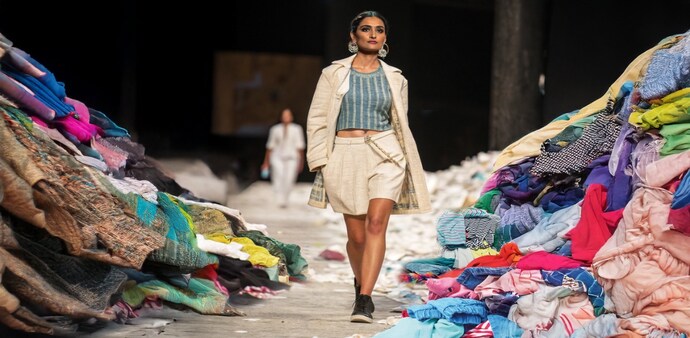
As the third-largest contributor to global textile waste, India's textile sector is facing pressure to adopt eco-friendly practices. In response, both retailers and manufacturing units are embracing innovative strategies.
Astha Oriel
- Jun 15, 2025,
- Updated Jun 15, 2025 9:21 PM IST
Millennials and gen Zers are tied to trending fashion. For them, fashion is a lifestyle, and it better be fresh and fast. “Latest trend” has become the holy grail, pushing brands to design and deliver at breakneck speed. However, there is a cost in keeping up with trends.
Hey!
Already a subscriber? Sign In
THIS IS A PREMIUM STORY FROM BUSINESS TODAY.
Subscribe to Business Today Digital and continue enjoying India's premier business offering uninterrupted
only FOR
₹999 / Year
Unlimited Digital Access + Ad Lite Experience
Cancel Anytime
-
 Unlimited access to Business Today website
 -
 Exclusive insights on Corporate India's working, every quarter
 -
 Access to our special editions, features, and priceless archives
 -
 Get front-seat access to events such as BT Best Banks, Best CEOs and Mindrush
Millennials and gen Zers are tied to trending fashion. For them, fashion is a lifestyle, and it better be fresh and fast. “Latest trend” has become the holy grail, pushing brands to design and deliver at breakneck speed. However, there is a cost in keeping up with trends.
Advertisement
According to a McKinsey report, global apparel consumption is set to reach 102 million tonnes by 2030, driven largely by fast fashion and obsession with the latest trends. Sayooj Thekkevariath, Partner, Climate Change and Sustainability Services, EY India, says demand for cheap, trendy clothing drives high volume, low-margin manufacturing that undermines environmental and social sustainability.
Nonetheless, the textile industry, both globally and at home, is facing a mounting pressure to adopt eco-friendly practices that reduce the environmental impact while fostering growth.
Advertisement
THE TRUE COST
A 2015 documentary, The True Cost, reveals that mass production of cheap garments leads to water pollution, excessive textile waste and use of harmful chemicals, particularly in developing countries such as India and Bangladesh.
A UNDP report says that every year 92 million tonnes of textile waste is produced globally. While production doubled from 2000 to 2015, the duration of garment use decreased by 36%. An estimated 17% textile waste ends up in landfills; the industry contributes 8-10% to the total greenhouse gas emissions.
India is the sixth-largest textile exporter. The sector contributes 2.3% to GDP, 13% to industrial production and 12% to exports. The domestic textile industry accounts for a 4.5% share of global trade, with the US and the EU accounting for 47% of India’s textile and apparel imports. Approximately 7.8 million tonnes or 8.5% of global textile waste is accumulated in India every year, according to a report by IDH and Sattva Consulting.
Advertisement
The demand for man-made fibre textiles, which includes materials such as polyester, acrylic, viscose fibre and modal, has been increasing globally, as a substitute for cotton amidst changes in global fashion trends. At present, man-made fibre dominates global textile fibre consumption with a 72% share.
Analysts point out to the damage caused by polyester and nylon. “Large-scale use of synthetic fibres contributes significantly to Scope 3 emissions and microplastic pollution,” says Thekkevariath.
SUSTAINABILITY AND INNOVATION
The government’s National Technical Textiles Mission, launched with a `1,480 crore outlay in 2020, aims to push technical textiles across flagship programmes and strategic sectors.
“Rebates for renewable energy, low-carbon process tech and ETP/ ZLD (effluent textile plants/zero liquid discharge) in textile mills could incentivise sustainable practices,” says Thekkevariath.
As the government pushes for decarbonisation, companies have also stepped up their ESG efforts. Raymond Ltd has introduced dope-dyed wool to replace traditional white polyester wool, cutting dye use and slashing energy consumption. The company reduced its Scope 1 emissions by 1.84% in FY24.
Advertisement
Reliance Retail, which operates brands such as Reliance Trends and Ajio, is fully committed to reducing emissions. The company is advancing sustainable polyester technologies.
Fashion brand Trent, which owns popular retail chains Zudio and Westside, is also embracing sustainability, concentrating on product life cycle, materials and customer safety.
It has collaborated with waste management company WiseBin for plastic waste recycling.
Another leading fashion retail company, Aditya Birla Fashion and Retail (ABFRL), is advancing its decade-old ‘ReEarth Vision’ into Sustainability 2.0 by adopting sustainable sourcing and production practices to enhance circularity and improve the product lifecycle.
WITH TECH’S HELP
The evolving technological landscape is helping companies in their initiatives. ABFRL is using artificial intelligence (AI) to enhance innovation and integrate greener processes.
Sharmila Senthilraja, Vice President and Industry Platform Leader for Consumer Products and Retail – India, Capgemini says, “AI is streamlining inventory management, reducing overproduction, and enabling more responsible sourcing decisions. Blockchain ensures transparency and traceability throughout the supply chain.”
Start-ups and MSMEs are not behind. Gurugram-based clothing manufacturer and supplier ZYOD is harnessing AI to forecast trends and streamline on-demand production. “This tech-driven approach ensures faster turnaround and reduced waste. Our adaptable MOQ (Minimum Order Quality) lets brands produce exactly what they need, cutting waste and supporting a data-driven path to scale,” says co-founder Ankit Jaipuria.
Advertisement
WASTE TO WERABLES
Some emerging brands are also trying to bring in tangible change. Hyderabad-based Nicobar uses fabrics like certified 100% organic cotton, recycled polyester, TENCEL (fabric made from regenerated cellulose fibres), biodegradable Bemberg, and bamboo fabric instead of polyester. Similarly, New Delhi-based Doodlage is turning plastic bottles to fusion wear.
FASHION WITH CONSCIENCE
Sustainability shouldn’t be limited to a buzzword anymore. It should be a way of life. But are Indian shoppers ready to ditch fast fashion?
According to a 2023 Bain & Company report, over 65% of urban consumers say they’re concerned about climate change, but only 13% actively factor sustainability into fashion purchases.
Thekkevariath says strategies such as storytelling through QR-coded labels showing environmental impact can be leveraged to increase awareness. Globally, countries like Sweden and France are already nudging both brands and buyers toward circular fashion. Meanwhile, the EU’s Green Deal mandates that by 2025, all EU member states must establish separate textile waste collection systems.
Closer home, Bangladesh and Vietnam have embraced sustainability through factory-level certifications like LEED (Leadership in Energy and Environmental Design) and Higg Index. Bangladesh’s Green Garment Factories movement, backed by global buyers, now boasts over 200 LEED-certified units.
Advertisement
As India steps up decarbonisation, its textile industry has the potential to lead the way. But it would require more than just talk to achieve this.
@OrielAstha11
Read more!