
The Air India Turnaround Challenge for the Tata group
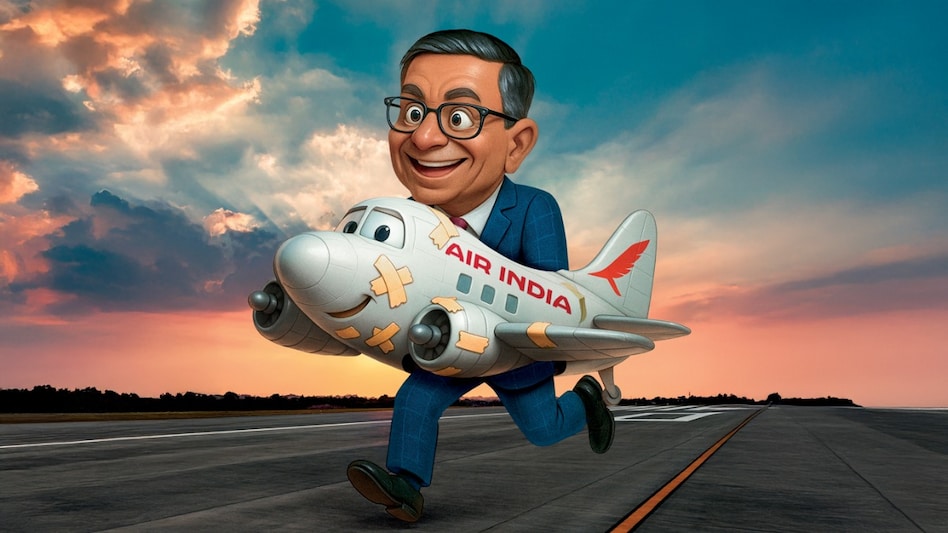
The Tata Group is facing its toughest challenge yet with Air India. After a recent crash that claimed 260 lives, turning it around will be one of the most complex tasks in Indian business history.
K Giriprakash
- Aug 25, 2025,
- Updated Sep 4, 2025 3:36 PM IST
The Air India crash on June 12, which killed 260 people, seconds after take-off from the Ahmedabad airport, was the deadliest aviation disaster in India in over a decade. It also ruptured the Tata Group’s carefully managed narrative of the airline’s revival.
Hey!
Already a subscriber? Sign In
THIS IS A PREMIUM STORY FROM BUSINESS TODAY.
Subscribe to Business Today Digital and continue enjoying India's premier business offering uninterrupted
only FOR
₹999 / Year
Unlimited Digital Access + Ad Lite Experience
Cancel Anytime
-
 Unlimited access to Business Today website
 -
 Exclusive insights on Corporate India's working, every quarter
 -
 Access to our special editions, features, and priceless archives
 -
 Get front-seat access to events such as BT Best Banks, Best CEOs and Mindrush
The Air India crash on June 12, which killed 260 people, seconds after take-off from the Ahmedabad airport, was the deadliest aviation disaster in India in over a decade. It also ruptured the Tata Group’s carefully managed narrative of the airline’s revival.
The AI171 Dreamliner crash, amid the much-touted five-year transformation plan, Vihaan.AI, cannot be more nightmarish for an airline struggling to shed the baggage of decades-old state control.
Advertisement
To add to the injuries, Air India will discontinue its non-stop flights between Delhi and Washington, DC, due to a temporary shortage of aircraft.
A former Air India director provides the crucial context to the crash: “In my over 20 years in the aviation sector, I’ve never witnessed a crash of this scale. But we need to put this into perspective,” says the former official, who did not wish to be named. The official says while accidents are tragic and unfortunate, they are not unprecedented. Almost every major airline has had an incident at some point in its history. Questions are raised about maintenance, procedures, and accountability, but airlines recover even as they learn, adapt, and move forward.
Air India too can bounce back but not that easily. Its overhaul has been under strain for a while due to a series of missteps. The Directorate General of Civil Aviation (DGCA) has pulled up the airline’s management over issues such as pilot duty timings and fatigue management. According to the civil aviation ministry, a total of nine show-cause notices related to five safety violations have been issued to the airline over the last six months. In July itself, it found 51 safety lapses at Air India. These included incidents regarding a lack of adequate training for pilots, the use of unapproved simulators, and a poor rostering system. These findings assume significance in the context of the recent crash.
Advertisement
A spokesperson for the airline told Business Today that the airline has voluntarily undertaken enhanced pre-flight safety checks on all its Boeing 787 and Boeing 777 aircraft. It has also completed precautionary inspections of the fuel control switch (FCS) locking mechanism on all Boeing 787 and Boeing 737 aircraft, well within the timeline set by the DGCA. Experts say this is a start.
HARD CALLS
Tata Sons’ chairman N Chandrasekaran has acknowledged the crash is a “grave setback” for Air India’s comeback narrative. As a stakeholder puts it, corporate turnarounds are hard; airline turnarounds are more complex, and recovering from a high-profile disaster is the hardest. The Tata Group, which owns Air India, has been trying to put its house in order.
Advertisement
Tata Sons and its joint venture partner, Singapore Airlines, have poured in fresh capital totalling Rs 9,558 crore in FY25 alone, with Rs 6,333 crore coming in from the foreign airline. This represents the largest single-year capital infusion in the history of Indian aviation. Singapore Airlines owns a 25.1% stake in Air India.
In 2023, Air India placed a record-breaking order for 470 aircraft, followed by another 100 Airbus jets in 2024, bringing its total order book to 570 aircraft. The earlier order for 470 aircraft was worth $70 billion. The orders include a mix of narrow-body and wide-body aircraft, with a focus on the Airbus A320neo family and A350S, as well as Boeing 737 MAX, 777X, and 787s.
Air India has also committed over $400 million to retrofit 67 of its legacy aircraft, with new interiors and next-generation in-flight entertainment. It has also invested US$200 million to revamp its entire IT infrastructure, replacing old systems. The airline is also setting up an aviation training academy in Gurugram for pilots, cabin crew, engineers, and ground staff, a flying training unit in Maharashtra, and an aircraft maintenance training institute in Hyderabad. Additionally, it is in the process of setting up an MRO facility in Bengaluru to handle both narrowbody and widebody aircraft.
Advertisement
“The impact of the crash has been severe on AI, both financially and non-financially. However, it is regrouping fast and expects normalisation by October 1,” says Kapil Kaul, the CEO of aviation consultancy firm CAPA India.
MESSY OPERATIONS
But a revival is easier said than done. The airline’s poor financial performance shows that it will take much longer to turn around. In FY25, the Air India Group posted losses of Rs 10,859 crore, an increase of about 48% from the previous year, while the revenue grew 18% to Rs 78,636 crore. The dismal performance of the airline also impacted Singapore Airlines’ profitability. Its net income dropped 59% to $145 million in the three months ended June 30, dragged by losses at Air India.
According to analysts, Tata Sons will have to inject Rs 20,000 crore and Rs 25,000 crore each year for fleet modernisation, technology upgrades, and working capital requirements. For a multi-diversified group with AAA credit ratings, this represents not just a financial commitment but a reputation-defining gamble.
Despite all the progress the airline has made under its transformation plan—such as new aircraft orders, better technology, infrastructure investments, and branding—the crash, according to several analysts and former airline executives Business Today spoke to, highlights deeper, underlying weaknesses within the system.
Advertisement
Capt. G R Gopinath, the founder of the country’s first low-cost airline, Air Deccan, says it is going to be a herculean task for the Tatas to put the building blocks together again and avoid future mishaps. “The group, with its strong management legacy and proven capabilities, must do whatever it takes to restore public trust,” he says.
There are fundamental issues that the airline must tackle, say former executives. A former finance head pointed out that the new management has alienated the more experienced professionals to create space for a younger employee base.
“You simply cannot run an airline on consultant advice alone, especially when many of the people involved lack core domain experience. The airline today seems to be run by a select group where each leader is the king of his silo,” says the official, who did not wish to be named. He says while cost consciousness is essential, it should not be at the cost of institutional memory.
While Air India’s legacy workforce—including experienced cabin crew—has been shown the door, a certain resentment has set in among the rank and file, as the Vistara team has been driving decisions, says the former executive.
Advertisement
One former top executive says the management is wary of seeking advice from some of the retired officials who are willing to help the airline in its transformation journey. “I wrote to Air India offering my inputs and willingness to help. There was no response. I travelled to Delhi on my own expense to meet a senior executive, but he wasn’t interested in hearing what I had to say.”
The impact of the crash has been severe on AI, both financially and non-financially. However, it is regrouping fast and expects normalisation by October 1.
-KAPIL KAUL,CEO, CAPA
RESTORING TRUST
Former officials BT spoke to say the entire top deck, including the airline’s MD & CEO Campbell Wilson, lacks the necessary experience to run such a large airline with international operations. “The leadership lacks core aviation experience,” says an aviation consultant who has been part of the launch of a few airlines.
According to the official, Wilson ran Scoot, a low-cost carrier in Singapore. That requires different skill sets than managing a full-service international airline. Other key decision-makers like Nipun Aggarwal (Chairman of Air India Express), a former merchant banker, and Yogesh Agarwal (Head, Aircraft Acquisition and Leasing), have no aviation background. He believes since they are from the Tata group, they could have been suitable for non-operational roles. Both were involved in the acquisition and merger process.
Some believe that Tata Sons is offering steep salaries to the top management for too little work on the ground. “I’m told the CEO draws a salary of Rs 27 crore. That’s unheard of in Indian aviation,” the official said.
Air India management, however, wants stakeholders to believe that the leadership will do whatever it takes to regain passenger confidence. A spokesperson says transforming a 93-year-old organisation is a complex, long-term endeavour. “Over the last three years, some significant organisational changes were introduced to bring professionalism and accountability. This is an ongoing journey,” says the spokesperson.
CHANGING STRUCTURES
Air India also faces cultural integration challenges following the merger of Vistara, AirAsia India, and Air India Express with the airline. Officially, the legal merger of Vistara is complete. However, integrating culturally and operationally on the ground is a long-drawn process. Vistara was founded on the back of the service ethos of Singapore and with a private-sector approach, unlike other Indian airlines. In contrast, Air India was a government behemoth for 93 years, powered by an intensely bureaucratic, hierarchy-driven culture.
Merging of pay scales, pilot retirement ages, and job grades has already seen sparks fly. Last November, Air India had to appoint a Chief Integration Officer just to iron out the creases when the Vistara brand was folded up. Sources said that there were several issues which made the transition difficult. For example, when Air India was privatised, the government did not hand over Air India Engineering Services Ltd (AIESL) as part of the deal. Hence, the airline started outsourcing maintenance to AIESL. Several reports suggest that the engineering services’ accounting and governance systems are outdated. Sources say following the crash, Air India is expected to utilise its joint venture partner Singapore Airlines’ engineering services for maintenance, which will be carried out in a phased manner.
For Air India, it is not just about navigating internal challenges, but also about external competition. The biggest one is from IndiGo, which sits comfortably with a seemingly impregnable market dominance. Its June 2025 market share was a whopping 64.5%; Air India was at 27.1%.
Even Air India's strongest positioning—55% share on metro-to-metro routes and 40% share on top 120 domestic routes—reflects niche dominance rather than a comprehensive market challenge. Hence, Wilson's target of a 30% domestic market share by 2027 appears ambitious now, given that it lost nearly 2% share in a year and might lose more post the tragic crash.
THE INDIGO CHALLENGE
The stranglehold of IndiGo on the Indian aviation market might be hard to challenge, but there are several things that Air India can do to put up a good fight.
According to a former chief pilot at one of the airlines, Air India still has a bloated staff and hence needs to keep a watch on CASK and RASK, the key metrics to measure an airline’s efficiency. CASK (cost per available seat kilometre) and RASK (revenue per available seat kilometre) are key financial metrics used to evaluate an airline’s operational efficiency and profitability.
IndiGo’s massive market share translates directly into pricing power, and Air India cannot match that without sacrificing the premium positioning, which is essential to its full-service strategy.
IndiGo’s Q4FY25 financial performance—Rs 22,152 crore revenue from operations (24% Y-o-Y growth) and Rs 3,068 crore net profit (62% Y-o-Y growth), the highest-ever in its lifetime—clearly shows the kind of profitability that is available to market leaders. Air India’s loss-making trajectory, despite improved operational metrics, indicates that it has a long way to go before it can compete effectively with a profitable incumbent, while simultaneously investing in transformation.
Insiders believe Wilson is confident the airline can achieve profitability through premium positioning and network advantage, but that would mean competing against IndiGo’s ability to combine low costs with operational excellence.
A senior pilot with a domestic airline says Air India should allow Air India Express, its low-cost entity, to compete directly with IndiGo. “It is hard for a full-service carrier to compete with a low-cost airline. Hence, AI Express should be utilised on more routes in the domestic market, which will free up Air India to consolidate its position on international routes,” he adds.
It is going to be a herculean task for the Tatas to put the building blocks together again. The group must do whatever it takes to restore public trust.
-CAPTAIN GOPINATH,Founder, Air Deccan
Playing To Strength
Air India, with its vast experience in international flying and an order book of 400 aircraft, has an advantage that other airlines in South Asia lack. For instance, flying multiple times a week to London—a route IndiGo cannot yet match—allows Air India to consolidate where it is already strong. However, IndiGo's expansion into international markets and its business-class offerings directly challenge Air India’s strategic differentiation, potentially limiting the premium pricing power essential to its financial recovery.
While IndiGo’s impact and influence on the industry are overwhelming, Air India has enough firepower to focus on delivering better customer service, reliability, and one-time performance. “They are doing everything possible to demonstrate this. One can expect AI to become a world-class airline to be stronger than ever before,” Kaul says.
Industry watchers also believe that Akasa Air has a good chance in this evolving landscape. Ultimately, the coordination between Air India and Air India Express must be strong enough to challenge IndiGo’s dominance effectively. Adding competitive complexity, Akasa Air’s rapid growth—5.3% market share in June, with an industry-leading 91.4% passenger load factor—shows how nimble new entrants can quickly capture market share in India's expanding aviation sector. Akasa’s 156% YoY passenger growth, though from a low base, signals the market's receptiveness to well-executed new brands, making Air India’s transformation more urgent.
DELIVERY CHALLENGES
Supply chain constraints affecting aircraft deliveries compound the challenges of fleet modernisation. Wilson’s warning that “aircraft shortages from both manufacturers are expected to persist for 4–5 years” suggests Air India’s expansion timeline faces structural headwinds beyond management control. The delivery of 50 Boeing 737 MAX aircraft, which was put off from December 2024 to June 2025, has been further delayed, now impacting capacity planning and route development.
This reality forces difficult resource allocation decisions. Wilson’s strategic approach, according to reports, is that if an airline is capacity constrained, one has to be ruthless concerning where one deploys the aircraft to maximise returns, which indicates prioritisation of profitable routes over network completeness. Such tactical adjustments, while rational, may delay the comprehensive transformation required to challenge IndiGo’s market dominance. As an example of this strategy, Air India has announced that it will discontinue its non-stop flights between Delhi and Washington, DC, due to a temporary shortage of aircraft. In this context, Wilson’s target of 400 aircraft by 2027 and 30% domestic market share represents ambitious goals that will require sustained execution excellence and market expansion.
DGCA’s POOR SHOW
Even as Air India grapples with several headwinds, it is also essential to highlight the inadequacies of the DGCA. “The fundamental problem with India’s civil aviation sector is the absence of an independent, empowered regulator. In other sectors that underwent privatisation or liberalisation—such as telecom, insurance, and pensions—the government created strong regulatory institutions at the outset to oversee the transition and protect consumer interests. Why was the aviation sector treated differently?” asks an aviation analyst quoted before.
He claims that the government’s refusal to treat aviation with the same seriousness reflects a more profound neglect. “Today, regulators appear to be hand-in-glove with the airlines. The absence of proper documentation, accountability, and regulatory oversight is not just an oversight—it’s a dereliction of duty bordering on sacrilege.”
The coming months will reveal whether Air India's transformation can evolve from capital-intensive operational improvement to sustainable competitive advantage.
Read more!