
The Bollywood Makeover: How the Hindi film industry is moving away from the high-star-fee-driven model towards a greater focus on content
The Bollywood Makeover: How the Hindi film industry is moving away from the high-star-fee-driven model towards a greater focus on content
The hindi film industry is moving away from the high-star-fee-driven model towards a greater focus on content and a more refined business strategy.
Krishna Gopalan
- Feb 4, 2026,
- Updated Feb 13, 2026 12:31 PM IST
In a year of box-office failures, only a few Hindi films stood out. Their success didn't come from a common theme or budget size, but from different strategic choices, including timing, storytelling, casting, and cost control. From a spy thriller to a musical featuring newcomers, an animated myth, and a sports drama, each film succeeded on its own terms, demonstrating that there is no single formula for success in today’s market.
Hey!
Already a subscriber? Sign In
THIS IS A PREMIUM STORY FROM BUSINESS TODAY.
Subscribe to Business Today Digital and continue enjoying India's premier business offering uninterrupted
only FOR
₹999 / Year
Unlimited Digital Access + Ad Lite Experience
Cancel Anytime
-
 Unlimited access to Business Today website
 -
 Exclusive insights on Corporate India's working, every quarter
 -
 Access to our special editions, features, and priceless archives
 -
 Get front-seat access to events such as BT Best Banks, Best CEOs and Mindrush
In a year of box-office failures, only a few Hindi films stood out. Their success didn't come from a common theme or budget size, but from different strategic choices, including timing, storytelling, casting, and cost control. From a spy thriller to a musical featuring newcomers, an animated myth, and a sports drama, each film succeeded on its own terms, demonstrating that there is no single formula for success in today’s market.
Advertisement
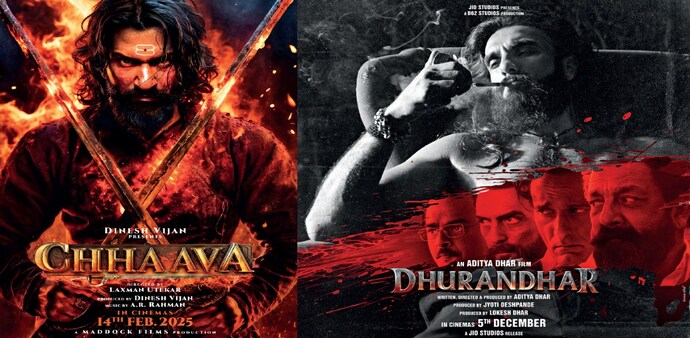
Two years ago, an opportunity beckoned for the team at Jio Studios. The spy genre had long fascinated audiences, but the films produced had failed to capture interest. “What one had seen was mediocre. The challenge was to make it entertaining,” says Jyoti Deshpande, President, Jio Studios, the media and content business of RIL. That eventually led to Dhurandhar, a film that ensured a happy 2025 for Bollywood, in a landscape dominated by flops.
Only four films succeeded (excluding the dubbed versions originating in the south), but each brought a valuable insight that Bollywood would like to apply to its filmmaking process. Together, Chhaava, Saiyaara, Sitaare Zameen Par and Dhurandhar grossed nearly Rs 2,000 crore at the domestic box office (overseas collections were around Rs 600 crore), a notable feat considering that multi-starrers with big budgets have usually dominated these numbers. That’s what makes 2025 different, with capital and creative energy being allocated much more strategically.
Advertisement
Deshpande says Dhurandhar was right on timing, especially considering the heightened sense of nationalism among audiences. “There was rage after Operation Sindoor. It’s not about jingoism,” she says. The film earned Rs 890.80 crore till January 27. It also grossed Rs 293.50 crore overseas. Yet, not all films tapping into nationalistic or historical themes resonated with audiences in 2025. Emergency, a politically charged biographical drama, generated a lot of anticipation but failed to turn that interest into ticket sales. It earned only a small portion of its modest budget and received criticism for uneven storytelling and unclear narrative. Kesari Chapter 2, despite its large cast and historical backdrop, also fell short of expectations. Its elevated production costs, combined with a shift toward a niche courtroom-drama approach, failed to attract a broad audience, leaving the film struggling to recover its investment. It ended its run with collections lower than its budget.
Advertisement
In contrast, Dhurandhar thrived thanks to strong execution, timely release, and a wider audience connection. This showed that having a theme isn’t enough without good storytelling, awareness of audience sentiment, and careful commercial planning.
The limited successes of 2025 show that the industry is actively rethinking its cost structures. It is applying stricter financial and operational discipline to filmmaking and adjusting expectations for risk and return, rather than relying on star power alone.
A period of learning
Many things made 2025 unique. For around two years, Bollywood struggled as big-budget films failed, largely on the back of an inefficient business model. High star fees left limited capital for production value, which consequently affected quality in several cases. While stars walked away unscathed, smaller producers, distributors, and exhibitors bore the brunt of the losses.
To that extent, overhauling the engine was necessary for the survival of the Hindi film industry. Akshaye Rathi, director, Aashirwad Theatres, calls 2025 a year when breakout films worked, creating renewed interest and possibilities for filmmakers. He cites the case of Saiyaara, with two newcomers in a romantic musical. “Then, we had Chhaava and Dhurandhar. In the case of Mahavatar Narsimha, there has never been an Indian animated film doing that well.”
Advertisement
The overarching takeaway has been to expect the unexpected. Even highly hyped films like War 2, Sikandar, Baaghi 4 and Mastiii 4 did not recover their budgets. An interesting hit was Sitaare Zameen Par, an Aamir Khan production, in which the actor plays a basketball coach. Before discussing others that made it big, a mention of Kantara: A Legend – Chapter 1 is necessary. On a budget of Rs 125 crore, this Kannada film (it had dubbed versions in Hindi, Tamil, Telugu and Malayalam), raked in over Rs 800 crore. Its producer, Chaluve Gowda, Co-founder & MD of Hombale Films, insists the success recipe is simple. “The story was actually the same. It all comes down to the way you handle it, and that must be different each time,” he says with a smile. Hombale Films has also produced KGF: Chapter 1 and a sequel, followed by Kantara, Salaar: Part 1—Ceasefire.
Post-pandemic dynamics introduced new challenges. Staying away from the high-star-fee model during the frenzy when OTT platforms paid huge sums for content rights, leading to stars raising their fees, was not easy. “Today, the audience wants a big spectacle. Having a film with big stars has failed too often,” says Deshpande. Her company consciously moved away from that construct and “will sign on a star if there is a requirement.” She emphasises how, in a very short period, Jio Studios had successes like Laapataa Ladies and Singham 3.
Advertisement
It’s not as if we wanted to make a theatrical film (Chhaava). But we were clear that it had to be honourable content with wide appeal.
-Dinesh Vijan,Founder, Maddock Films
Upfront OTT deals helped producers recover a significant portion of their costs, often covering star salaries in big-budget films. The amount left to recover was much smaller. However, it created a risky model and left no room for the smaller producers. When films with big stars started to fail, wealthy OTT companies slowed down, which allowed for disruption. Since then, star fees have become more reasonable, and films featuring lesser-known actors or better content have started to succeed. In the past, star salaries could consume more than half the budget. Now, with more strategic allocation of funds—not necessarily smaller budgets—films are better positioned for success, achieving a healthier risk-return balance. The same trend can be seen in important Southern markets like Telugu and Tamil. Theatrical revenue has regained its importance, and only when it performs well do OTT platforms step in confidently, unlike in the past when upfront deals were common.
Eye for detail
The first time Dinesh Vijan heard the story of Chhaava, he liked it. “All of us knew a little about that part of history, but not enough. It’s not as if we wanted to make a historical film. But we were clear that it had to be honourable content with wide appeal,” says the founder of Maddock Films, the entity that is known for Stree, Stree 2, Sky Force and Munjya.
Advertisement
Starring Vicky Kaushal, Akshaye Khanna and Rashmika Mandanna, the film, based on the life of Sambhaji, turned out to be a huge hit. Gautam Dutta, CEO, Revenue and Operations, PVR Inox, says a big reason was the choice of a simple, underexplored character in history. “It was the same with Mahavatar Narsimha, where parents took their kids to watch the film.”
To Vijan, putting the right actors in “phenomenal stories and if directed by the right captain, can create havoc.” He looks at this phase as disruptive, with technology, particularly artificial intelligence (AI), starting to reshape content creation. “Every small content creator is empowered to tell large stories,” he says.
Vikram Malhotra, Founder & CEO, Abundantia Entertainment, the company behind Sherni, Chhorii and Jalsa, maintains that 2025 is a year of reset for the Hindi film industry.
“It has been taking place for at least a decade. Now, we are seeing the maturity and sensibility of the audience, along with distinct segments emerging. The one-size-fits-all approach worked as long as options were limited.”
The big one
On December 5 last year, Dhurandhar hit the theatres hoping to capitalise on an important holiday season—the end of the year and Christmas. PVR Inox’s Dutta remembers the first reaction from the audience. “It was around violence and people saying they didn’t want to go for it,” he says. But interest picked up from those seeking action stars, who instead got a well-researched story, strong characters, and great music. “Those who went to watch it for Ranveer Singh and the action instead got a story that was well-researched, with great characters and good music.” Soon, word spread, and the last onion peel, he adds, was Akshaye Khanna’s performance. Deshpande says the treatment they had in mind was for it to be a “gangster film.” The sequel to Dhurandhar will be released this March.
The movie has done well beyond what Dutta or anyone else from the industry expected. “The audience now attaches a lot of importance to the story and not just stars. There is no doubt that a big star will give you an opening, but it’s really word of mouth after that,” he feels. He estimates that about 8% of viewers returned for a second showing, versus the usual 1–2%. “It offered a lot more to grasp, as a wholesome product, delivering on music, dialogues, and cast,” he adds. In fact, the second week surpassed the first at the box office. “There was a lot more to grasp since it was a wholesome product. It delivered on key factors like music, dialogues and star cast.” In fact, it made more in the second week at the box office than in the first.
Today, the audience wants a big spectacle. Having a film with big stars has failed too often. We have consciously moved away from that construct and will sign on a star where it is a requirement.
-Jyoti Deshpande,President, Jio Studios
Refining the model
Bollywood’s cost structure has long been unstable, not very different from Telugu or Tamil markets, which also suffered from high star fees limiting success. Gowda is clear that money should not be spent on the stars. “Instead, it should go into the story, content and putting together a great narrative,” he says.
Take the case of Mahavatar Narsimha, a story that is not new by any stretch. Gowda says it goes back 40-50 years, with earlier versions released in Telugu and Kannada. “There is a large audience for devotional films, and we decided to focus on that. The trick in mythology is to keep it simple.”
In a post-pandemic world with OTT’s massive content offerings, audiences are more aware, discerning, and demanding, expecting new stories constantly.
Looking ahead, Maddock’s Vijan is clear that this year will see unique disruptors. “I expect 2027-28 to be a curveball as AI starts to affect content creators. We must learn to be screen agnostic in the face of technology,” he says. To Gowda, the requirement from the audience is simple. “They just want a good story, and that has never changed. The moment you do that, the audience will reward you,” he explains. Border 2, which released on January 23, is Bollywood's first major success of 2026.
Studios are also increasingly looking at data on audience preferences, release windows, and digital engagement. They combine traditional instincts with modern analytics to make films more resistant to market changes.
Clearly, the industry is changing. Old formulas have become outdated, and new models, which are leaner, smarter, and driven by content, are gaining ground. However, AI presents a new challenge. It could make creation more accessible while increasing competition. This means studios need to rethink not just budgets and casting, but also their approach to intellectual property, creative processes, and audience engagement. The next decade will likely be shaped by how quickly Bollywood responds to this technological shift.
In a year of failures, a few films stood out. They showed that success is no longer about size, stars, or safe formulas. With stricter cost control, smarter risk-taking, and improved attention to audience preferences, the Hindi film industry is slowly finding a new direction. This new approach may determine its resilience in an AI-driven future.
@krishnagopalan
Read more!